What Is the Difference Between Wrangler and Rubicon
As an Amazon Associate we earn from qualifying purchases.
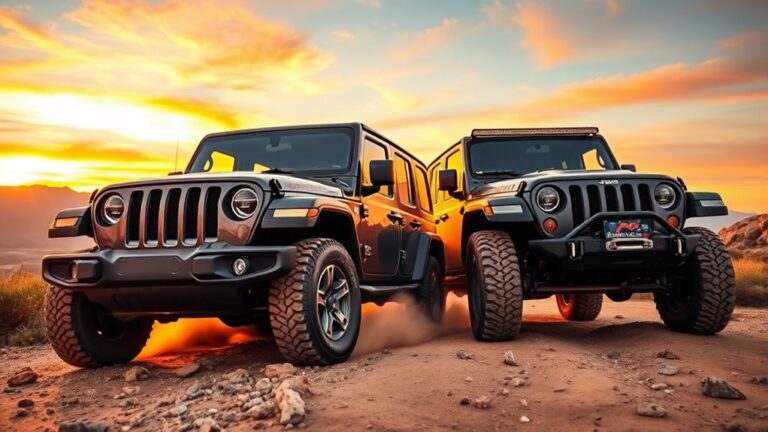
If you drive a Jeep Wrangler on a rough trail and then compare it with a Rubicon on the same route, you’ll notice the difference fast.
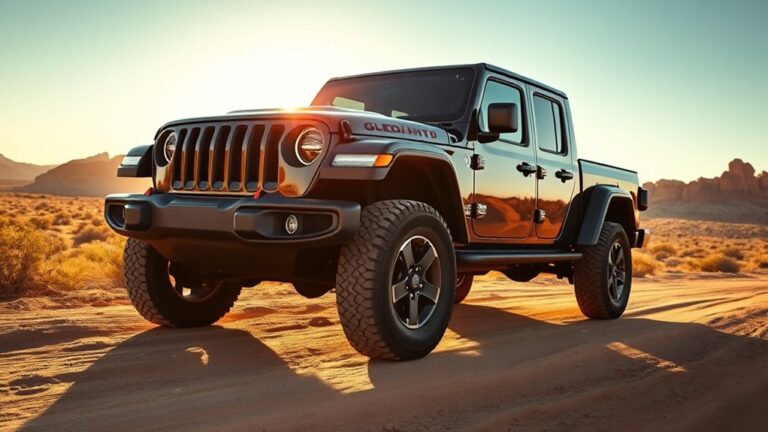
The Jeep Wrangler is the broader model line, built for daily use and trim flexibility, while the Rubicon is a factory off-road package designed for serious trail performance.
The Rubicon features heavier-duty axles, locking differentials, and an electronic sway bar disconnect, offering enhanced capability.
The tradeoff is a higher cost and a setup that changes how you choose your Jeep.
Ultimately, the Rubicon is tailored for off-road enthusiasts who want maximum performance, whereas the Wrangler appeals to a wider range of drivers.
Key Takeaways
- Wrangler is the broader Jeep model line, while Rubicon is a specialized higher-performance trim within the Wrangler lineup.
- Rubicon adds off-road hardware like Dana 44 axles, locking differentials, and an electronic sway bar disconnect.
- Both share engines, transmissions, and the same basic cabin layout, so the main difference is capability and tuning.
- Wrangler is generally cheaper, simpler, and better for everyday driving; Rubicon costs more for factory off-road performance.
- Choose Wrangler for versatility and mild use, or Rubicon for frequent rock crawling and tougher trail driving.
What Are the Wrangler and Rubicon?
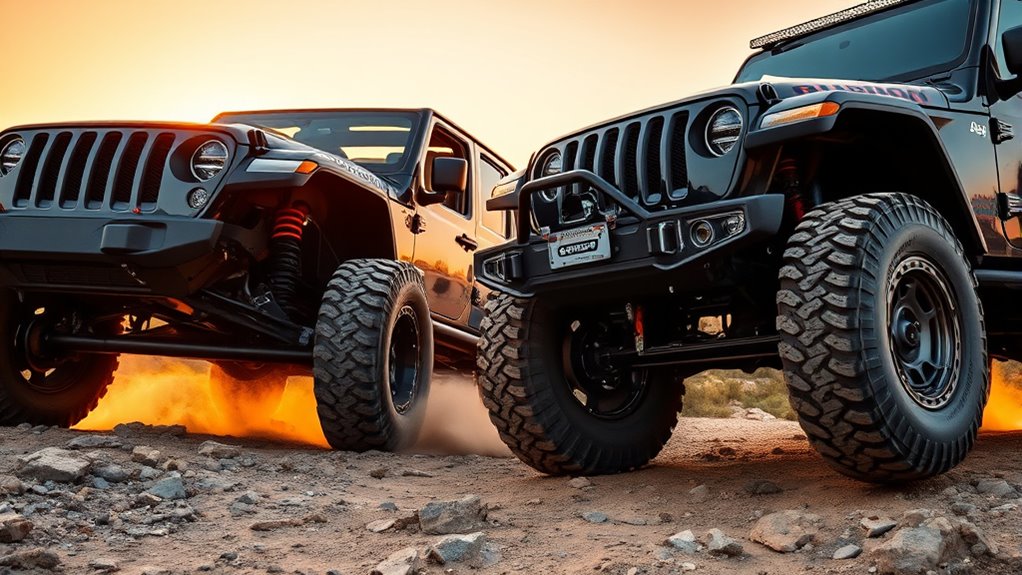
The Wrangler is Jeep’s core compact SUV platform, built as a versatile off-road vehicle available in multiple trims and configurations. You can think of it as the base nameplate that defines the vehicle family, while Rubicon identifies a specialized version within that lineup.
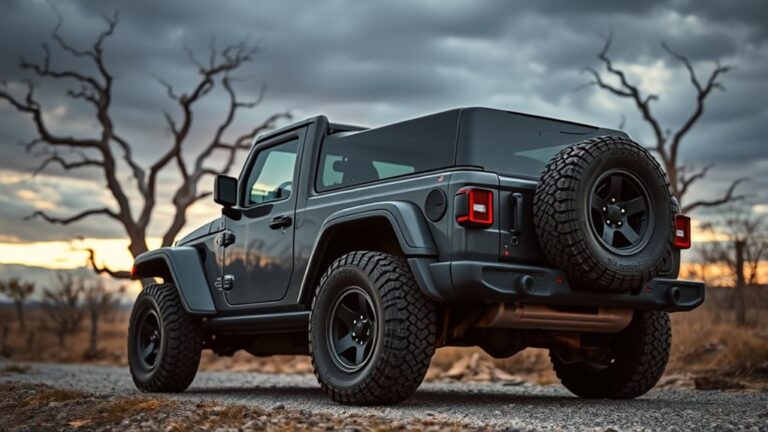
In wrangler vs rubicon discussions, you’re comparing a general-purpose model designation with a trim engineered for more demanding terrain. You’ll find that both share the same body-on-frame architecture, removable roof panels, and four-wheel-drive design.
The key context is off road innovations vs interior comfort, since Jeep packages capability-focused hardware and cabin features differently across versions. When you evaluate them, you’re looking at one platform and one performance-oriented trim, not two unrelated vehicles.
How Do They Differ?
At a practical level, the Wrangler and Rubicon differ in equipment, capability tuning, and intended use. You’ll usually see the Wrangler as the broader model line, with trim choices that balance daily driving, comfort, and customization.
The Rubicon is a specific configuration with more specialized hardware and calibration. You may notice different axle ratios, transfer case settings, suspension tuning, and wheel-and-tire packages.
In practice, that means you’re comparing a general-purpose Jeep to one set up with more aggressive factory components. You can also add off road tires or off road lights to either model, but those accessories don’t change the underlying trim distinction.
If you want a vehicle aimed at mixed-use versatility, the Wrangler fits that role; if you want a more purpose-built package, the Rubicon sits higher in the lineup.
What Makes the Rubicon Better Off-Road?
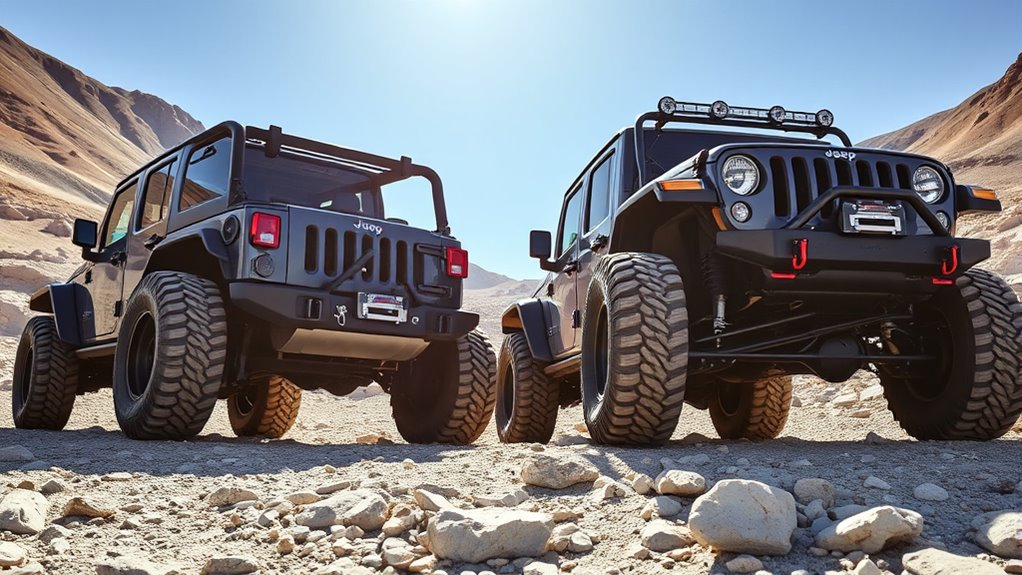
You get Dana 44 axles, which provide greater strength and durability under off-road load. You also get locking differentials that force both wheels on an axle to turn together, improving traction on uneven terrain.
An electronic sway bar disconnect increases wheel articulation, so the suspension can keep contact over larger obstacles.
Dana 44 Axles
Because the Rubicon uses Dana 44 front and rear axles, it can handle more torque and harsh articulation than the standard Wrangler’s lighter-duty axle setup. You get thicker axle tubes, stronger housings, and improved shaft support, which reduces flex under load. In jeep design, that strength lets suspension travel work without stressing the drivetrain as much.
- Better load distribution
- Greater durability on rocks
- More stable wheel alignment
- Improved resistance to axle wrap
- Less strain during steep climbs
You won’t gain much fuel efficiency from these axles, but you do gain confidence when traction and impact loads rise. If you compare both models off-road, the Rubicon’s axle hardware gives you a more robust foundation for demanding terrain.
Locking Differentials
Locking differentials are one of the main reasons the Rubicon outperforms a standard Wrangler on difficult terrain, since they can force both wheels on an axle to turn at the same speed even when one tire loses traction. You get more usable torque because the wheel with grip doesn’t let the spinning wheel waste power.
That advantage matters on rocks, loose climbs, mud, and uneven ruts, especially when you pair the vehicle with aggressive off-road tires. In a base Wrangler, an open differential can send power to the wheel with the least resistance, which limits forward motion.
The Rubicon’s factory lockers give you this capability without relying on aftermarket lockers, so you gain traction control suited to low-speed crawling and technical obstacle traversal.
Electronic Sway Bar
Another key Rubicon advantage is its electronic sway bar disconnect, which lets the front suspension articulate more freely on rough trails. You can engage it at low speeds to improve wheel drop, keep tires on uneven ground, and maintain traction over rocks and ledges.
Compared with a fixed bar, it reduces chassis binding and helps the axle move independently. That added articulation complements locking differentials and makes the Rubicon more capable in technical terrain.
- Improves front-axle flex
- Enhances tire contact on obstacles
- Reduces traction loss on uneven surfaces
- Works best at crawl speeds
- Pairs well with off road lighting and roof rack alternatives
What Engine Options Do They Offer?
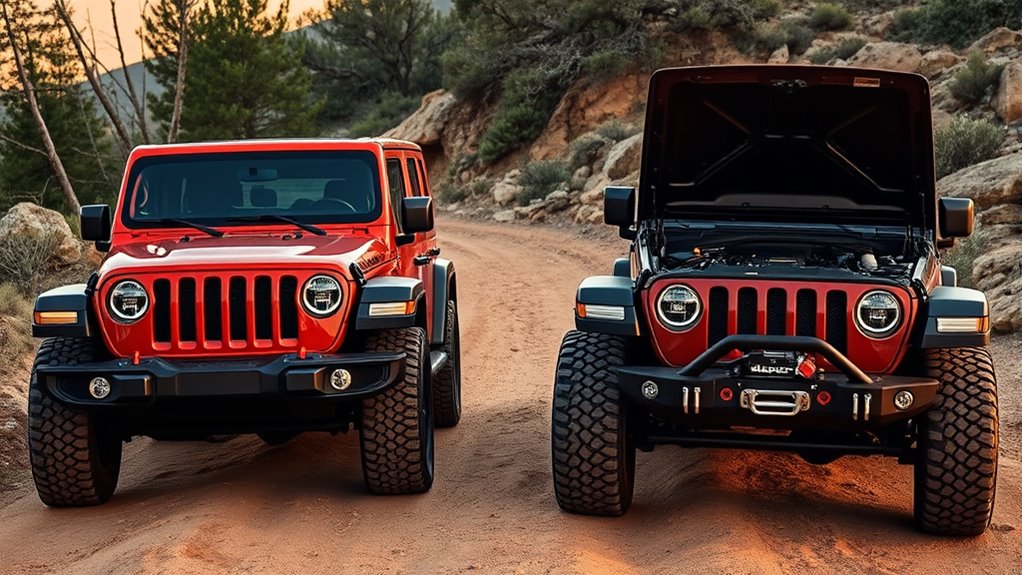
When you compare Wrangler and Rubicon engine options, you’ll find that Rubicon is a trim level within the Wrangler lineup, so the available powertrains are largely shared. You can usually choose among a turbocharged 2.0-liter inline-four, a 3.6-liter Pentastar V6, and, in some configurations, a 6.4-liter V8 or plug-in hybrid 4xe system.
These engine options focus on torque delivery, off-road tractability, and highway efficiency rather than outright speed. Your transmission choices typically include an eight-speed automatic, and some trims also offer a six-speed manual.
Because Rubicon adds off-road hardware, it doesn’t change the core engines; instead, it pairs the same mechanical lineup with crawl-focused gearing and drivetrain enhancements.
Which Jeep Costs More?
The Rubicon typically costs more than a standard Wrangler because it bundles specialized off-road equipment, including upgraded axles, locking differentials, skid plates, and more aggressive suspension tuning. You’ll usually pay a premium for that factory-installed off road gear, while a base Wrangler stays lower in price and leaves more room for upgrades later.
- Higher trim content raises MSRP
- Standard Wrangler starts with simpler hardware
- Rubicon includes trail-focused drivetrain parts
- Options can narrow or widen the gap
- Cargo space is generally similar across trims
If you compare similarly equipped models, the Rubicon still usually lands higher because its components are engineered for harder use, not just appearance. That added capability explains the cost difference.
How Do the Interiors Compare?
Inside, the Wrangler and Rubicon are very similar, since both share the same basic cabin layout, controls, and seating arrangement. You’ll notice that interior materials vary by trim and package, but both models typically use durable plastics, washable surfaces, and straightforward switchgear designed for easy cleaning.
The Rubicon may include more premium trim accents, yet the core cabin design stays practical rather than luxurious. Seating comfort is also closely matched, with upright front seats, available heating, and sufficient support for daily use.
Rear-seat space and cargo access remain comparable because the body structure is shared. In practice, your choice affects equipment levels more than cabin architecture, so the interior difference is subtle and mostly tied to finish details rather than layout or usability.
Which Jeep Fits Your Driving Needs?
You should start by matching the Jeep to your daily driving needs, since commute comfort, road noise, and fuel use affect how well it fits routine use. If you need stronger off-road capability, the Rubicon gives you more hardware for rough terrain, while the Wrangler trims keep the setup simpler for mixed driving.
You’ll also want to compare budget and features, because the right choice depends on how much capability you need versus how much equipment you’re willing to pay for.
Daily Driving Needs
For daily driving, a Wrangler usually offers the simpler, more road-friendly setup, while a Rubicon adds off-road hardware that can make commuting feel a bit firmer and less efficient. You’ll notice the Wrangler often rides with less noise and lower running costs, especially if you avoid heavy aftermarket tires.
If you want a clean daily driver, it’s easier to keep weight down and skip extra off-road lighting unless you need it.
- Wrangler: more straightforward for commuting
- Rubicon: adds complexity and cost
- Standard parts often improve fuel economy
- Lighter setups usually feel calmer on pavement
- Accessories can change comfort and efficiency
Off-Road Capability
When the trail gets rough, the Rubicon brings clear advantages with locking differentials, stronger axle hardware, and a more capable transfer case setup. This helps it tackle rocks, deep ruts, and steep climbs with less driver effort.
| Wrangler | Rubicon |
|---|---|
| Better for light trails | Built for severe terrain |
| Usually adequate clearance | More aggressive approach angle |
| Works with off road tires | Optimized for rock crawling |
| Less specialized drivetrain | Front and rear lockers |
| Handles dirt roads well | Improves traction on ledges |
You can still take a Wrangler off pavement, but the Rubicon gives you more control when traction drops. Its factory hardware helps you maintain wheel articulation and reduce tire spin, especially on uneven surfaces.
If you want confident rock crawling without relying as much on momentum, the Rubicon’s tuning makes the difference.
Budget And Features
Off-road hardware gives the Rubicon a clear edge, but budget and standard equipment often decide which Jeep fits your needs best. You’ll usually pay less for a Wrangler trim with fewer locking differentials, simpler suspension tuning, and standard off-road tires.
If you drive mostly on pavement, that lower price can free budget for upgrades you’ll actually use. The Rubicon adds heavy-duty axles, disconnecting sway bars, and more aggressive calibration, so you get better trail performance without immediate modification.
You should also compare roof options, infotainment, and axle ratios, because these features change total value.
- Wrangler: lower entry cost
- Rubicon: stronger factory trail gear
- Wrangler: easier to customize
- Rubicon: fewer aftermarket needs
- Both: multiple roof options
Which One Should You Buy?
Choosing between the Wrangler and Rubicon comes down to how you plan to use the vehicle, not just how much capability you want. If you’ll mostly drive on pavement, commute daily, and only tackle mild trails, you should pick a standard Wrangler and save money for upgrades like off road tires, roof racks, and recovery gear.
If you expect frequent rock crawling, deep ruts, or uneven terrain, the Rubicon’s factory hardware gives you stronger axles, locking differentials, and better low-speed control. You’re also paying for components you’d otherwise add later.
Consider tire size, gear ratios, and suspension needs before you buy. Choose the Wrangler for versatility and lower cost, and choose the Rubicon when factory off-road performance matters more than price or efficiency.
Frequently Asked Questions
Is the Rubicon Available in All Wrangler Body Styles?
No, you can’t get the Rubicon in every Wrangler body style. You’ll find it on select two-door and four-door configurations.
Some body styles are limited or discontinued trims, unlike luxury variants.
Does the Wrangler Have a Removable Roof Like the Rubicon?
Yes, you can get a removable roof on a Wrangler; it’s practically a sky-opening machine. You’ll find hardtop or soft-top options, and both support strong off-road capabilities, just like a Rubicon variant.
Can You Daily Drive a Rubicon Comfortably?
Yes, you can daily drive a Rubicon comfortably, but you’ll notice firmer suspension, higher ride height, and more road noise.
Your driving comfort and daily practicality depend on tire choice, steering feel, and frequent use of amenities.
What Factory Colors Are Available for Both Models?
You’ll find Wrangler colorways and Rubicon options vary by model year, but both usually share core factory paints like black, white, gray, silver, and red.
Jeep occasionally adds limited hues, so you should verify current order guides.
How Much Does Maintenance Cost for Each Jeep?
You’ll usually pay similar maintenance cost and reliability expenses for both Jeeps; the Rubicon can cost slightly more due to specialized tires and driveline parts.
Both offer strong aftermarket support and customization, keeping service predictable.
Conclusion
If you mostly drive on pavement and want a lower-priced, highly customizable Jeep, you’ll likely prefer the Wrangler. It offers great versatility for everyday use and can easily be modified to suit your style and needs.
If you want factory-built trail hardware, the Rubicon is the better choice. It comes equipped with Dana 44 axles, locking differentials, and an electronic sway bar disconnect, making it tougher for off-road use.
Think of it like choosing hiking boots versus mountaineering boots: I once saw a stock Wrangler cruise a dirt road that stopped a sedan, but a Rubicon kept going when the terrain turned rocky. When deciding between Wrangler and Rubicon, consider how much off-road capability you really need.