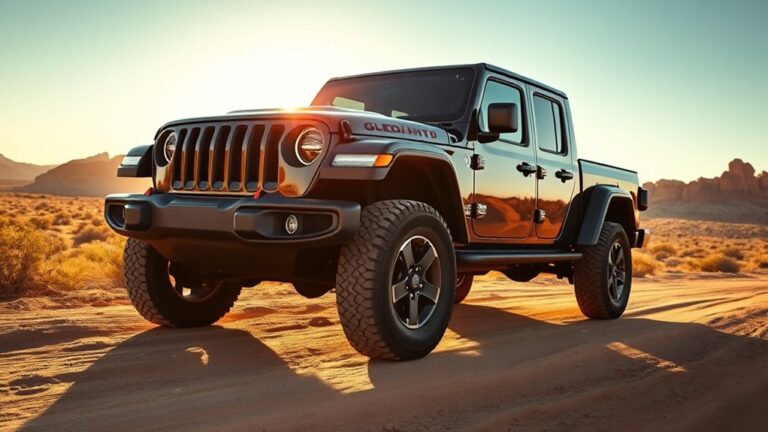
What Is a Willys Jeep
As an Amazon Associate we earn from qualifying purchases.
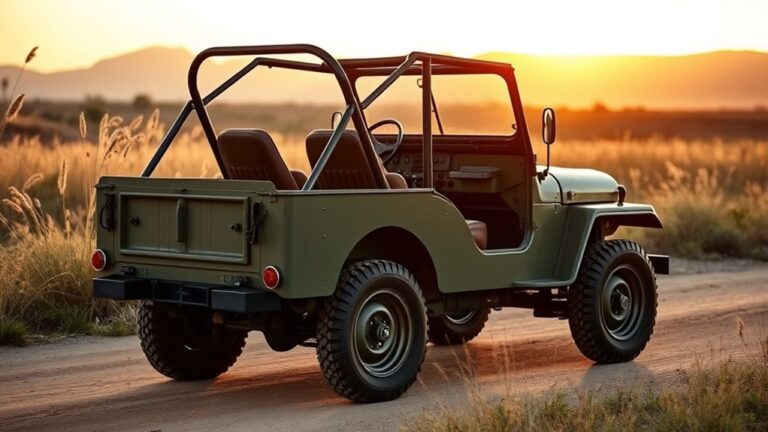
You might not know that the Willys Jeep began as a wartime answer to a strict Army contest, not as a finished legend. The Willys Jeep you see today started as a compact 4×4 that Willys-Overland refined into the MB, a vehicle prized for its low weight, simple mechanics, and rugged frame.
Its wartime success shaped every civilian Jeep that followed. The details behind that transformation tell a larger story.
Key Takeaways
- A Willys Jeep was a compact 4×4 military utility vehicle built for the U.S. Army in the early 1940s.
- Willys Overland produced the standard MB model after wartime prototype competition and design refinement.
- Its boxy body, short wheelbase, and simple mechanics made it durable, easy to repair, and highly mobile.
- The Jeep excelled in mud, desert, and rough terrain, carrying troops, scouts, messengers, and supplies under fire.
- Its WWII design became the basis for civilian CJ Jeeps and influenced modern off-road vehicles.
What Is a Willys Jeep?
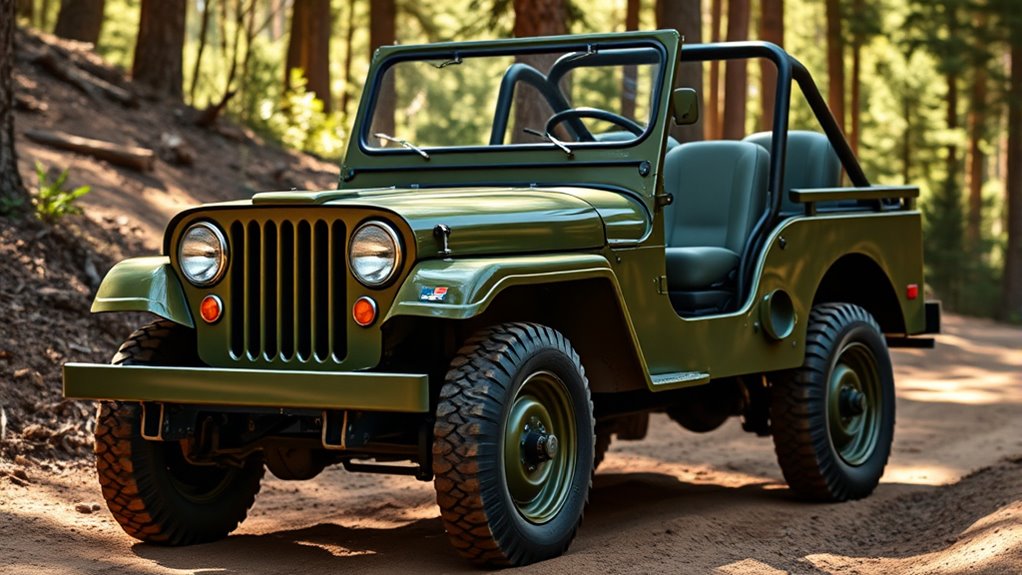
A Willys Jeep is the original military light utility vehicle developed in the early 1940s, built by Willys-Overland for the U.S. You recognize it as a compact 4×4 designed for rugged service, simple repair, and dependable performance across mud, sand, and broken roads.
Its boxy body, exposed hardware, and short wheelbase reflect hard military requirements rather than comfort. When you study it, you see how innovative partnerships shaped a standard vehicle that could serve soldiers, engineers, and field crews with equal efficiency.
Today, collectors prize its authenticity, while vintage modifications often preserve its wartime character. You’re looking at a machine that became a benchmark for durable utility, influencing generations of off-road vehicles through practicality, mechanical honesty, and unmistakable historical significance.
How the Willys Jeep Began
You can trace the Willys Jeep’s origins to the U.S. Army’s urgent need for a light reconnaissance vehicle at the start of World War II. In response, Bantam entered the design competition with a practical prototype that proved the concept, even as larger manufacturers refined it.
Willys Overland later won the contract, and its stronger engine and durable design helped shape the Jeep you know today.
Army Light Reconnaissance Need
Why did the Willys Jeep come into being at all? You can trace its origins to the Army’s urgent need for a light reconnaissance vehicle that could move fast, carry messages, and reach rough ground where heavier trucks failed.
In the late 1930s, planners judged reconnaissance roles essential to modern warfare, and they pushed vehicle prioritization toward compact, four-wheel-drive machines. They wanted something soldiers could keep running with simple maintenance strategies, even far from depots.
The Army also needed designs that could fit into expanding global vehicle fleets without straining supply chains. That demand shaped the requirements that Willys would later meet.
Before any battlefield fame, the jeep answered a practical military problem: how to give commanders reliable mobility, scouting reach, and field efficiency in one small platform.
Bantam Design Competition
To meet the Army’s demand, the War Department turned in 1940 to a small competitive trial that would become the Bantam design competition, the first formal step toward the Willys Jeep. You can trace the vehicle’s origin to that urgent request for a light reconnaissance car that could be built quickly and tested under strict military standards.
Bantam, a small Pennsylvania firm, answered first and presented a prototype that proved the idea was workable. In this design competition, engineers had to balance low weight, ruggedness, and off-road mobility.
The Bantam design competition mattered because it established the basic military layout you still associate with the Jeep: compact proportions, open bodywork, four-wheel drive, and simple serviceability for hard field use.
Willys Overland Selection
After Bantam’s prototype showed that a light military reconnaissance vehicle was possible, the War Department widened the field and invited larger automakers to submit their own versions. You can trace Willys-Overland’s rise to its strong engine, lower cost, and practical design, which won officials over in 1940.
Willys refined the MA into the MB, adding stronger axles, better cooling, and simpler production methods suited to wartime output.
| Model | Key Trait | Significance |
|---|---|---|
| MA | Early pilot | Tested refinements |
| MB | Standardized jeep | Mass production |
| Willys | Low bid | Won contract |
| Overland styling | Clean layout | Influenced later looks |
| Restoration sourcing | Parts availability | Helps you preserve authenticity |
When you study it, you see how this selection shaped the jeep’s identity.
Why the Willys Jeep Stood Out in WWII
In the brutal terrain of World War II, the Willys Jeep stood out because it could go where larger vehicles simply could not. You saw it threaded through mud, shell craters, and narrow tracks with a flexibility that commanders valued in every theater.
Its compact profile helped with battlefield camouflage, while its steady performance in desert operations made it useful from North Africa to Europe. You could trust it to carry messengers, scouts, and supplies quickly, often under fire.
Unlike heavier transport, it didn’t demand prepared roads, so it kept formations moving when timing mattered most. In a war defined by mobility, the Willys Jeep gave Allied forces a practical edge that matched the urgency of modern combat.
Willys Jeep Features That Made It Tough
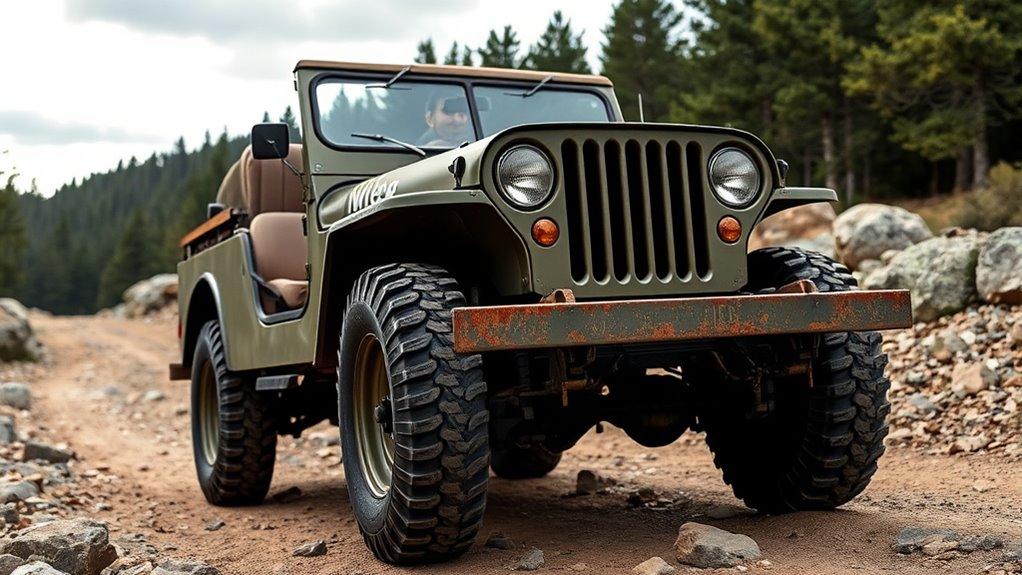
What made the Willys Jeep so tough? You saw a simple, purpose-built machine with a boxed frame, high ground clearance, and short overhangs that let it climb, cross, and recover with less drama.
Its four-wheel drive and low gearing gave you steady pull over mud, rocks, and shell-pocked roads. Engineers chose rugged steel panels and easy-access mechanical parts, so field repairs stayed practical.
| Feature | Effect |
|---|---|
| Boxed frame | Adds strength |
| 4×4 drivetrain | Improves traction |
| High clearance | Clears obstacles |
| Simple mechanics | Speeds repairs |
These were no irrelevant topics; they were two word discussion ideas grounded in battlefield need. You can trace the Jeep’s toughness to design discipline, not ornament, and that’s why it endured.
Willys MB, CJ, and Civilian Jeep Versions
The Willys MB was the wartime workhorse that turned the Jeep into an icon, and its civilian descendants, the CJ series, carried that same basic formula into peacetime. If you study the MB, you’ll see a compact 4×4 built for military duty, with simple controls and rugged hardware.
You’ll also notice Willys MB variants adapted for reconnaissance, transport, and field repairs. After the war, Willys reworked the design into the CJ, or Civilian Jeep, and that shift marked the civilian jeep evolution.
You got a farm tool, utility vehicle, and everyday driver in one package. The CJ kept the MB’s proven chassis layout, but added friendlier details for work and road use.
Why the Willys Jeep Still Matters Today
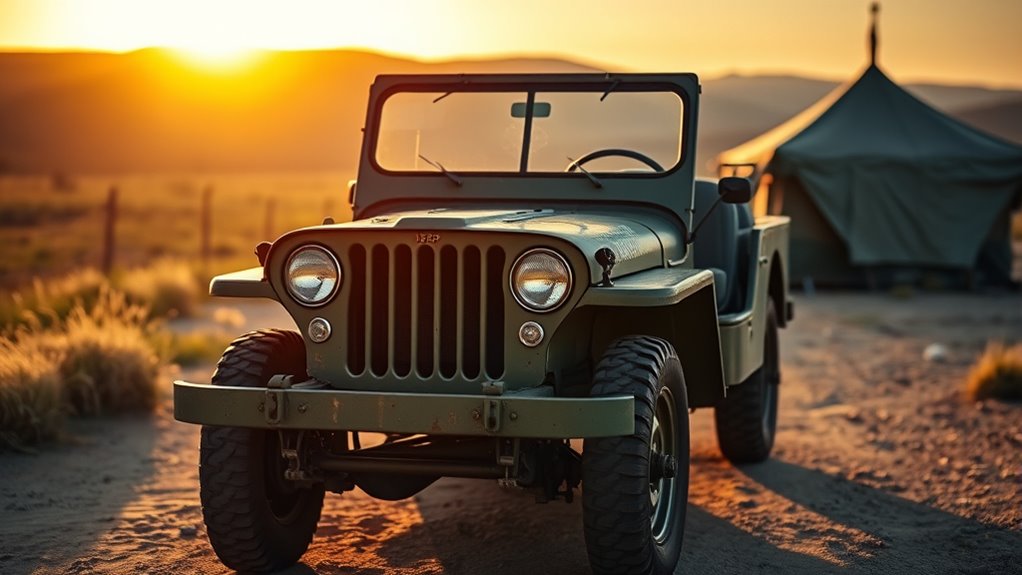
Why does the Willys Jeep still matter? You see its influence every time a rugged 4×4 tackles mud, snow, or broken pavement with confidence. Born from wartime necessity, the Willys Jeep proved that a compact vehicle could haul troops, tools, and supplies where larger machines failed.
You can trace modern off-road engineering back to its simple frame, short wheelbase, and durable mechanicals. Its innovative suspension set a practical standard for trail use, while later civilian models showed how military design could adapt to farms, highways, and remote work.
Collectors value it because it embodies American ingenuity, and restorers preserve it because the design still teaches efficiency. Even today, diesel variants keep that legacy alive in markets that demand torque and thrift.
Frequently Asked Questions
How Much Does a Restored Willys Jeep Typically Cost?
A restored Willys Jeep typically costs you $25,000 to $60,000, depending on originality and condition. You’ll need careful restoration budgeting and smart parts sourcing, since rare wartime components can drive prices much higher.
Are Original Willys Jeep Parts Still Easy to Find?
Yes, you can still find original parts, though they’re not always easy. You’ll rely on aftermarket sourcing, swap meets, and specialist sellers. Patience pays off, and authentic pieces can keep your restoration historically faithful.
What Engine Size Did Early Willys Jeeps Use?
Early Willys Jeeps typically used a 134-cubic-inch Go-Devil four-cylinder. You’ll find engine compatibility matters in restorations, and you should avoid restoration pitfalls by matching mounts, bellhousing, and cooling hardware to the original setup.
Can a Willys Jeep Be Driven Comfortably on Modern Highways?
Not really. You’ll feel every mile. Your Willys can manage modern highways only with careful model identification, proper engine size, and decent restoration costs.
Parts availability helps, but driving comfort and highway viability remain limited.
How Can You Identify a Genuine Willys Jeep Model?
You’ll identify a genuine Willys Jeep by checking stamped frame tags, original body panels, wartime-style grille, flat-fender proportions, and Willys-branded engine numbers.
Be wary of identifying scarcity; restoration challenges often mask swapped parts.
Conclusion
You can see the Willys Jeep as both a war machine and a civilian legend: rough yet refined, simple yet revolutionary. Born from wartime urgency, it gave you unmatched mobility with a boxed frame, high clearance, and no-nonsense mechanics.
In battle, it carried troops and supplies; after the war, it helped shape the CJ and every Jeep that followed.
If you admire endurance, you’re looking at the vehicle that proved usefulness can become history—the Willys Jeep.