What Does Tj Stand for Jeep
As an Amazon Associate we earn from qualifying purchases.
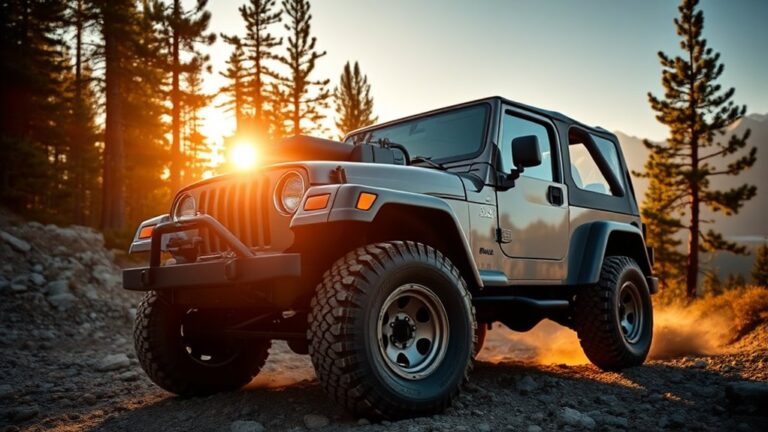
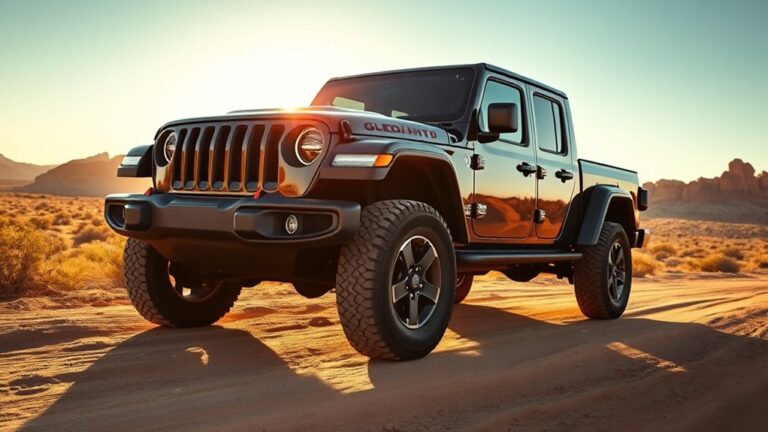
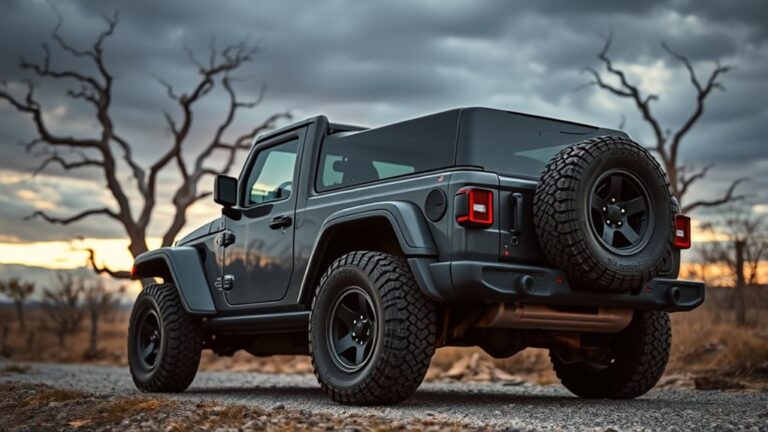
When you spot a Jeep badge and hear someone say “TJ,” you’re looking at more than a trim code. The term “TJ” stands for the internal platform name used by Jeep for the 1997–2006 Wrangler. This generation introduced coil-spring suspension, improving ride comfort without sacrificing its trail-ready capabilities.
If you’ve ever wondered why enthusiasts still use that shorthand, the answer says a lot about how the Wrangler changed—and what made it endure. The TJ Wrangler marked a significant evolution in Jeep’s design while staying true to its off-road roots.
Key Takeaways
- TJ is the factory code for the second-generation Jeep Wrangler, built from 1997 to 2006.
- It is an internal platform designation, not a marketing nickname.
- Jeep enthusiasts use “TJ” to identify that specific Wrangler generation and its parts.
- The TJ marked a shift to coil-spring suspension, improving ride quality while keeping classic Wrangler character.
- Commonly, “TJ Wrangler” refers to the round-headlight, trail-focused model between the YJ and JK.
What Does TJ Stand for Jeep?
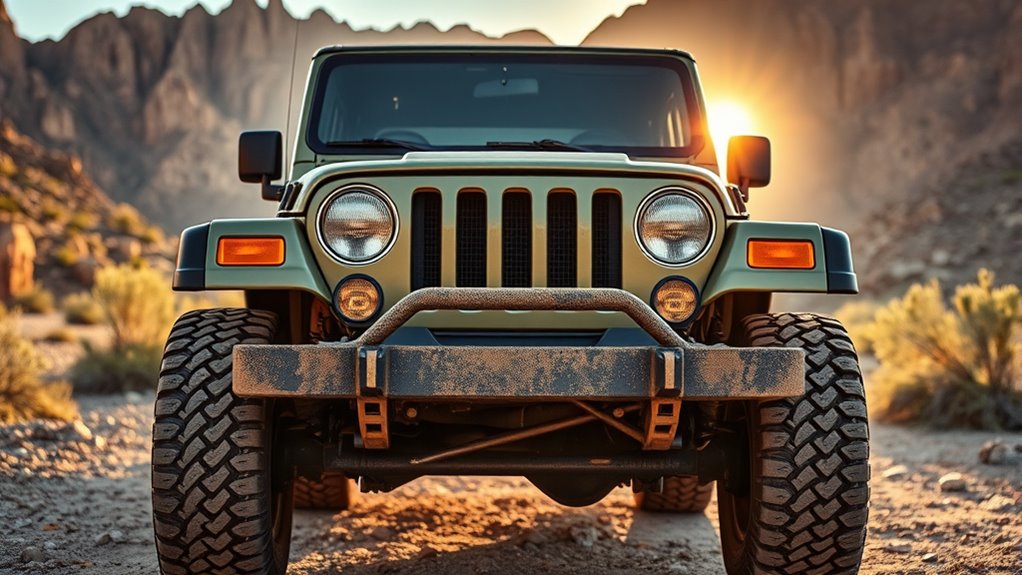
If you’ve ever wondered what “TJ” means on a Jeep, it’s the factory code for the second-generation Jeep Wrangler, built from 1997 to 2006. You use TJ to identify that specific model family, which replaced the YJ and later gave way to the JK.
When you see a TJ, you’re looking at a Wrangler with coil-spring suspension, round headlights, and classic off-road character. That code helps you sort parts, compare trims, and talk accurately about the vehicle.
It also sparks tj nostalgia among owners who remember its simple, rugged feel. If you’re sharing two word discussion ideas, “TJ Wrangler” and “TJ era” work well.
In short, TJ isn’t a nickname; it’s the platform code that defines this Jeep generation.
Why Jeep Chose the TJ Name
Jeep didn’t pick “TJ” as a marketing nickname; it used the code as an internal platform designation for the Wrangler line. You see a practical naming choice that helped engineers, suppliers, and dealers track the model without creating a flashy badge story.
Jeep often keeps development codes simple, and TJ fit that pattern. If you’re wondering why it stuck, the answer is straightforward: enthusiasts adopted it because it was easy to say and clearly identified the generation.
That makes TJ useful in specs, forums, and parts discussions. It also keeps attention on the vehicle itself, not an unrelated topic or off topic discussion. In short, Jeep chose TJ for organization, and you kept it for convenience.
How the TJ Fits Wrangler History
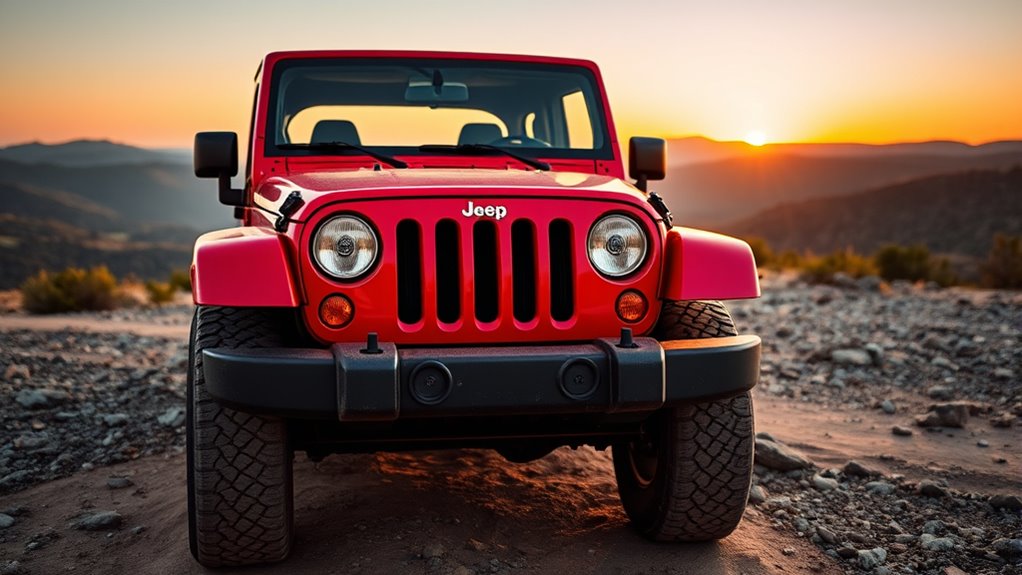
Within Wrangler history, the TJ marks the shift from the YJ generation to a more refined off-road platform, blending classic Jeep styling with updated suspension and ride quality. You see it as a bridge between old-school simplicity and the Wrangler’s modern era, keeping the open-air identity while improving everyday drivability.
Jeep fans often use the TJ as a reference point because it widened appeal without losing the brand’s rugged character. If you’re comparing ownership costs, customer service at parts counters and aftermarket pricing can influence how you view its place in the lineup.
The TJ also helped set expectations for later Wranglers by showing that capability and comfort could coexist. That balance is why many enthusiasts still value it today.
TJ Design Changes That Stand Out
The TJ stands out because Jeep made several clear design updates that improved both function and daily comfort. You’ll notice the return to round headlights, a cleaner body shape, and a more refined dashboard that still keeps jeep heritage visible.
Jeep also switched to coil-spring suspension, which gave you a smoother ride without losing the Wrangler’s simple, rugged character. The fold-down windshield and removable doors stayed true to tj naming traditions tied to earlier Jeep models.
Inside, you got more usable space and better seating support, making the TJ easier to live with every day. These changes didn’t erase the classic look; they balanced tradition with practical upgrades, so you can see why the TJ feels familiar yet distinct in the Wrangler lineup.
TJ Engine Specs and Trail Ability
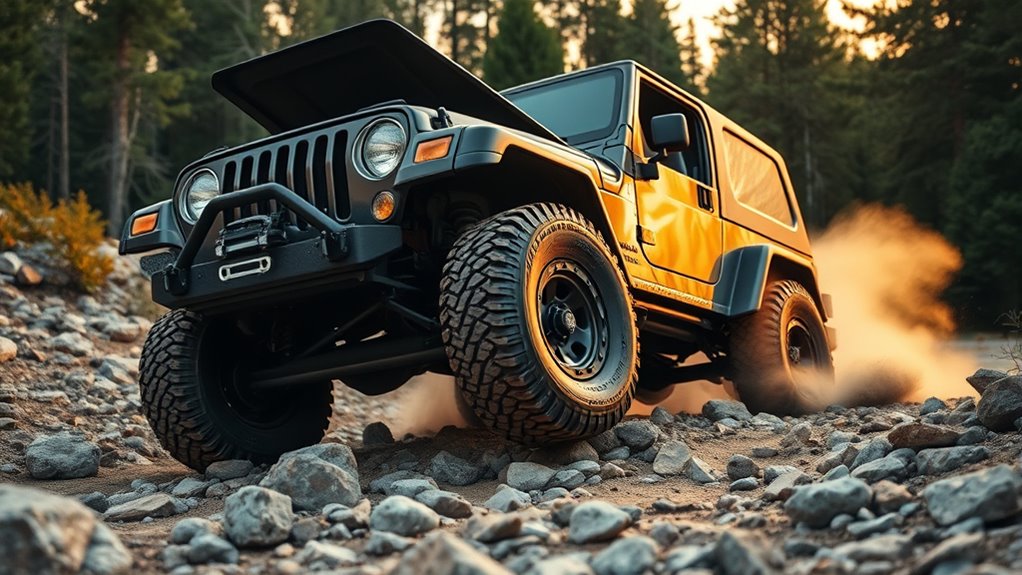
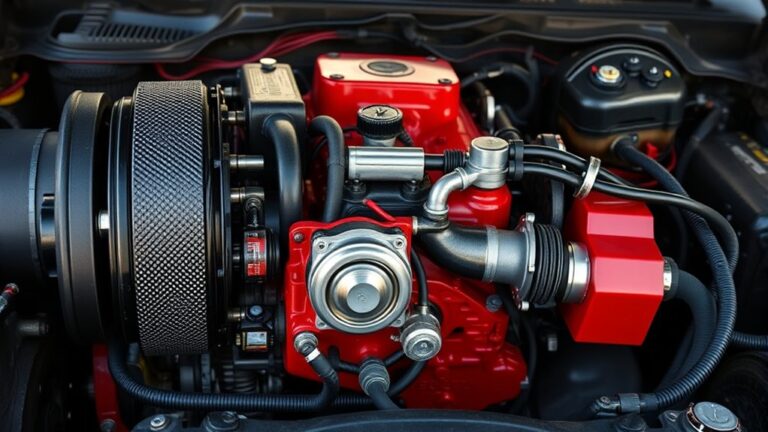
You’ll find the TJ with a range of engine options, including the well-known 2.5L four-cylinder and 4.0L inline-six. These engines give you enough torque and reliability to handle technical trails and steady low-speed climbing.
Its short wheelbase, solid axles, and strong suspension travel also help you keep traction when the terrain gets rough.
TJ Engine Options
When you’re looking at TJ engine options, the main choices are the 2.5L inline-four and the 4.0L inline-six, each with a different balance of power, fuel economy, and trail performance. You’ll see the 2.5L in lighter TJs where efficiency matters, while the 4.0L gives you stronger torque and better passing power.
In the tj naming conversation, these engines help explain how Jeep origins shaped the TJ formula. This tj engine options article keeps things simple:
- 2.5L: modest output, lower weight, less thirst.
- 4.0L: strong low-end pull, broad aftermarket support.
- Both: simple mechanical layout, easy maintenance.
If you want a TJ that feels relaxed on-road and capable off-road, the 4.0L usually fits better.
Trail Performance Features
Trail performance starts with torque, gearing, and how well the TJ keeps steady traction over rough ground. You feel that in the 2.4L and 4.0L engines, which give usable low-end pull for climbs and slow crawls.
Solid axles, short overhangs, and available Dana 44 hardware help you clear obstacles with less drama.
| Feature | Trail Benefit | Note |
|---|---|---|
| 4.0L I6 | Strong crawl torque | Best for steep terrain |
| Low-range transfer case | Controlled speed | Improves obstacle control |
| Short wheelbase | Tight maneuvering | Helps on switchbacks |
For a distinct restoration, you should verify axle ratios, suspension lift, and drivetrain wear before parts sourcing. The TJ rewards setup choices that match your terrain and keeps trail manners predictable.
Why the TJ Became So Popular
The TJ became so popular because it hit a sweet spot between old-school Jeep character and everyday usability. You got a coil-sprung chassis that felt more composed on pavement, yet it still handled rough trails with confidence.
Buyers also trusted its reliability benchmarks, which made ownership feel predictable and practical. Its aftermarket compatibility mattered too, because you could personalize your Jeep with lifts, armor, and lighting without much hassle.
Buyers trusted its reliability, while the aftermarket made personalization with lifts, armor, and lighting feel effortless.
- You can use it daily without losing capability.
- You get broad parts support and easy upgrades.
- You benefit from strong community knowledge and proven durability.
That mix helped you see the TJ as a Jeep you could drive, modify, and enjoy for years, not just weekends.
TJ vs. YJ: What Changed?
If you’re comparing the TJ to the YJ, the biggest changes show up in the suspension, ride quality, and overall refinement. You’ll notice the TJ uses coil springs instead of the YJ’s leaf springs, and that switch gives you better articulation and a smoother daily drive.
Jeep also improved steering, chassis tuning, and interior comfort, so the TJ feels more composed on pavement and more predictable off-road. The rounded headlights stayed, but the body structure and cabin details became more modern and practical.
When you focus on two word discussion ideas, the TJ clearly wins for drivability. If unrelated topics come up, they don’t change the core fact: the TJ is the more refined evolution of the YJ, without losing the Wrangler’s rugged character.
TJ vs. JK: Key Differences
If you’re comparing the TJ and JK, you’ll notice the TJ keeps the classic Wrangler basics: simpler size, solid axles, and a more traditional feel.
The JK brings more room, more safety features, and a wider stance that changes how it handles on and off the road. When you look at both, you can see how Jeep balanced old-school capability with newer comfort and convenience.
TJ Wrangler Basics
When you compare a TJ Wrangler to a JK, the biggest differences show up in size, ride, and design philosophy. You get a shorter wheelbase, coil-spring suspension, and a classic Jeep feel that many drivers prefer for trails.
TJ durability is a major draw, especially if you want a simple, proven platform that’s easier to inspect and modify. In a YJ comparison, the TJ feels more refined while still keeping the Wrangler’s rugged identity.
- You sit upright and handle tight terrain well.
- You can find strong aftermarket support for lift kits and armor.
- You’ll notice a more compact body that helps off-road maneuverability.
JK Wrangler Changes
By contrast, the JK Wrangler brought a bigger body, a longer wheelbase, and a more modern ride than the TJ. You’d notice better highway stability, a roomier cabin, and improved crash protection.
Jeep also gave you coil suspension tuning that felt less twitchy on pavement while still handling trails well. The JK added power options, electronic features, and stronger convenience focus, so it moved closer to daily-driver territory.
If you’re comparing TJ vs. JK, those are the key differences that matter most. Keep your two word discussion ideas centered on size, comfort, and capability, not some irrelevant topic.
The JK changed the Wrangler formula without losing its off-road identity, but it clearly aimed at broader appeal and easier ownership.
Common TJ Problems to Watch For
Even a well-loved TJ can develop a few familiar trouble spots over time. You’ll want to inspect the axle seals, steering components, and frame for rust or wear. In TJ history, these issues reflect the model’s trail-focused design, while its Wrangler lineage explains why durability matters so much.
- Rust: Check the frame, skid plates, and body mounts, especially if you drive in wet or salty conditions.
- Steering play: Loose tie rods, ball joints, or a worn track bar can make the Jeep wander.
- Drivetrain leaks: Look for seepage at the transmission, transfer case, and differential housings.
Catching these problems early helps you keep your TJ reliable and easier to service.
Is a TJ Jeep a Good Buy?
A TJ Jeep can be a good buy if you want a simple 4×4 with strong off-road capability and you’re ready for regular maintenance. You should check its service history, since reliability depends a lot on how well it’s been cared for.
If you value trail performance over modern comfort, a clean TJ can still be a smart choice.
Reliability And Maintenance
When it comes to reliability, the Jeep TJ has a solid reputation if you’re willing to stay on top of routine maintenance. You’ll see favorable reliability trends in well-kept examples, especially because the drivetrain is simple and parts are widely available.
Don’t buy into maintenance myths that suggest every TJ is a problem; most issues come from age, neglect, or deferred repairs. If you inspect carefully, you can avoid costly surprises.
- Check for rust on the frame and body mounts.
- Verify service records for fluids, belts, and steering parts.
- Test for leaks, worn bushings, and electrical wear.
If you handle upkeep consistently, you can own a TJ without constant drama, and that makes it a sensible buy for you.
Off-Road Capability
Off-road, the TJ is one of the strongest cases for a used Jeep buy, especially if you want a simple, capable 4×4 that still feels mechanical and direct. Its solid axles, short wheelbase, and coil-spring suspension help you crawl rocks and soak up ruts with confidence.
The TJ naming reflects Jeep’s focus on trail use, and the off-road branding isn’t just marketing here.
| Feature | What You Feel |
|---|---|
| Solid axles | More grip on rough terrain |
| Short wheelbase | Better breakover on obstacles |
| Low-range transfer case | Slower, steadier control |
If you’ve got budget for tires and lifts, you’ll unlock even more capability. For backroads, mud, and technical trails, the TJ still punches above its age.
Frequently Asked Questions
What Years Were TJ Wranglers Made?
You’re looking for TJ Wrangler years: Jeep built them from 1997 through 2006. In Tj spelling, Jeep branding covered this generation, and you can spot its round headlights, coil springs, and compact, classic stance.
How Many TJ Trim Levels Existed?
You’ll find four primary TJ Jeep Wrangler trim levels: SE, Sport, Sahara, and Rubicon.
TJ means Wrangler history in shorthand, and its off road capability, wheel and tire upgrades, and aftermarket support made it beloved.
Did the TJ Have Removable Doors?
Yes, you could remove the TJ’s doors, and that’s part of Jeep culture. The TJ acronym refers to the Wrangler generation, and you’ll need to disconnect mirrors and wiring before taking them off.
Was the TJ Available With a Hardtop?
Yes, you could get a hardtop on the TJ; hardtop availability varied by trim and year. As the saying goes, different strokes for different folks. You also got removable doors, which made it versatile.
What Transmission Options Did the TJ Offer?
You could get a 5-speed manual or 3-speed automatic in the TJ. Jeep branding emphasized rugged simplicity, while aftermarket tuning often targeted gearing.
Safety features were basic, and fuel economy varied by engine and transmission.
Conclusion
So, what does TJ stand for Jeep? You’re looking at Jeep’s internal code for the second-generation Wrangler, not a trim name. That little badge marks a trail-ready turning point: coil springs, classic looks, and stronger off-road chops.
If you’re comparing models, the TJ stands out for its blend of simple style and smart upgrades. In short, you get a rugged, reliable, and remarkably respected Wrangler.
When it comes down to it, knowing what TJ stands for Jeep helps you appreciate the legacy behind this iconic off-road vehicle.