How to Put a Jeep Wrangler in 4 Wheel Drive
As an Amazon Associate we earn from qualifying purchases.
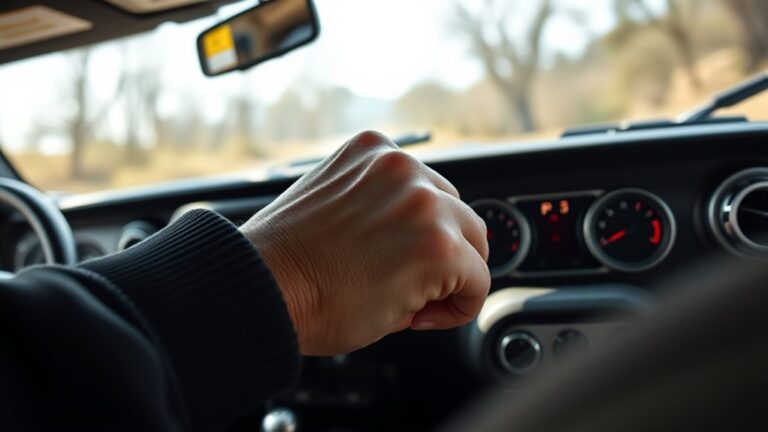
A Jeep Wrangler can feel both ordinary on pavement and unstoppable off it, but only if you shift the transfer case correctly to put a Jeep Wrangler in 4 wheel drive. You’ll use 4H for slippery roads at speed and 4L for slow, high-torque crawling.
Before you move the lever, you need the right vehicle speed, gear position, and brake control. Get those wrong, and the lights may say one thing while the drivetrain says another.
Key Takeaways
- Slow down or stop, keep the wheels straight, and apply the brake before shifting into 4WD.
- Move the transfer case from 2H to 4H for slippery roads, gravel, snow, or mud without changing gearing.
- For 4L, stop completely, shift the transmission to neutral, then move the transfer case into 4L.
- Use 4H for higher-speed traction and 4L for slow, controlled crawling on steep, rocky, or muddy terrain.
- Confirm the 4WD indicator lights up, and return to 2H when traction improves or on dry pavement.
What 4WD Does in a Jeep Wrangler
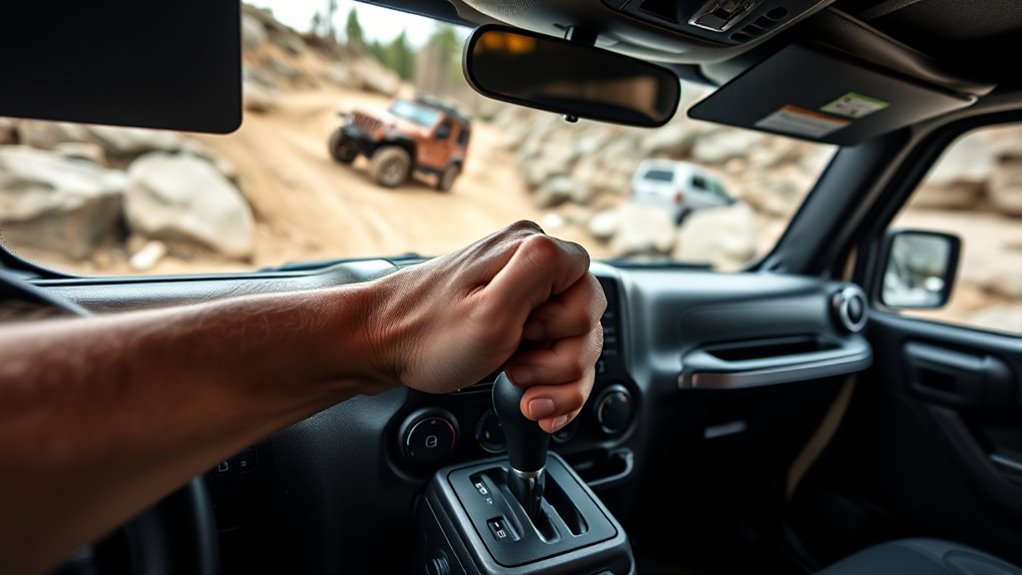
4WD in a Jeep Wrangler sends power to both the front and rear axles, which gives you better traction on loose, wet, snowy, or uneven surfaces. You use it when 2WD can’t keep the tires hooked up.
In 4WD basics, torque splits to help all four tires pull instead of letting two spin uselessly. In Jeep terminology, you’ll hear part-time 4WD, 4H, and 4L; each mode changes how the drivetrain responds.
4H helps you maintain speed on slippery roads, while 4L multiplies torque for slow, controlled crawling. You don’t get more tire grip from 4WD itself, but you do get better power delivery to use the grip that’s already there.
What You Need Before Shifting Into 4WD
Before you shift, make sure your Jeep is rolling slowly or stopped, your foot is on the brake, and you’re on a surface that suits 4WD use, since part-time systems aren’t meant for dry pavement. Check your transfer case mode, confirm the drivetrain isn’t binding, and keep steering input light.
Good tire maintenance matters because mismatched pressure or worn tread can affect traction and shift feel. Use proper off-road etiquette: yield room, avoid spinning tires, and don’t engage 4WD where it can damage pavement or driveline parts.
| Item | Why it matters |
|---|---|
| Brake pedal | Stabilizes the Jeep |
| Low speed | Prevents harsh engagement |
| Suitable terrain | Protects the transfer case |
| Tire condition | Improves traction and control |
How to Put a Jeep Wrangler in 4H
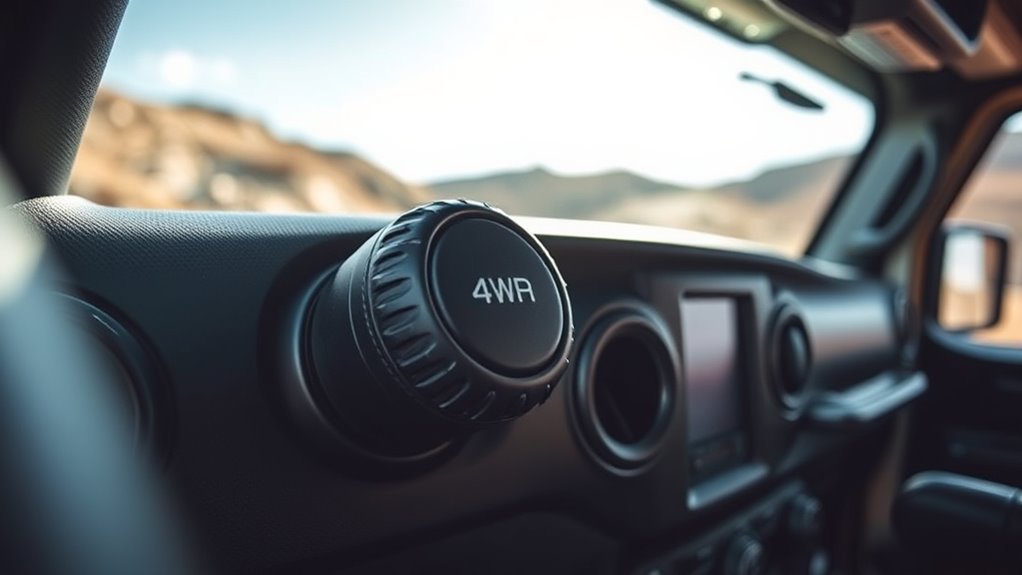
To engage 4H in a Jeep Wrangler, keep the Jeep moving slowly in a straight line or stop it with your foot on the brake, then shift the transfer case from 2H into 4H. You’ll feel a firm detent when the system engages. Use 4H on low-traction pavement, gravel, snow, or mud for better traction optimization without changing gearing.
Shift from 2H into 4H while rolling slowly or stopped; feel the firm detent as it engages.
The setting keeps normal driving dynamics, so you can maintain regular road speed while improving grip.
- Confirm the 4WD indicator lights up.
- Keep steering inputs smooth.
- Avoid sharp acceleration on dry pavement.
- Return to 2H when traction improves.
If the lever resists, ease off the throttle and roll slightly. Don’t force it; the transfer case should engage cleanly.
How to Shift a Jeep Wrangler Into 4L
When you need maximum torque and control, shift the Wrangler into 4L by stopping the vehicle, placing the transmission in neutral, and moving the transfer case lever or switch from 2H or 4H into 4L. Keep steady pressure on the control until the indicator confirms engagement.
If the shift resists, let the drivetrain settle, then try again with the wheels straight and the vehicle fully stopped. For manual transmissions, keep the clutch depressed while you complete 4L shifting. For automatics, stay in neutral until the transfer cases lock into low range.
After engagement, return the transmission to drive or first gear and proceed smoothly. Don’t force the selector; a clean shift protects the drivetrain and helps ensure reliable low-range operation on steep, slow terrain.
When to Use 4H vs 4L
Use 4H when you need extra traction at higher speeds on wet pavement, gravel, or snow, and keep your speed steady.
Use 4L when you need maximum low-speed power and control for steep climbs, deep mud, rocks, or towing. Match the mode to the terrain so your Jeep delivers the right balance of traction, torque, and drivability.
High-Speed Traction
How do you decide between 4H and 4L in a Jeep Wrangler? Use 4H when you need high-speed traction on loose gravel, wet pavement, or light snow; it keeps steering responsive and stabilizes the Jeep without forcing slow travel.
For off road safety, check tire inflation first, because incorrect pressure can reduce grip and increase wear. Use 4L only when you’re moving slowly and need maximum control on steep, rocky, or deeply rutted terrain.
- 4H: maintain momentum
- 4H: preserve traction at road speeds
- 4L: apply for crawl control
- 4L: avoid on dry pavement
Shift before conditions worsen, not after wheels spin. Match the drivetrain mode to speed, surface, and traction demand, and you’ll protect components while keeping control.
Low-Speed Power
Need stronger low-speed pull? Use 4L when you need maximum torque at low speed, such as climbing steep grades, crawling over rocks, or easing through deep mud. 4L lowers the gear ratio, so you get better power management and finer throttle control without riding the brakes.
Use 4H when you still need extra traction but want normal road speeds, like on wet pavement, gravel, or light snow. In 4H, your Wrangler keeps more speed while still sending power to all four wheels.
Don’t use 4L for regular driving; it can make the drivetrain feel bound up. Your traction control can help, but it won’t replace proper gear selection. Match the range to the load, surface, and low speed demands, and you’ll drive more smoothly.
Terrain Matching
What terrain are you tackling? Use terrain matching to choose 4H or 4L before you move. Select 4H when you need extra grip at speed on loose gravel, wet pavement, light snow, or shallow sand. It keeps wheel speed higher and lets you steer normally.
Shift to 4L when the trail gets steep, rocky, deeply rutted, or muddy and you need controlled torque for mud traction.
- 4H: maintain momentum
- 4L: maximize crawl control
- 4H: better for moderate surfaces
- 4L: better for technical obstacles
If wheels start slipping, reduce throttle and reassess the surface. Match the mode to the terrain, not the weather, and you’ll protect driveline parts while improving control and traction.
How to Tell If 4WD Engaged Correctly
You can tell 4WD engaged correctly when the transfer case shifts cleanly and the dashboard indicator confirms the selected mode. You should feel a firm engagement, not a grinding sound, and the lever or switch should settle without hesitation.
4WD engages cleanly when the indicator confirms the mode and the transfer case settles without grinding or hesitation.
Then check for normal drivetrain behavior: front-wheel torque should help pull the Jeep, and the steering may feel slightly heavier in 4H. In 4L, you’ll notice lower speed and stronger engine braking.
Use discussion ideas like a short test drive on loose gravel to confirm subtopic relevance without stressing the system. If the indicator blinks or the vehicle stays in 2WD, stop and recheck your procedure.
Always match speed, transmission position, and terrain before judging the result.
Common Jeep Wrangler 4WD Shift Problems
Even when the 4WD indicator lights up, Jeep Wrangler shift problems can still show up as hard engagement, grinding, or a lever that won’t move smoothly. You may face bind-up from driveline tension, worn shift linkage, or low transfer case fluid. Don’t buy into 4wd shift myths that say force always fixes it; you can damage parts fast.
Watch for transfer case warnings like flashing lights, delayed engagement, or a stuck selector. Inspect these points:
- Loose or misadjusted linkage
- Damaged shifter bushings
- Transfer case fluid leaks
- Faulty vacuum or electrical actuators
If the lever resists, stop and reset the vehicle on level ground. Shift only after the drivetrain unloads. If problems repeat, you need a qualified inspection before you drive farther.
4WD Driving Tips for Mud, Snow, and Sand
When you’re in mud, keep your speed steady, use low gear, and avoid sudden throttle inputs so the tires can maintain traction.
In snow, drive smoothly, leave extra following distance, and use the Jeep’s 4WD settings to help you maintain control on low-friction surfaces.
In sand, keep momentum up without spinning the tires, and lower tire pressure only if conditions and your setup call for it.
Mud Traction Tips
For mud, snow, and sand, traction depends on maintaining momentum and choosing the right 4WD mode before the Jeep starts to bog down. In mud traction, use 4-High for faster, shallow sections and 4-Low when you need controlled wheel speed and torque. Terrain matching matters because your line, throttle, and tire placement must suit the rut depth and surface grip.
- Keep steering inputs smooth.
- Use steady throttle, not sudden bursts.
- Stay in existing tracks when they’re firm.
- Back out early if the Jeep starts to sink.
If the tires spin, ease off and let the tread clear. You’ll preserve control, reduce wheel hop, and keep forward motion through soft ground without burying the axles.
Snow Mode Driving
Snow changes traction fast, so you need to shift into 4WD before the Jeep loses grip and keep your inputs gentle throughout the run. In snow mode, use 4H for most packed roads and engage 4L only if you need low-speed control on steep, slick sections.
Keep steering smooth, brake early, and avoid abrupt throttle changes that can trigger wheelspin. If the Jeep starts to push wide, ease off the accelerator and let the tires regain bite. Watch for ice under fresh snow, especially on shaded pavement and bridge decks.
Compared with mud traction, snow demands lighter throttle and more precise steering. Check that your tires are properly inflated and clear of packed snow, because buildup can reduce contact patch and worsen control.
Sand Momentum Control
In sand, you need steady momentum to keep the Jeep from digging in and bogging down. Select 4H before the soft section, then build smooth sand momentum without sudden throttle inputs. Keep your steering inputs small so you don’t scrub sand traction.
If the Jeep starts to slow, add power early instead of waiting for it to settle.
- Lower tire pressure for a larger contact patch.
- Shift to a higher gear to reduce wheelspin.
- Keep a constant throttle through loose patches.
- Avoid sharp turns that increase drag.
Watch for soft dunes, ruts, and buried obstacles. If the Jeep loses speed, ease off, straighten the wheels, and let the tires float. Controlled speed keeps you moving; aggressive driving only digs holes and reduces control.
Frequently Asked Questions
Can I Shift Into 4WD While Driving?
Yes, you can shift into 4WD while driving if you’re in 4H and moving slowly in a straight line. Check your rear differential and maintain vehicle stability. Don’t shift into 4L unless stopped.
Does 4WD Improve Fuel Economy?
No, 4WD won’t improve your fuel economy; it’ll usually hurt it dramatically.
You should ignore 4WD misperceptions and fuel economy myths. Use 2WD on pavement, and engage 4WD only when traction demands it.
Will 4WD Work on Dry Pavement?
No, you shouldn’t use 4WD on dry pavement; it can bind driveline parts.
4WD legality varies by area, but dry pavement traction usually doesn’t require it. Use 2WD unless low-grip conditions demand 4WD.
How Often Should I Use 4WD?
Use 4WD only when traction drops, such as in snow, mud, sand, or on steep grades.
If you’re driving a trail with off-road tires and correct tire pressure, using traction control, engage it as needed. Don’t run it on dry pavement.
Is 4WD the Same as AWD?
No 4WD isn’t the same as AWD. You’ll see 4WD vs AWD: differences and myths in traction, control, and use.
You engage 4WD manually; AWD works automatically. You need 4WD for tougher off-road conditions.
Conclusion
Now you can shift your Jeep Wrangler into 4WD with confidence and tackle slippery trails like a pro. Use 4H for added traction at speed and 4L when you need serious low-end torque for rough climbs or deep mud. Watch for the indicator lights and feel for a solid engagement.
Shift back to 2H when conditions improve to maintain optimal performance. It’s a simple system that can make your Jeep feel unstoppable on the wildest terrain. Mastering how to put a Jeep Wrangler in 4 wheel drive will greatly enhance your off-road adventures.