How to Fix a Jeep Death Wobble
As an Amazon Associate we earn from qualifying purchases.
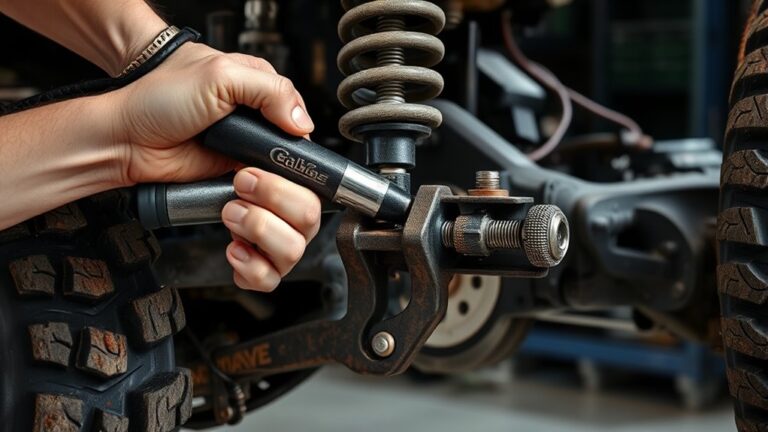
If your Jeep starts shaking violently at speed, you’re likely dealing with Jeep death wobble, and you need to stop and diagnose it before the problem gets worse.
Start with the track bar, ball joints, tie rods, drag link, wheel bearings, and lug nuts. Then check for worn bushings, loose hardware, and bad alignment.
The real fix usually hides in one overlooked front-end component, and it won’t stay hidden for long.
Key Takeaways
- Ease off the throttle, keep both hands on the wheel, and safely stop without hard braking when death wobble starts.
- Inspect the track bar first for loose bolts, worn bushings, oval holes, or cracked mounts, then replace damaged parts.
- Check tie rod ends, drag link, ball joints, wheel bearings, and lug nuts for play, wear, or improper torque.
- Balance tires, inspect rims, and verify alignment, especially toe, caster, and steering wheel centering after lifts or repairs.
- Recheck shocks, control arms, and drivetrain hardware for leaks, looseness, or vibration sources, then road test again.
What Jeep Death Wobble Feels Like
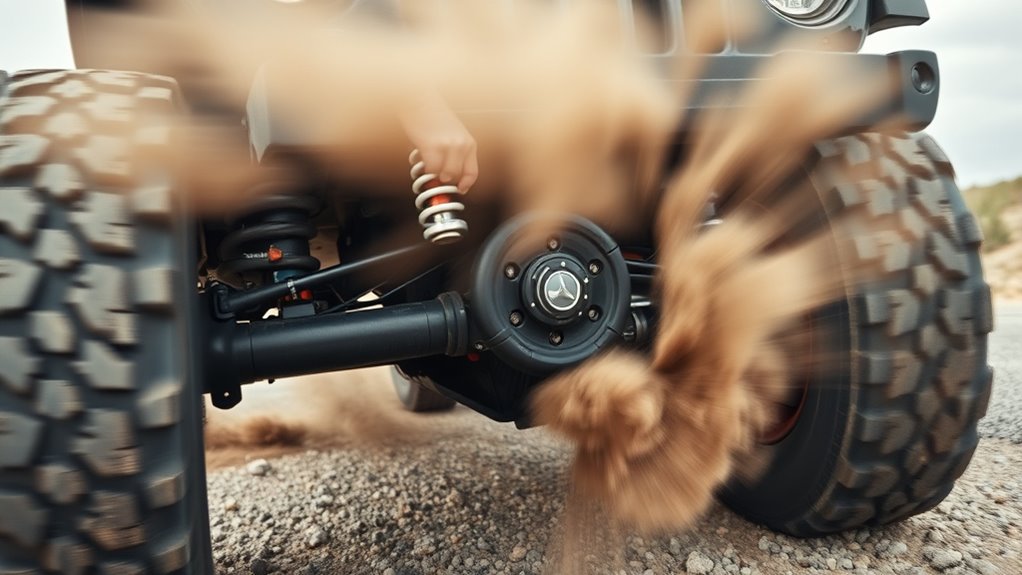
Jeep death wobble feels like a violent, rapid shaking in the front end that starts suddenly, usually after hitting a bump or pothole at speed. You’ll feel the steering wheel kick side to side, often with the whole axle vibrating hard enough to blur the tires.
In this concept overview, the shake doesn’t fade into a normal shimmy; it continues until vehicle speed drops or the inputs change. You may notice the Jeep tracking straight but feeling uncontrolled, as if the front suspension’s components aren’t holding alignment under load.
For safety framing, treat any episode as a warning that something in the steering or suspension has loosened or worn. The sensation is unmistakable: abrupt, repetitive, and intense, with no smooth transition.
Stop Jeep Death Wobble Safely
When the wobble starts, your first job is to regain control, not diagnose it on the move. Keep both hands firm, ease off the throttle, and let the Jeep slow naturally. Don’t brake hard; sudden weight transfer can amplify oscillation. If traffic allows, signal early and move to a safe shoulder. Follow your emergency procedures and any safety training you’ve practiced.
| Action | Why it helps | Risk if ignored |
|---|---|---|
| Hold wheel steady | Reduces overcorrection | Wobble worsens |
| Lift off throttle | Lowers speed smoothly | Oscillation continues |
| Coast to stop | Preserves control | Harsh braking destabilizes |
Once stopped, shift to park, set the brake, and exit only when the vehicle’s motion has fully settled.
Inspect the Track Bar and Ball Joints
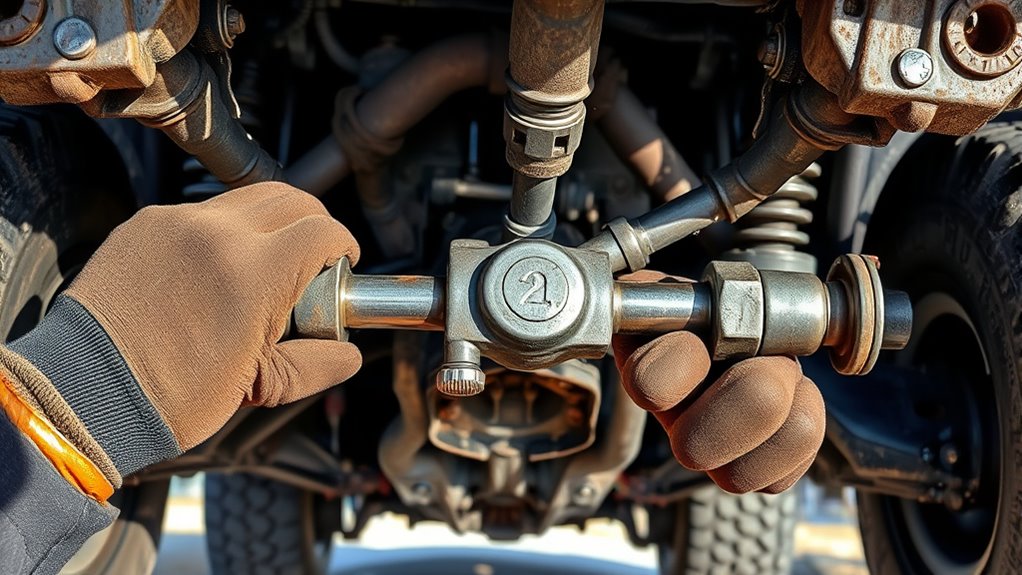
Start with the track bar, since any looseness, torn bushings, or shifting at the frame or axle mounts can trigger death wobble.
Then test each ball joint for free play by lifting the front end and checking for movement as you rock the tire at the top and bottom. If you feel clunking or see visible motion, replace the worn part before you road test the Jeep.
Track Bar Wear Check
Next, inspect the track bar and ball joints for looseness, play, or visible wear, since either one can let the axle shift and trigger death wobble. During this track bar wear check, look closely at the bushings, mounting bolts, and frame-side bracket for oval holes, cracked rubber, or shiny contact marks.
Have someone turn the steering wheel slightly while you watch for lateral movement at each end. If the bar shifts before the tires respond, the joint or hardware is suspect. Verify that all fasteners are torqued to spec and that aftermarket brackets haven’t bent or elongated.
Replace any worn bushing, heim joint, or bolt immediately. A tight, correctly aligned track bar keeps the axle centered and prevents oscillation under load.
Ball Joint Play Test
Now check the ball joints for play, since worn joints can let the knuckle shift and feed the wobble. Jack up the axle, support it, and grab the tire at 12 and 6 o’clock. Rock it while watching each ball joint; any clunk, vertical movement, or visible separation means trouble.
Repeat the wobble test with a pry bar under the tire to load the joint. If the movement appears with the brake applied, the hub isn’t the issue. Use this quick guide:
| Check | Normal | Fault |
|---|---|---|
| Tire rock | Tight | Clunks |
| Joint boot | Intact | Split |
| Knuckle motion | None | Noticeable |
If a ball joint fails this test, replace it before chasing alignment or steering parts.
Check Your Tie Rods and Drag Link
Your Jeep’s tie rods and drag link should be one of the first places you inspect, because any looseness, bent tube, or worn joint can trigger or worsen death wobble. With the front end supported, grab each link and feel for play while a helper turns the steering wheel slightly.
Check for cracked boots, ovalized holes, or shiny witness marks that show movement. If the tie rods or drag link flex under load, replace them; don’t try to mask the issue.
- Inspect both tie rod ends for free play.
- Verify the drag link is straight and tight.
- Look for damaged adjustment sleeves or clamps.
- Torque all hardware to spec after repairs.
Even slight deflection can amplify vibration, so confirm everything feels solid before moving on.
Look for Loose Wheel Bearings and Lug Nuts
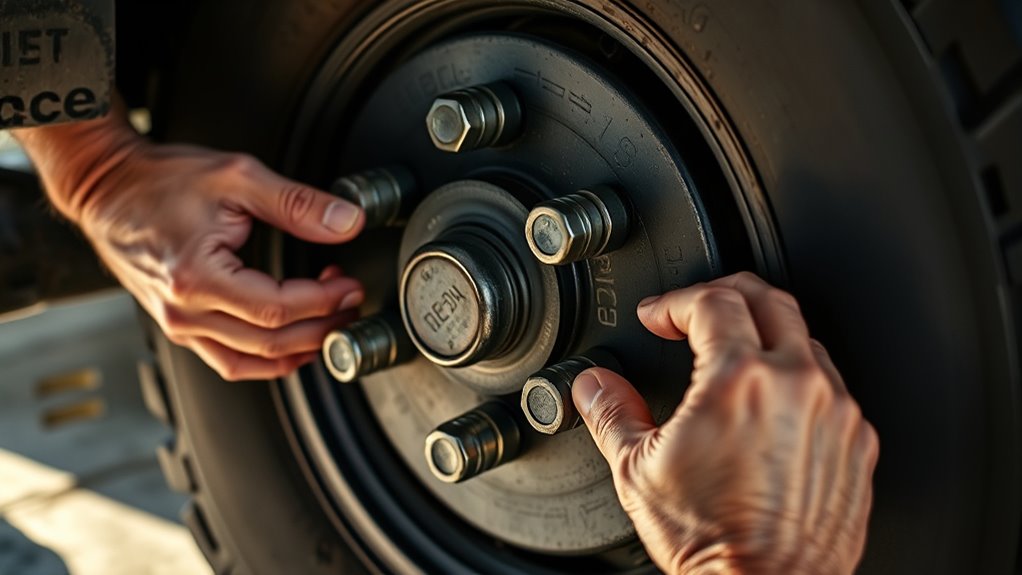
Loose wheel bearings or under-torqued lug nuts can let the front wheel shift just enough to set off a death wobble, so check them early in the diagnosis. Jack up each front corner and grab the tire at 12 and 6 o’clock.
If you feel play, inspect the wheel bearings for roughness, excessive end play, or a clunk as you rock the hub. Spin the wheel and listen for grinding or scraping.
Next, verify every lug nut is tight and seated evenly; loose lugnuts can mimic a bigger suspension fault. Recheck torque with a calibrated wrench, using the Jeep’s spec, not guesswork.
If the hub feels loose after proper torque, replace the bearing assembly before driving further.
Verify Tire Balance and Alignment
Next, verify tire balance and alignment, because an out-of-balance front tire or a misaligned axle can amplify a small shimmy into a full death wobble. Jack up each front wheel and inspect for bent rims, missing weights, or uneven tread wear.
Then:
- Check tire balance on a balancer and correct any heavy spots.
- Measure wheel alignment, especially toe, and compare it to Jeep specs.
- Inspect steering wheel centering during a straight road test.
- Recheck after a short drive to confirm the wobble’s gone.
If the Jeep still shakes, don’t guess; isolate the fault with another test drive and measure again. Precise tire balance and wheel alignment can remove the vibration source before you chase larger suspension problems.
Correct Lift Kit and Suspension Issues
Lift kits and worn suspension parts can trigger death wobble by changing steering geometry or letting the axle move where it shouldn’t. You should measure ride height, caster, and track bar angle before you chase random parts.
If your Jeep uses a tall kit, confirm the control arms, track bar, and drag link still work within spec. Many lift kit myths blame size alone, but poor installation, soft bushings, or mismatched components usually cause the problem.
Inspect ball joints, tie rod ends, control arm bolts, and frame or axle brackets for play. Don’t assume all suspension brands perform the same; cheap parts can flex, bind, or wear fast. Replace damaged hardware, torque everything to factory spec, and correct geometry with quality parts sized for your exact lift.
Test Drive and Recheck Repairs
After you’ve replaced or adjusted the suspect parts, take the Jeep on a controlled test drive and listen for any return of the wobble. Drive at the speed where the shake showed up, then vary road load and steering input to verify the fix.
Take the Jeep on a controlled test drive, then vary speed and steering to confirm the wobble is gone.
Use these checks:
- Run a straight segment and note steering wheel feedback.
- Brake lightly and feel for shimmy or drift.
- Hit minor bumps and watch axle response.
- Inspect fasteners and alignment marks after the drive.
If the Jeep still wanders on dusty trails or after road grit hits the suspension, stop and recheck the affected joints, bushings, and torque values. Tighten only to spec, and compare both sides for consistency.
A clean, repeatable test result tells you the repair held.
Prevent Jeep Death Wobble From Returning
To keep Jeep death wobble from coming back, maintain the front-end components that control toe, caster, and axle location. Inspect tie rod ends, ball joints, track bar bolts, control arm bushings, and wheel bearings at every oil change, and torque them to spec after off-road trips.
Rotate tires, balance them carefully, and replace cupped or separated tires before they start oscillating. Keep alignment within factory range, especially after lifts, impacts, or steering repairs.
Check shocks for fade and leaks, because weak damping lets shimmy build. Use proper drivetrain maintenance to reduce vibration loads through the chassis, and investigate engine rattles that could mask loose hardware.
If you catch play early, you can stop small looseness from turning into another violent wobble.
Frequently Asked Questions
Can Weather Conditions Make Jeep Death Wobble Worse?
Yes, weather can worsen it. You’ll notice more wobble on wet or cold roads because tire interaction changes, reducing grip.
Temperature, rain, and wind can amplify wear symptoms, so inspect alignment, balance, and steering components promptly.
Does Rear Suspension Affect Jeep Death Wobble?
Yes, your rear suspension can influence it, though it’s usually not the main culprit. Ironically, the back end can still shake the front. Check worn bushings, loose links, and axle alignment to isolate vibration paths.
How Often Should Steering Components Be Inspected?
You should inspect steering components every 3,000 to 5,000 miles and after hard impacts. A steering inspection helps you catch wobble causes early, like worn joints, loose hardware, or play before they trigger unsafe handling.
Can Aftermarket Tires Trigger Death Wobble?
Yes, aftermarket tires can trigger death wobble if you install oversized or unbalanced tires, because they amplify existing suspension play.
You should inspect alignment, wheel balance, and steering components to isolate the death wobble trigger.
Is Death Wobble Covered by an Extended Warranty?
It depends on your extended warranty; you’ll need to check coverage terms. Usually, it covers defects, not wear items like tire balance.
You should document symptoms, then inspect steering, suspension, and alignment for exclusions.
Conclusion
To fix Jeep death wobble, you’ve got to inspect the front end methodically: check the track bar, ball joints, tie rods, drag link, wheel bearings, and lug nuts for play or damage. Then verify torque, alignment, and tire balance, and correct any lift or suspension issues.
Once you replace worn parts and recheck everything, take a careful test drive. If you skip a step, the wobble can return like a sledgehammer shaking the steering wheel.
Properly addressing each component is key to a lasting solution. Follow these steps closely to effectively fix Jeep death wobble.