How Do You Put a Jeep in 4 Wheel Drive
As an Amazon Associate we earn from qualifying purchases.

To put your Jeep in 4-wheel drive, you need to match the transfer case mode to the terrain and shift it correctly. Engaging 4-wheel drive properly ensures better traction and control in challenging conditions.
You’ll use 4H for loose or slippery surfaces at moderate speed, and 4L when you need low-speed torque for steep, rough, or deep traction loss. The key is knowing when to shift, how to do it smoothly, and what to check if the system won’t engage.
Pay attention to your Jeep’s specific instructions, as some models require you to be stopped or moving slowly to shift into 4L. Always listen for the transfer case to engage fully before proceeding.
Key Takeaways
- Shift the transfer case into the correct 4WD mode, such as 4H or 4L, based on terrain and speed.
- Slow down and, on many Jeeps, shift from 2H to 4H with the transmission in neutral.
- Watch for the 4WD indicator light to confirm engagement before accelerating.
- Use 4H for normal slippery conditions and 4L for slow, high-torque crawling or steep descents.
- If 4WD will not engage, roll slightly and check for binding, low fluid, linkage, or actuator problems.
How Jeep 4WD Works

Jeep 4WD works by sending engine power to both the front and rear axles so the tires can share traction when the road gets slippery or uneven. You use this extra drive force to keep moving when one axle starts to slip, sink, or lose grip.
In many Jeep systems, a transfer case splits torque and can lock the front and rear driveshafts together for better control. That setup helps you maintain forward motion on dirt, snow, mud, or rocks.
Your traction control system can then reduce wheelspin by braking a spinning wheel and helping power shift to the tires with grip. When you pack adventure gear, 4WD gives you the stability and pulling power you need for demanding routes.
How to Put a Jeep in 4 Wheel Drive
To put a Jeep in 4 wheel drive, first slow down and shift the transfer case into the correct 4WD mode for the terrain, such as 4H for loose or slippery roads and 4L for low-speed, high-traction-demand driving. Keep your foot off the accelerator, move the lever or selector firmly, and confirm the indicator shows engagement.
In a manual transfer case, you may need to shift from 2H to 4H with the transmission in neutral. In an electronic system, select the mode and wait for confirmation before accelerating. Maintain straight-line driving while engaging.
Don’t force the selector if it resists. Check the owner’s manual for your model’s procedure; that’s not an unrelated topic. Proper off road etiquette also means using 4WD only when you need traction and control, then returning to 2H on firmer surfaces.
When to Use 4H and 4L
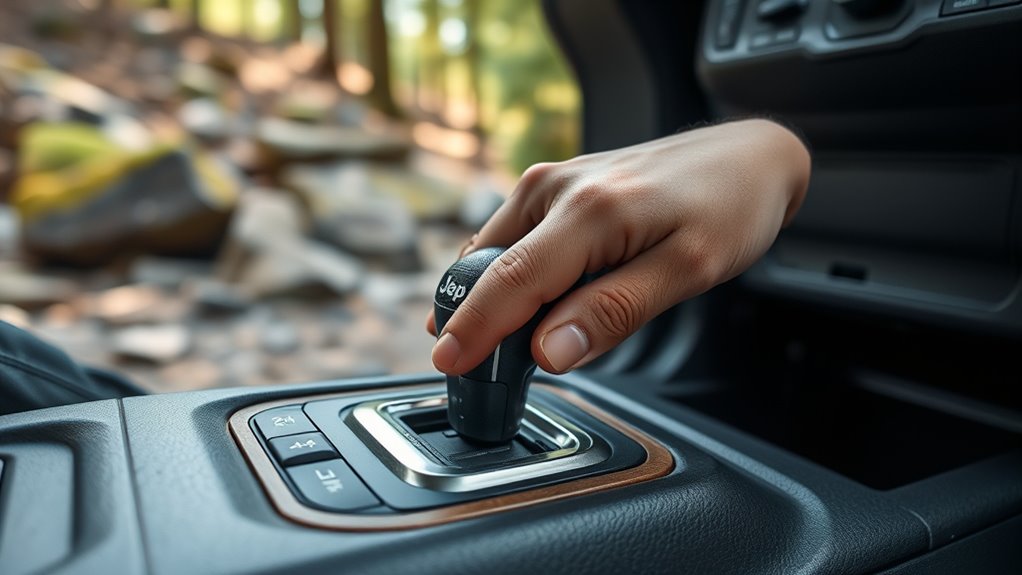
Use 4H when you need extra traction at normal driving speeds on loose gravel, snow, rain, mud, or other slippery surfaces, and keep your speed moderate. Use it before you lose control, especially on roads where quick wheels can break traction.
Shift to 4L only when you need maximum torque at very low speed, such as climbing rocks, pulling through deep mud spinning, or descending a steep grade with precise throttle control. In 4L, you’ll get stronger wheel force but less speed, so don’t use it on dry pavement.
Select 4H for routine low-traction driving; select 4L for slow, demanding obstacles that require controlled power. Match the range to the surface, load, and speed, and you’ll protect drivetrain components while improving traction and control.
Why Your Jeep Won’t Shift Into 4WD
If your Jeep won’t shift into 4WD, the problem is usually one of a few common issues: the vehicle may need to be rolling slightly to complete the shift, the transfer case or linkage may be binding, the system may be low on fluid, or a vacuum, electrical, or actuator fault may be preventing engagement. Inspect these points in order:
If your Jeep won’t shift into 4WD, check speed, fluid, linkage, and actuator issues in order.
- Verify the shifter position and vehicle speed.
- Check transfer case fluid level and condition.
- Inspect linkage for misalignment or corrosion.
- Test vacuum lines, wiring, and actuator function.
- Confirm tire size matches axle settings for proper mud traction.
You should also follow driving etiquette: shift only when conditions warrant, and avoid forcing the lever. If the Jeep still won’t engage, diagnose the transfer case before driving further.
Frequently Asked Questions
Do All Jeep Models Have Part-Time Four-Wheel Drive?
No, you don’t get part-time four-wheel drive in every Jeep. Some models use all-wheel drive instead, which improves fuel economy.
You should check your transfer case and trim, because drivetrains vary by model.
Can I Shift Into 4WD While Driving on the Highway?
Yes, you can shift into 4WD while driving on the highway only if your Jeep’s system allows it. However, you shouldn’t use low range at speed; reserve it for driving in snow, slow terrain, and traction loss.
Does Using 4WD Affect My Jeep’s Fuel Economy?
Yes, 4WD usually lowers your Jeep’s fuel economy like dragging an anchor. You’ll use more fuel because you’re engaging extra drivetrain components, increasing drivetrain noise and mechanical loss.
For better fuel efficiency, shift back to 2WD promptly.
How Often Should I Service My Jeep’s Transfer Case?
You should service your Jeep’s transfer case every 30,000 to 60,000 miles, or per your manual. Don’t trust maintenance myths; check service intervals, inspect fluid condition, and replace contaminated fluid promptly.
Can I Use 4WD on Dry Pavement Without Damage?
No, you shouldn’t use 4WD on dry pavement; it can bind the drivetrain and cause damage. You’ll need it for low-traction surfaces.
Check your off road tires and wheel alignment to reduce stress.
Conclusion
You can shift your Jeep into 4-wheel drive with confidence when you match the mode to the terrain. Use 4H for snow, gravel, or mud, and 4L for slow, demanding conditions like rocks or deep ruts. Move straight, shift smoothly, and wait for the indicator to confirm engagement.
If it won’t shift, check speed, position, and system issues. Like a steady compass in rough country, your Jeep’s drivetrain helps you press on. Knowing how to put a Jeep in 4 wheel drive ensures you’re ready for any adventure.