Are All Jeep Grand Cherokees 4 Wheel Drive
As an Amazon Associate we earn from qualifying purchases.
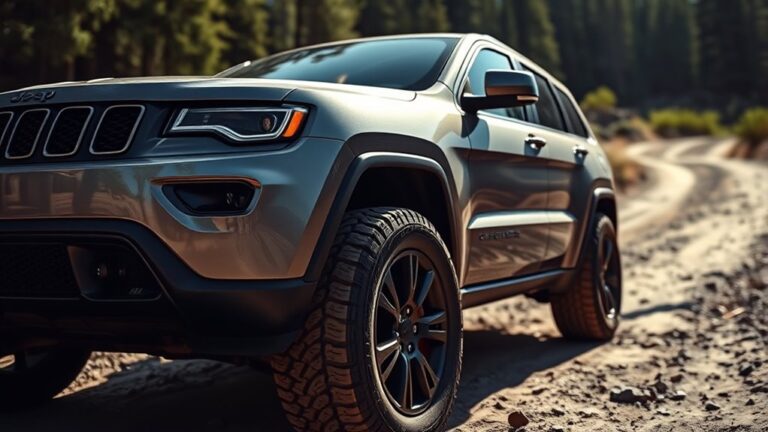
You can picture a Jeep Grand Cherokee rolling off the line with different drivetrain hardware tucked underneath, and that detail changes everything. Not every Jeep Grand Cherokee is 4WD; some models use rear-wheel drive, while others get part-time or full-time 4×4 systems depending on trim, year, and market.
If you want the exact setup, you’ll need to check the sticker, build sheet, or VIN, because the answer isn’t always obvious.
Key Takeaways
- No, not all Jeep Grand Cherokees are 4WD; drivetrain varies by trim, model year, and option package.
- Some trims offer 4WD as optional, while off-road trims like Trailhawk usually include standard 4WD.
- Check the window sticker, build sheet, owner’s manual, or VIN decoder to confirm the exact drivetrain.
- Console drive modes, 4WD lock, or low-range settings can indicate a 4WD system.
- Appearance alone is unreliable, and drivetrain affects traction, fuel economy, maintenance, and resale value.
Are All Jeep Grand Cherokees 4WD?
Not all Jeep Grand Cherokees are 4WD, although many are equipped that way. You should verify the exact drivetrain on the trim and model year, because Jeep has offered different configurations over time.
Some buyers assume every Grand Cherokee uses four-wheel drive, but that’s one of the common non 4wd myths. If you inspect the window sticker, owner’s manual, or build sheet, you can confirm whether your vehicle uses 4WD or another setup.
This matters because drivetrain choice affects traction, maintenance, and fuel economy. You’ll usually see different efficiency ratings depending on system type and hardware.
If you need certainty, check the VIN decoding resources or the label on the vehicle itself rather than relying on appearance alone.
Jeep Grand Cherokee Drivetrain Options
Jeep Grand Cherokee drivetrain options vary by model year and trim, and you’ll typically find either rear-wheel drive, part-time 4WD, or Jeep’s full-time 4×4 systems depending on the configuration. You should check the transfer case, axle gearing, and transmission pairing because they affect traction behavior and service demands.
Rear-wheel-drive versions usually prioritize lower weight and better fuel economy, while 4WD systems add capability and can reduce efficiency. If you compare setups, look at drivetrain reliability, since maintenance intervals, fluid changes, and electronic controls can differ.
You’ll also notice that some systems engage automatically, while others require driver input. That distinction matters when you assess road use, snow performance, and off-road capability.
Which Grand Cherokee Trims Have 4WD?
You’ll find that 4WD availability on the Grand Cherokee depends on trim, since some base models come with it while others may use rear-wheel drive. Trailhawk and Limited trims typically offer more advanced 4WD systems, designed for better traction and off-road control.
Check the drivetrain listed for each trim, because Jeep can pair different transfer cases and axle setups with the same nameplate.
Base Trim 4WD Availability
On the Grand Cherokee, 4WD isn’t exclusive to higher trims. Several base and mid-level configurations can include it, depending on model year and package selection. You’ll often see this option on entry trims, where Jeep pairs the system with a standard engine and a modest equipment list.
That setup lets you add traction without unnecessary redundancy in features you may not need. When you choose 4WD on a base model, you’re usually balancing capability against cost and fuel economy, so performance tradeoffs matter. You should verify the window sticker or build sheet, because trim names alone don’t guarantee drivetrain hardware.
In some years, 4WD is bundled with convenience packages, while in others it’s a separate factory option.
Trailhawk And Limited Systems
Trailhawk and Limited trims are two of the clearest examples of how Grand Cherokee 4WD availability varies by configuration. You’ll usually get standard 4WD on the Trailhawk, because Jeep tunes it for off road capability with upgraded traction hardware, drive modes, and extra ground clearance. The Limited often offers 4WD as an option, so you need to verify the drivetrain on the window sticker or VIN build sheet.
- Trailhawk: standard 4WD, lower-range-oriented tuning
- Limited: available 4WD, often paired with comfort features
- Check axle ratios and transfer case type for real-world performance
If you prioritize snow, trail use, or towing, 4WD matters more than trim badges. If you want better fuel efficiency, a 2WD Limited can be the more efficient choice.
How to Tell If Your Grand Cherokee Has 4WD
You can check the drive mode selector to see whether your Grand Cherokee offers settings for 4WD or terrain-specific traction control. You should also inspect the exterior and interior badges, since a 4WD label or system designation can identify the drivetrain.
Together, these checks give you a quick, reliable way to confirm whether your vehicle has 4WD.
Check the Drive Modes
One of the quickest ways to confirm 4WD is to check the drive-mode selector in your Grand Cherokee. If you see options such as Auto, Snow, Sand, Mud, or Rock, you likely have a 4WD system with selectable terrain settings.
You should verify the labels on the console or rotary dial, because trim and model year can change the exact layout. This check isn’t affected by an unrelated topic or a random product pairing; it’s a direct indicator of drivetrain hardware.
Look for terrain-specific modes beyond Normal. Compare the selector with your owner’s manual. Confirm whether the vehicle offers a 4WD lock or low-range setting.
If the selector only shows standard road settings, your Grand Cherokee may be a 2WD model or a different drivetrain configuration.
Inspect the 4WD Badge
Check the 4WD badge on the tailgate, liftgate, or front fenders, since Jeep often labels 4WD-equipped Grand Cherokees with badges such as “4×4,” “4WD,” or a trim-specific emblem. You can verify the badge location against the trim sheet and compare it with the VIN. An absent badge doesn’t always mean 2WD, but it’s a useful clue.
| Badge text | Likely meaning | Check next |
|---|---|---|
| 4×4 | 4WD present | Inspect axle and transfer case |
| 4WD | 4WD present | Confirm by VIN |
| Trailhawk emblem | Off-road 4WD trim | Review build sheet |
| No badge | Not conclusive | Search drivetrain tags |
| Dealer sticker | May list drivetrain | Cross-check documentation |
Don’t confuse an irrelevant topic or unrelated concept with drivetrain identification.
Rear-Wheel Drive vs. 4WD on the Grand Cherokee
Jeep has offered the Grand Cherokee with different driveline layouts over the years, so rear-wheel drive and 4WD aren’t interchangeable on every model. You can’t assume every trim uses the same drive train, and a rear wheel setup typically sends power only to the back axle. That changes how the SUV behaves on pavement, in rain, and during acceleration.
Jeep Grand Cherokee drivetrains vary by year and trim, so rear-wheel and 4WD models aren’t always interchangeable.
- Check the window sticker for the listed drivetrain
- Verify the transfer case or axle setup
- Match the model year to factory specs
If you’re comparing used examples, look for the badge, VIN details, and seller documentation. A 4WD Grand Cherokee adds traction capability, but a rear-wheel drive version can still meet daily driving needs when you understand its limits.
Jeep Grand Cherokee 4WD Systems
Grand Cherokee 4WD systems vary by model year and trim, so you’ll want to identify the exact setup before assuming how the SUV sends power to the wheels. You may find part-time systems that driver-select between rear-biased and locked modes, or full-time setups that manage torque automatically through a transfer case and electronic controls.
Some trims use low range for slower, off-road traction, while others prioritize on-road smoothness with variable torque distribution. You should check the transfer-case code, axle ratio, and any limited-slip or electronic differential features, because they affect drivetrain complexity.
These components also influence maintenance costs, since fluid changes, actuator service, and diagnostic work can differ. In practice, the system’s design determines how consistently it delivers traction across changing surfaces.
Is 4WD Worth It on a Grand Cherokee?
Whether 4WD is worth it on a Grand Cherokee depends on how and where you drive, since the system’s value changes with terrain, weather, and towing demands. If you face snow, mud, steep grades, or regular trail use, you’ll likely benefit from the added traction and stability. For highway commuting in mild climates, you may not notice much advantage beyond extra complexity and cost.
- Compare fuel economy, maintenance, and purchase price.
- Match drivetrain choice to off road setups and towing needs.
- Use these discussion ideas to evaluate resale value and winter safety.
A well-equipped 4WD model can improve control, but you should weigh that against weight, tire wear, and transfer case service.
Frequently Asked Questions
Can I Add 4WD to a Grand Cherokee Later?
Yes, you can sometimes add 4WD later, but retrofit feasibility is usually poor. You’d need drivetrain, transfer case, axles, electronics, and controls.
Check add on options, because costs often exceed buying a 4WD Grand Cherokee.
Does 4WD Affect Grand Cherokee Fuel Economy?
Yes, 4WD usually lowers your Grand Cherokee’s fuel economy, like extra armor slowing a runner. You’ll see more drivetrain drag and weight.
Ignore 4WD myths; in real tests, fuel economy drops modestly, not dramatically.
Is 4WD Better for Towing With a Grand Cherokee?
Yes, 4WD usually improves towing with your Grand Cherokee by adding traction and stability, especially on slippery launches or hills.
Still, you’ll need to mind towing considerations, payload, brakes, and off road capabilities.
What Is the Difference Between 4WD and AWD?
You’ll find 4WD lets you select extra traction for off road capabilities, while AWD automatically sends power where needed.
In drivetrain terminology, 4WD suits tougher conditions; AWD works best for everyday driving and variable weather.
How Much Does a 4WD Grand Cherokee Cost to Maintain?
Maintenance typically runs $600 to $1,200 yearly, depending on mileage and repairs. You’ll face lower fuel economy than AWD models, but 4WD vs AWD differences mainly affect drivetrain service, not routine maintenance costs.
Conclusion
So, no, not every Jeep Grand Cherokee comes with 4WD. You need to check the trim, model year, and build details, because drivetrain choices vary from rear-wheel drive to part-time and full-time 4×4 systems.
If you want certainty, verify the window sticker, build sheet, or VIN decode. In this case, the badge isn’t the whole story—it’s just the tip of the iceberg.
Confirm the equipment, and you’ll know exactly what you’re getting. When it comes to Jeep Grand Cherokees, understanding the specific drivetrain options is key to knowing whether your vehicle has 4WD.