Where Is f150 Made
As an Amazon Associate we earn from qualifying purchases.
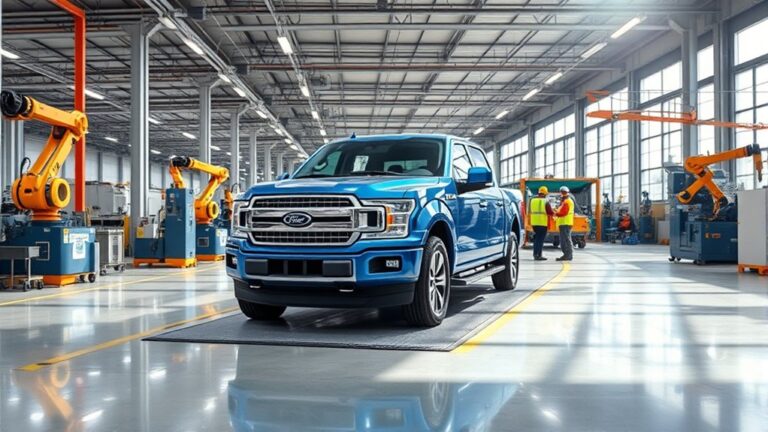
You probably don’t know that your F-150 is made at more than one final assembly site, even within the same model year. Ford mainly builds the F-150 in Dearborn, Michigan, and Claycomo, Missouri. However, parts can come from a wider North American supplier network.
Trim, drivetrain, and model year can change the build path. If you want to verify where your F-150 was made, the VIN and door label tell a more exact story.
Key Takeaways
- The Ford F-150 is primarily made in the United States and Canada, depending on model year and configuration.
- Major U.S. assembly plants include Dearborn Truck Plant in Michigan and Kansas City Assembly in Missouri.
- Dearborn Truck Plant handles high-volume F-150 production and supports Ford’s U.S. truck supply base.
- Kansas City Assembly in Claycomo, Missouri, produces F-150s for domestic demand and some export markets.
- Check the VIN and door-jamb label to identify the exact assembly plant for a specific F-150.
Where Is the Ford F-150 Made?
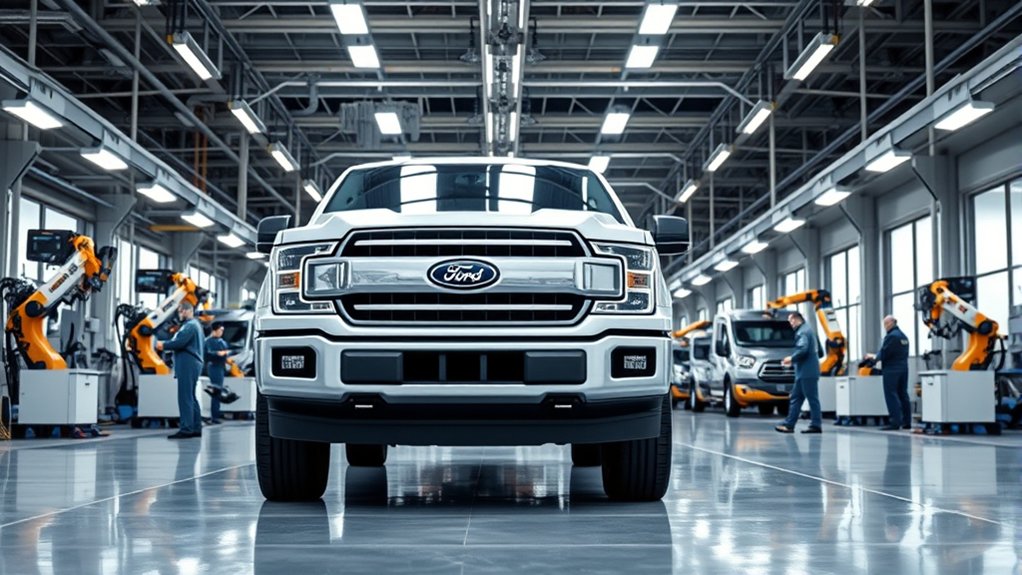
The Ford F-150 is primarily manufactured in the United States and Canada, with final assembly taking place at multiple Ford plants depending on the model year and configuration. You can trace its location origins to a North American production network built around integrated stamping, body, paint, and assembly operations.
Ford manages plant logistics to match trims, drivetrains, and cab styles with specific facilities, reducing transport complexity and supporting throughput. You’ll find that sourcing also spans regional suppliers for frames, powertrains, and electronics, which helps standardize quality control.
Because production shifts by model year, your best reference is the VIN label and current factory data. That approach gives you the most accurate view of where a given F-150 was built and assembled.
Which U.S. Plants Build the F-150?
You’ll find the F-150 assembled in two main U.S. plants: Dearborn Truck Plant in Michigan and Kansas City Assembly in Missouri. Dearborn handles high-volume F-150 production, while Kansas City also builds the truck to meet national demand.
Together, these facilities form the core domestic assembly network for the model.
Dearborn Truck Plant
Ford’s Dearborn Truck Plant in Michigan is one of the primary U.S. facilities that assembles the F-150, and it has long been tied to high-volume production of the nameplate. You’ll see a facility optimized for body shop throughput, final assembly coordination, and quality checks.
For your research, note these key points:
- Output supports Ford’s U.S. F-150 supply base.
- Subtopic idea 1 highlights plant-level production capacity.
- Subtopic idea 2 emphasizes manufacturing consistency and traceability.
You can use Dearborn’s role to compare U.S. assembly sources without assuming every trim is built there. The plant’s importance lies in its measurable contribution to F-150 availability, manufacturing efficiency, and domestic sourcing strategy.
Kansas City Assembly
Kansas City Assembly in Claycomo, Missouri, is another major U.S. source of F-150 production, giving Ford a second high-volume truck assembly site alongside Dearborn. You can view it as a critical node in Ford’s pickup network, with body, paint, and final assembly operations designed for sustained throughput.
The plant draws on regional suppliers for stamped parts, powertrain components, and interiors, which helps shorten logistics cycles and stabilize inventory flow. You’ll also see Kansas City support export markets, since Ford can allocate output to domestic demand and selected overseas buyers from the same production base.
This flexibility improves capacity utilization and lets Ford balance model mix, trim levels, and equipment content while keeping U.S. assembly volumes high and geographically diversified.
How Does the F-150 Assembly Line Work?
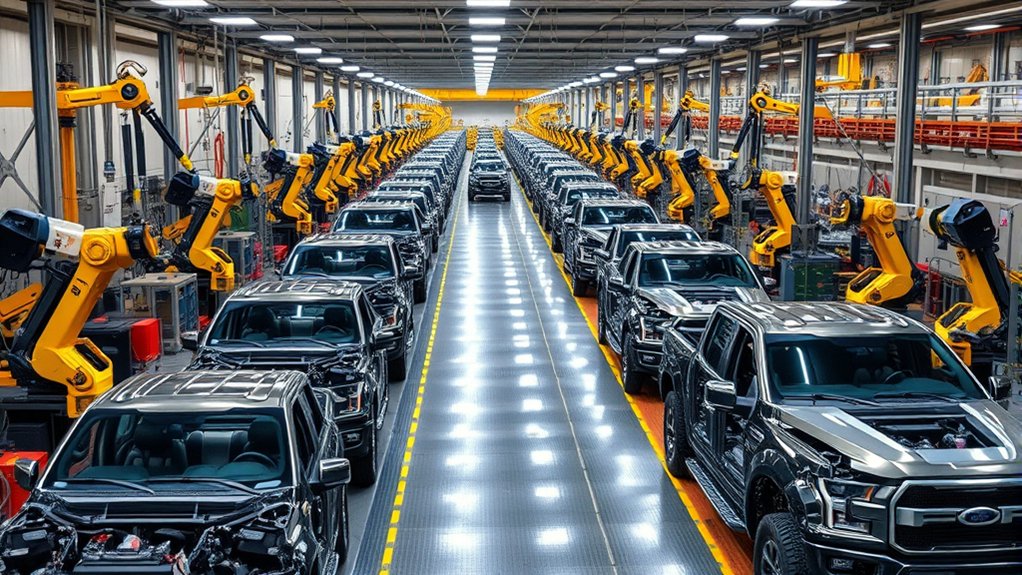
You can track the F-150 assembly line as a sequence of staged operations, starting with frame build and body installation, then moving through powertrain, interior, and final trim.
Each station uses timed tasks and automated systems to keep throughput consistent while limiting variation between units.
Quality checks run throughout the line, with inspections and tests verifying fit, function, and compliance before the truck leaves the plant.
Assembly Stages
The F-150 assembly line moves through a tightly sequenced set of stages, starting with the cab, frame, and powertrain modules and ending with final trim, paint, and quality checks. You can track each station using manufacturing terminology, because takt time, line balance, and in-station handling define throughput.
The supply chain feeds parts to each point in the sequence, so components arrive just in time for assembly.
- Frame marriage joins the cab and chassis.
- Powertrain installation secures engine, transmission, and driveline modules.
- Trim, paint, and fluid fill complete the vehicle.
You’ll see automated carriers, torque-controlled tools, and barcode verification supporting each handoff. Each stage reduces rework, limits inventory, and keeps production moving at a measured pace.
Quality Checks
After final assembly, inspectors and automated systems verify fit, finish, and function at multiple checkpoints before the F-150 leaves the line. You can see quality checks built into the process at every build location, from panel-gap measurements to torque verification and electronic diagnostics.
Cameras and sensors compare each truck against digital specifications, while operators review paint coverage, trim alignment, and fastener integrity. If a measurement falls outside tolerance, the line flags the unit for rework rather than release.
You also get functional tests for lights, brakes, steering, and infotainment to confirm system performance. These checks reduce variation across plants and help ensure each F-150 meets the same engineering standard, regardless of build location or trim level.
Where Do F-150 Parts Come From?
F-150 parts come from a global supply chain, with Ford sourcing components from suppliers across North America and other regions to support assembly in multiple plants. You can trace F-150 sourcing through stamped steel, powertrain modules, electronics, glass, and trim, each with a distinct parts origin.
Ford qualifies suppliers to meet dimensional, material, and logistics targets, then ships parts in sequence to assembly lines.
- Engine and transmission modules
- Body panels, frames, and closures
- Wiring harnesses, interiors, and infotainment
You’ll see domestic and imported content mixed by subsystem, not by vehicle. This sourcing model lets Ford balance cost, capacity, and technical specifications while maintaining consistent build inputs across plant schedules and trim levels.
Why Is the F-150 Built in the U.S.?
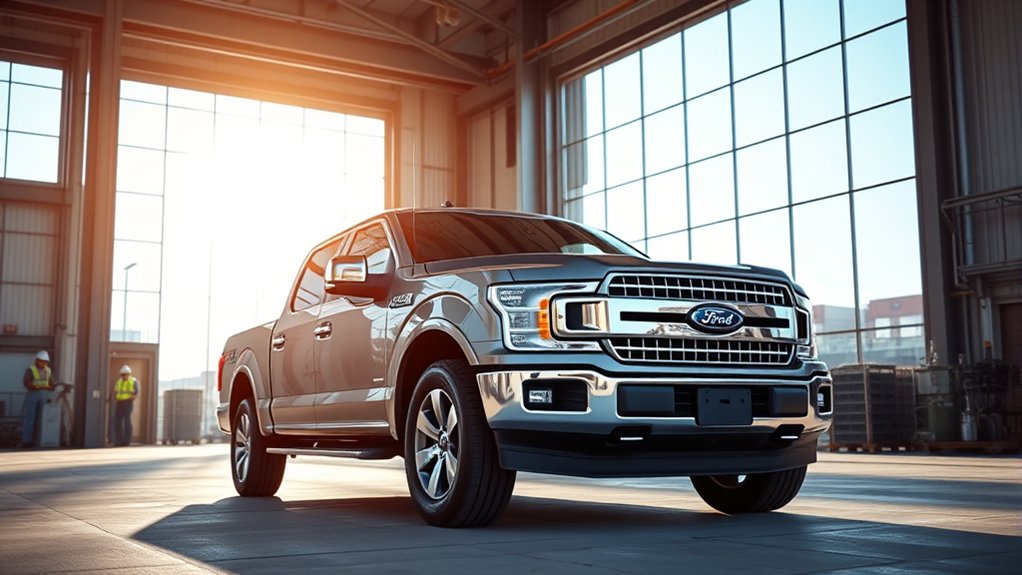
Even though Ford sources parts globally, it builds the F-150 in the U.S. because the truck’s high-volume, labor-intensive assembly benefits from established domestic plants, supplier networks, and logistics tied to North American production.
Ford builds the F-150 in the U.S. because scale, suppliers, and logistics make domestic production more efficient.
You also get lower coordination risk when stamping, body, paint, and final assembly sit near major suppliers. That proximity reduces transport time, inventory exposure, and tariff uncertainty.
U.S. production supports compliance with domestic content rules, quality control, and labor oversight, while limiting innovation constraints from fragmented cross-border engineering workflows.
Ford can also audit suppliers more directly, which strengthens supply chain ethics through traceability, wage monitoring, and environmental checks.
For a vehicle with tight profit margins and massive throughput, U.S. manufacturing delivers measurable operational efficiency and policy alignment.
How Has F-150 Production Changed Over Time?
Over time, F-150 production has shifted from a more dispersed manufacturing footprint to a highly optimized U.S.-centered system. You can trace that exploration history through production shifts that reallocated assembly, stamping, and powertrain capacity to high-volume facilities.
Today, Ford concentrates output to improve throughput, standardize quality metrics, and streamline logistics.
- Early production used a broader North American network.
- Later shifts increased U.S. plant specialization and scale.
- Current operations emphasize repeatable processes and capacity utilization.
You’ll see the result in tighter sequencing, lower interplant complexity, and more consistent build data. These production shifts reflect long-term industrial planning rather than short-term change, and they’ve made the F-150 line more efficient, measurable, and stable across model cycles.
Why Does F-150 Build Location Matter?
Where the F-150 is built matters because plant location affects logistics, parts sourcing, labor availability, shipping time, and final vehicle cost. You can see the F-150 origin in how assembly proximity shapes supply-chain efficiency and quality control.
A shorter transport route usually cuts handling steps and reduces exposure to delay. Local labor markets also influence throughput, shift coverage, and production stability. If a plant sits near supplier clusters, you get faster component replenishment and lower inbound freight costs.
Manufacturing provenance matters too because it helps you compare regional production strategies, regulatory environments, and cost structures. In technical terms, build location is a measurable input to lead time, unit economics, and operational risk, not just a label on a vehicle.
How Can You Check Your F-150’s Build Location?
You can verify your F-150’s build location by checking the Vehicle Identification Number, the door-jamb certification label, or the Monroney window sticker, each of which can identify the assembly plant and country of origin. Decode the VIN’s plant code, then match it to Ford’s published manufacturing data. The label also lists the final assembly site and certification details. The window sticker may confirm where the truck was built.
- VIN: Use the plant identifier for a fast origin check.
- Door label: Read the compliance data and assembly location.
- Window sticker: Cross-reference the build site with option data.
These records reflect production scheduling and supplier logistics, so they provide reliable, objective evidence. If two documents disagree, use the VIN and label first.
Are All F-150 Trims Built the Same Way?
No, F-150 trims aren’t built identically, because each one can include trim-specific parts, materials, and option packages. You’ll still see a shared assembly process for the core truck structure, powertrain installation, and final quality checks.
The main differences show up in feature content, not in the basic manufacturing flow.
Trim-Specific Features
Not all F-150 trims are built identically, even though they share the same core manufacturing network. You’ll see trim-specific hardware, software, and content changes that alter performance metrics and user-facing capability. Higher trims can add advanced towing aids, upgraded infotainment, and materials that affect weight, fuel efficiency, and payload calibration.
Electric options introduce different powertrain packaging, battery systems, and thermal management requirements, so you shouldn’t assume every variant follows the same spec set.
- Engine and drivetrain selections vary by trim.
- Interior electronics and driver-assist suites scale with trim.
- Wheel, suspension, and lighting packages change output and efficiency.
These differences make each trim technically distinct, even when Ford uses common platform standards.
Shared Assembly Process
Ford uses a largely shared assembly process for the F-150, but that doesn’t mean every trim leaves the line in exactly the same configuration. You’ll see common body, chassis, and final-assembly stages, then trim-level variation appears through tooling, software, and component installation.
Higher trims add different seats, infotainment modules, driveline parts, and exterior packages, while fleet models often follow simpler bill-of-materials rules. The supply chain also changes by trim, since sourcing origins for electronics, upholstery, and performance hardware can differ by plant schedule and supplier availability.
You’re still getting the same core production architecture, but Ford calibrates each build order to match the VIN’s specified content. That’s why shared assembly increases efficiency without making all F-150s identical.
What Should F-150 Buyers Know About Origin?
When you check an F-150’s origin, you’re really looking at more than a plant location: assembly site, parts sourcing, and final inspection can all affect build consistency, feature availability, and delivery timing. You should verify the VIN sticker, because it identifies the final assembly plant and model-year build data.
- Origin can shift with trim, cab, and drivetrain.
- Further manufacturing may occur through the global supply chain.
- Country of final assembly doesn’t always match parts origin.
You’ll get the most accurate picture by checking Ford’s build records, dealer paperwork, and compliance labels. That data shows where major systems were assembled and whether specific components were sourced domestically or internationally. Knowing this helps you compare configurations, anticipate lead times, and assess regional production differences without relying on assumptions.
Frequently Asked Questions
Does the F-150 Come From the Same Factory Every Year?
No, you shouldn’t assume the F-150 comes from the same factory every year. Ford may shift factory sourcing and production location based on capacity, trims, and model-year changes, so you need to verify each VIN.
Are F-150 Engines Made in the Same Location?
Not always; you’ll find F-150 engine sourcing spread across multiple plants and manufacturing partnerships, depending on model year and engine type.
You can verify the exact location by checking Ford’s build data and supplier records.
Can I Choose Where My F-150 Is Assembled?
You can’t choose the assembly plant; Ford assigns it through factory scheduling, option mix, and supplier diversity constraints.
You can influence trim, cab, and drivetrain, but not the exact factory producing your F-150.
Does Build Location Affect F-150 Resale Value?
No, your F-150’s birthplace is usually a shadow, not a lever, on resale value. You’ll see minor resale value impact from manufacturing location, regional assembly, factory sources, engine sourcing, build time, and factory shifts.
How Long Does It Take to Build an F-150?
You’re usually looking at about 8 to 12 weeks from order to delivery, though location timing and factory variability can shift that.
Assembly itself takes hours, but scheduling, parts, and shipping drive the total.
Conclusion
So, where is your F-150 made? Mostly in the U.S., at Ford’s Dearborn Truck Plant in Michigan and Kansas City Assembly in Missouri. That matters because final assembly affects provenance, sourcing, and resale transparency.
Ford has built the F-150 for decades, and it remains one of the best-selling trucks in America. You can verify your truck’s origin on the VIN label, door jamb sticker, or Monroney label, depending on model year and trim.
In conclusion, knowing where your F-150 is made helps ensure you understand its quality and history, making “where is F-150 made” an important consideration for buyers.


