What Gas Ford f150
As an Amazon Associate we earn from qualifying purchases.
If you’re wondering what gas your Ford F-150 takes, the answer is usually regular unleaded 87 octane, but it depends on the engine and trim.
Some EcoBoost and high-output models can have different requirements, and certain setups may support E85.
You should always check the fuel door label and owner’s manual before filling up, because the wrong fuel can affect performance and reliability.
Using the correct gas ensures your truck runs smoothly and maintains its efficiency over time.
Key Takeaways
- Most Ford F-150 gas models use regular unleaded gasoline, typically 87 octane.
- Check the fuel door label and owner’s manual for your exact engine’s fuel requirement.
- Some high-output or special trims may need premium fuel for best performance.
- Premium fuel usually does not improve power or economy unless Ford specifically recommends it.
- Never use diesel or incorrect ethanol blends in a gasoline F-150.
What Gas Does a Ford F-150 Use?
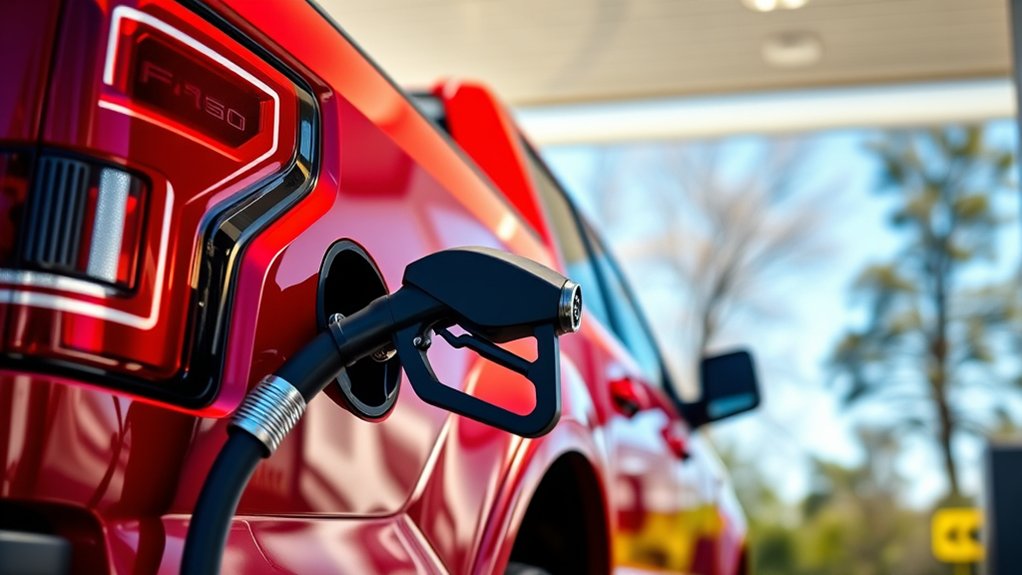
Most Ford F-150 models run on regular unleaded gasoline with an 87 octane rating, though some trims and engine options may recommend premium fuel for optimal performance. You should always check the fuel door label and your owner’s manual before filling up.
Using the correct octane helps your fuel system deliver consistent combustion and protects engine maintenance schedules from avoidable stress. If you choose a higher octane than required, you usually won’t gain extra efficiency unless the engine is calibrated for it.
Never use diesel or fuel with improper ethanol content. When you refuel, avoid overfilling, and keep the cap tight to limit evaporative losses. Following the manufacturer’s guidance helps your F-150 run efficiently, maintain power, and reduce long-term wear.
F-150 Fuel Requirements by Engine
Different F-150 engines can call for different fuel grades, so you should match octane to the specific powertrain under the hood. Your owner’s manual sets the baseline, but the engine’s design, compression, and calibration drive the requirement.
Fuel quality also depends on gas composition, which can affect combustion stability and deposit control. Protect fuel system health by using clean fuel from reputable stations and replacing a contaminated supply quickly.
| Engine | Fuel Need |
|---|---|
| 3.3L V6 | Regular |
| 2.7L EcoBoost | Regular |
| 5.0L V8 | Regular |
| 3.5L EcoBoost | Regular |
| High-output variants | Check manual |
If you track towing loads, temperature, and service history, you’ll keep performance consistent and avoid unnecessary wear.
When to Use Regular vs Premium Fuel
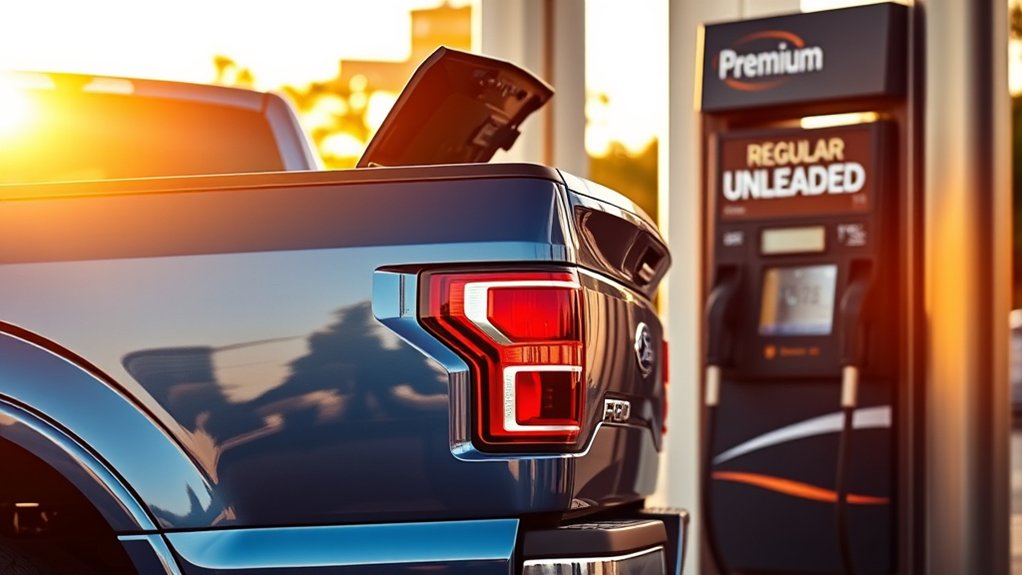
Regular fuel works for most F-150 trims because Ford calibrates those engines to run safely on 87 octane, but you should use premium only when the owner’s manual or under-hood label specifically calls for it. Premium won’t add power unless the engine management system is tuned to exploit higher knock resistance, so don’t pay extra for no benefit.
You’ll often hear fuel myths that premium cleans injectors or improves towing in every truck; those claims aren’t generally true. Check your engine code, octane rating, and warranty notes before filling up. For two word discussion ideas, think “octane choice” and “engine calibration.”
If you notice knock, rough running, or a detonation warning, verify fuel quality and consult your dealer rather than guessing.
Can You Use E85 in an F-150?
You can use E85 in an F-150 only if your truck is flex-fuel compatible, so check the fuel door, owner’s manual, or VIN details first. If your F-150 is approved for E85, the higher ethanol content can change fuel-system behavior but won’t harm the engine when used as specified.
You should also expect lower fuel economy with E85 because ethanol contains less energy per gallon than regular gasoline.
E85 Compatibility Check
Before you fill an F-150 with E85, check the fuel door, owner’s manual, or under-hood emissions label for a flex-fuel designation. If you see Flex Fuel, your fuel system is calibrated to handle ethanol blends up to E85. If you don’t, stick with gasoline the truck specifies.
E85 has different octane ratings than regular fuel, but octane alone doesn’t make it safe for every engine. You should verify the VIN build data or consult a dealer if the label is missing. Also inspect the capless filler area and factory stickers for ethanol warnings.
Use only the blend Ford approves for your exact model year and engine. That quick check protects injectors, seals, and pump components from compatibility issues.
Fuel Economy Impact
E85 can lower your F-150’s fuel economy because ethanol contains less energy per gallon than gasoline. You’ll usually see fewer miles per tank, even when your engine performance stays smooth. If your truck is flex-fuel, the ECU can adjust timing and fueling for E85, but it can’t fully offset the energy loss.
- Expect about 15% to 30% lower fuel economy, depending on driving conditions.
- Watch cold starts; ethanol can reduce efficiency more in low temperatures.
- Compare fuel prices and range, not just octane, before choosing E85.
Use E85 when lower pump price outweighs extra consumption. For towing, long trips, or maximum range, regular gasoline often makes more sense.
Which F-150 Trims Need Premium Gas?
Not every F-150 trim needs premium fuel, but certain higher-output engines do. If you’re driving a trim with the 3.5L EcoBoost High Output or other performance-tuned calibration, premium gasoline can help you achieve the rated power and knock protection.
Most base and midlevel trims run on regular unleaded without issue, so don’t treat premium as a blanket requirement. That would be an unrelated topic from a random pairing of fuel grade and trim naming.
The key is engine tuning, not badge level. When you step up to specialized packages, expect the fuel recommendation to change with the powertrain. Using premium where Ford specifies it helps the engine maintain timing, boost, and efficiency under load.
Check the Fuel Door and Owner’s Manual
Check the fuel door sticker and your owner’s manual to see the exact octane Ford specifies for your F-150. The Fuel door label gives the quickest factory-approved answer, while the Owner’s manual lists fuel requirements by engine and model year.
Read both before you buy gas, because trim and calibration can change the recommendation. If the two sources differ, follow the manual and verify the VIN-specific guidance in the truck’s documentation.
- Open the Fuel door and note the posted octane.
- Match that number with the Owner’s manual section on fuel.
- Use the higher-spec instruction only when Ford clearly requires it.
This simple check helps you avoid guesswork and keeps your fueling choice aligned with factory specifications for your truck.
How Fuel Type Affects Performance
Once you’ve confirmed the recommended octane, it helps to know what that choice does to your F-150’s behavior on the road. You’ll usually get the best balance of power, efficiency, and durability when you run the fuel grade Ford calibrated for your engine.
Higher-octane fuel can help turbocharged or high-compression engines resist knock, so the powertrain control module can maintain optimal timing and boost. Lower-than-specified fuel may trigger timing retard, reducing throttle response and towing performance.
Your fuel system also relies on stable combustion to keep injectors, pumps, and sensors operating within design limits. Matching the stated octane helps the truck meet emissions standards and preserves the performance you expect under load, in traffic, and during cold starts.
Common Fueling Mistakes to Avoid
You should use the octane Ford recommends, because a wrong octane choice can affect knock control and efficiency.
At the pump, make sure you’re selecting the correct fuel grade and nozzle, since misfueling can damage the fuel system.
You should also check that the fuel cap fits and seals properly, because a loose cap can trigger evap faults and fuel vapor loss.
Wrong Octane Choice
Using the wrong octane rating can hurt your Ford F-150’s performance and, in some cases, its engine. You should match the octane Ford specifies in the owner’s manual, because lower-grade fuel can cause knock, reduce timing, and trim power. Higher octane won’t add fuel diversification benefits or extra efficiency unless your engine requires it.
- Use the recommended grade for your trim and engine.
- Check for pinging, hesitation, or reduced throttle response.
- Stay consistent; frequent wrong octane choices can skew fuel economy and stress combustion components.
If you tow, haul, or drive in hot weather, correct octane matters even more. It helps the powertrain manage load and heat while preserving performance.
Misfueling At The Pump
Wrong fuel choice at the pump can cause immediate driveability problems and, in some cases, expensive repairs. You should always verify the nozzle and label before you begin. For a Ford F-150, use the fuel grade listed on the fuel door, and don’t rely on misfueling myths that premium always improves power or economy.
If you drive a flex-fuel model, make sure the blend matches your engine’s approval. Stop fueling if the pump seems inconsistent with your order.
Use pump etiquette: stay focused, avoid distractions, and double-check the dispenser selection before squeezing the handle. If you realize you’ve chosen the wrong fuel, don’t start the engine. Call for help and follow service guidance.
Quick verification at the pump prevents contamination, poor combustion, and unnecessary downtime.
Ignoring Fuel Cap Fit
A loose or mismatched fuel cap can trigger evaporative emissions faults, reduce fuel-system sealing, and invite check-engine warnings. You should always confirm the cap clicks fully after refueling, because even a slight leak can disrupt pressure management and waste vapor control. This is basic fueling etiquette and a key part of gas station safety.
- Inspect the cap seal for cracks, flattening, or contamination before you replace it.
- Tighten until you hear the ratchet clicks; don’t overtighten and damage the threads.
- If the warning light stays on, verify cap fit, then scan for EVAP codes.
Ignoring fit can mimic larger engine issues, but the fix is usually simple. Clean the neck, reseat the cap, and check again after a short drive.
Choosing the Best Fuel for Your F-150
Choosing the right fuel for your F-150 starts with the engine under the hood, since Ford calibrates fuel requirements by engine type and tuning. You should check the fuel door label and owner’s manual, then match octane to the engine’s minimum rating.
Most V6 and V8 gas engines run best on regular unleaded, while EcoBoost models may benefit from midgrade under load or in hot climates. Don’t assume premium adds power unless Ford specifies it.
If you’re researching electric conversions, fuel choice stops mattering, but battery and inverter sizing do. For diesel compatibility, only use fuel in a diesel-rated F-150; gas engines can’t tolerate diesel contamination.
Always buy fresh fuel from a high-turnover station, and avoid ethanol blends beyond Ford’s approved limit.
Frequently Asked Questions
How Often Should I Replace the Fuel Filter on My F-150?
You should replace your F-150’s fuel filter about every 30,000 to 40,000 miles, but check your owner’s maintenance schedule.
Your fuel system may need earlier service if you drive in dusty conditions.
Does Towing Require a Different Fuel Choice for My F-150?
No, towing doesn’t require a different fuel choice for your F-150, but you should follow towing considerations and fuel efficiency needs. Use the gasoline rankings your owner’s manual recommends for best performance, detonation control, and load handling.
Will Cold Weather Affect My F-150’s Fuel Economy?
Yes, cold weather can reduce your F-150’s fuel economy. You’ll see richer warm-up fueling, longer idle times, and denser air increasing drag.
Keep tires inflated, minimize idling, and drive smoothly to help.
Can Fuel Additives Help My F-150 Run Better?
Yes, fuel additives can help your F-150 run smoother, but they’re no magic wand. You’ll mostly benefit from cleaner injectors and better combustion when you use the right fuel additives and correct gas octane.
How Do I Reset the Fuel Gauge After Filling Up?
You can’t manually reset the gauge on most F-150s; it updates after the fuel sending unit reports the new level. Turn the ignition on, drive a few miles, and the cluster should recalibrate automatically.
Conclusion
So, what gas does your Ford F-150 use? Most F-150s run best on regular unleaded 87 octane, and that’s what Ford recommends for many engines, including the 3.3L, 2.7L EcoBoost, 5.0L V8, and 3.5L EcoBoost.
Check your fuel door and owner’s manual before you fill up. I once saw a driver lose time by using the wrong fuel spec—like putting winter tires on a race car, it slows everything down.
To keep your truck running smoothly and efficiently, always use the right gas for your Ford F-150.


