What Does Eco Mode Do on f150
As an Amazon Associate we earn from qualifying purchases.
If you use Eco Mode on your F-150, you’ll notice the truck softens throttle response, shifts earlier, and holds gears longer to keep RPMs low. Eco Mode can also trim climate-system output to reduce load on the engine.
The result is smoother, calmer driving with better fuel efficiency, but not more power. The real difference shows up in steady cruising and light throttle, where small changes can make a bigger impact than you might expect.
Key Takeaways
- Eco Mode on an F-150 softens throttle response for smoother, less aggressive acceleration.
- It shifts the transmission earlier and holds higher gears longer to improve fuel economy.
- Engine speed stays lower during cruising, reducing wasted fuel and noise.
- Climate control may reduce fan or compressor output to save energy.
- Eco Mode improves efficiency, but heavy throttle still gives normal power when needed.
What Eco Mode Does on an F-150
Eco Mode on an F-150 adjusts throttle response, transmission shift points, and sometimes climate control behavior to reduce fuel use. You’ll notice the truck feels calmer in daily driving because the system prioritizes efficiency over quick response.
It can help you improve fuel economy during commuting, light hauling, and steady highway travel. If your F-150 has an eco chip or a similar tuning module, it may further refine how the engine management targets efficiency, though results vary by calibration.
Eco Mode doesn’t add power; it modifies control logic to limit waste. You’ll still get normal drivability, but the truck may favor smoother operation and lower engine load. Use it when you want to stretch each gallon and keep operating costs down.
How Eco Mode Changes Throttle and Shifting
When you select Eco Mode, the truck softens throttle response so pedal input translates into less immediate acceleration, which helps prevent fuel from being burned unnecessarily. This eco throttle mapping makes your foot command less aggressive, so you can meter power more precisely in city traffic or steady cruising.
The transmission also favors earlier upshifts and holds higher gears longer, which keeps engine speed lower for mpg optimization.
| Input | Eco result | Benefit |
|---|---|---|
| Light pedal | Gentle response | Smoother launch |
| Moderate pedal | Delayed downshift | Lower rpm |
| Steady cruise | Higher gear hold | Better mpg |
You’ll notice the powertrain feels calmer, but it still responds when you press harder. That balance cuts waste without removing normal drivability, especially on flat roads and in stop-and-go driving.
What Else Eco Mode Changes
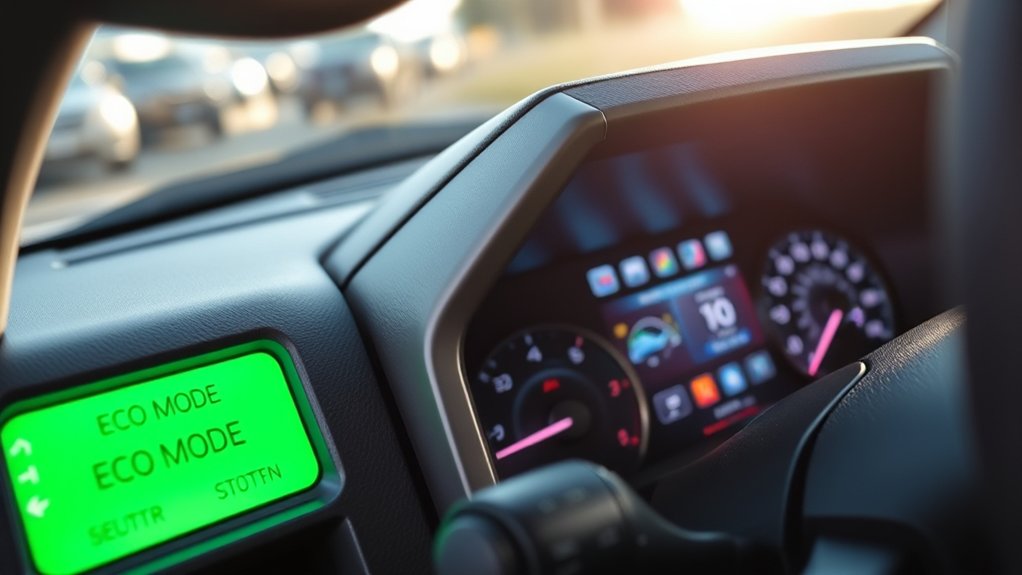
Eco Mode doesn’t just soften throttle response; it also adjusts how your F-150’s transmission chooses shift points to keep the engine in a more efficient range. You’ll often notice longer, earlier upshifts and less aggressive downshifting during normal driving.
In some trims, it can also limit climate control output to reduce accessory load and help save fuel.
Throttle Response Tuning
Throttle response tuning is one of the biggest changes Eco Mode makes on an F-150, and it does more than just reduce fuel use. You’ll notice the pedal feels less sensitive because Ford uses throttle calibration to soften initial tip-in and limit sudden torque demand.
That smoother mapping helps you modulate power more precisely in stop-and-go driving, especially when you’re easing away from lights or keeping speed steady on level roads. It’s part of the truck’s fuel economy tuning, designed to reduce aggressive inputs that waste energy.
The result is a calmer, more controlled feel at low and moderate throttle openings. You still get full engine output when you press harder, but Eco Mode makes you work a little more deliberately to reach it.
Transmission Shift Patterns
Eco Mode also changes how the F-150’s transmission shifts, not just how the pedal feels. You’ll notice the truck upshifts earlier and holds higher gears longer, which lowers engine speed during steady driving.
That calibration helps improve fuel economy and reduces engine noise, especially around town and on light hills. It also limits unnecessary downshifts when you ease into the throttle, so the powertrain feels calmer and less busy.
| Shift behavior | Eco Mode effect |
|---|---|
| Upshift timing | Earlier |
| Gear holding | Longer |
This strategy won’t maximize acceleration, but it does keep the truck in a more efficient operating range. When you need passing power, you can still press harder and the transmission will respond, just with a bias toward efficiency first.
Climate Control Adjustments
Another way Eco Mode affects the F-150 is by adjusting climate control behavior to reduce engine load. In eco mode, your truck may soften compressor operation, limit aggressive fan speeds, and delay full heating or cooling output when conditions allow.
These climate adjustments help the engine use less power, especially during stop-and-go driving or highway cruising. You’ll still get normal cabin comfort, but the system prioritizes efficiency over rapid temperature changes.
If you select defrost, max A/C, or extreme temperatures, the truck can override some limits to maintain safety and visibility. Eco mode doesn’t disable climate control; it simply tunes it to consume less fuel.
That makes the F-150 more efficient without changing how you manage your cabin settings.
When Eco Mode Helps Most
Eco Mode helps most when you’re driving at steady speeds with light throttle input, such as on highways, open roads, or in stop-and-go traffic where smooth acceleration matters. In these conditions, your F-150 can prioritize eco mode efficiency by softening throttle response and supporting engine load management.
You’ll usually notice the biggest benefit when you maintain momentum instead of making frequent hard accelerations. That makes it useful for commuting, long-distance cruising, and traffic where repeated speed changes waste fuel. It can also help when you’re carrying a light payload and don’t need maximum power.
For best results, keep inputs gradual and anticipate traffic flow so the truck can operate in its most efficient range without unnecessary demand.
Eco Mode vs Normal Mode
Compared with Normal mode, Eco mode changes how your F-150 responds to throttle, shifting, and climate-control demand to favor fuel savings over quick performance. You’ll notice softer pedal mapping, earlier upshifts, and less aggressive downshifting, which can reduce engine load during light driving.
The main eco mode pros are improved efficiency and smoother operation in stop-and-go traffic. Normal mode, by contrast, gives you sharper throttle response and more immediate transmission behavior, so it feels better when you need passing power, towing response, or quicker launches.
The main eco mode cons are slower acceleration and a less responsive feel, especially when you press hard on the pedal. If you want maximum responsiveness, Normal mode is the better choice.
How to Get Better MPG With Eco Mode
To get the best MPG in Eco mode, keep your driving smooth and avoid sudden throttle inputs so the transmission can stay in its higher gears longer. You should accelerate gradually, anticipate traffic, and coast early when you see a stop ahead.
Maintain steady speeds on highways, because repeated speed changes waste fuel. Check tire pressure often; underinflated tires increase rolling resistance and can hurt efficiency. Remove unnecessary cargo and roof racks to reduce weight and drag.
Use cruise control on flat roads, but disable it in hilly terrain if it causes frequent downshifts. Eco mode won’t fix aggressive habits, and many Eco mode myths and fuel economy myths overstate its effect. Your results depend most on load, terrain, maintenance, and how you drive.
Frequently Asked Questions
Does Eco Mode Improve Towing Performance on an F-150?
No, eco mode usually won’t improve towing performance on your F-150; it prioritizes fuel economy tradeoffs and has eco mode limitations. You’ll get softer throttle response, less transmission aggressiveness, and reduced towing confidence.
Can Eco Mode Damage the F-150 Transmission Over Time?
No, you generally won’t damage your F-150 transmission with Eco Mode. You may reduce eco mode longevity if you drive aggressively, but normal use usually lowers transmission wear by shifting earlier and reducing throttle response.
Does Eco Mode Affect Air Conditioning Performance?
Yes, it can slightly affect AC performance. Eco mode often reduces compressor load and may soften eco mode airflow, so you’ll notice weaker eco mode climate output.
You’re not imagining it; it prioritizes efficiency over cooling.
Is Eco Mode Useful in City Stop-And-Go Traffic?
Yes, Eco mode can help in city driving by smoothing throttle response and shifting earlier, so you’ll save fuel in stop-and-go traffic.
Eco mode benefits are greatest when you drive gently and avoid hard acceleration.
Can You Leave Eco Mode on All the Time?
Yes, you can leave Eco Mode on all the time, and you’ll often improve eco mode longevity. You may see better fuel savings, but towing impact can reduce performance, so switch modes when hauling heavy loads.
Conclusion
Eco Mode on your F-150 tunes the truck for efficiency, not extra power. It softens throttle response, shifts earlier, and can reduce climate-system demand to help you use less fuel. You’ll get the best results on steady commutes, highway cruising, and light throttle driving.
Think of it like setting your truck’s engine to cruise control for economy. If you want smoother, calmer operation and better MPG, Eco Mode can help without changing your truck’s core capability.
In summary, Eco Mode on your F-150 is designed to maximize fuel efficiency while maintaining reliable performance.


