Is Ford V Ferrari a True Story
As an Amazon Associate we earn from qualifying purchases.

At Le Mans, a car can look perfect on lap one and still fail after 24 hours, and that’s the best metaphor for whether Ford v Ferrari is a true story. You get a film rooted in the real Ford-Shelby-Miles effort, with genuine engineering pressure and the 1966 endurance race at its core.
But the movie also compresses timelines, simplifies people, and reshapes events. The question isn’t whether it’s true, but how much truth it preserves—and what it leaves just out of frame.
Key Takeaways
- Yes, *Ford v Ferrari* is based on the true Ford-Ferrari rivalry at Le Mans in the 1960s.
- Ford did aim to beat Ferrari, and Carroll Shelby and Ken Miles were central to the effort.
- The film captures the engineering challenge, especially the GT40’s development and reliability struggles.
- However, timelines, dialogue, and some characters were compressed or dramatized for storytelling.
- So, it is a true story in broad strokes, but not a precise historical documentary.
How Much of Ford V Ferrari Is True?
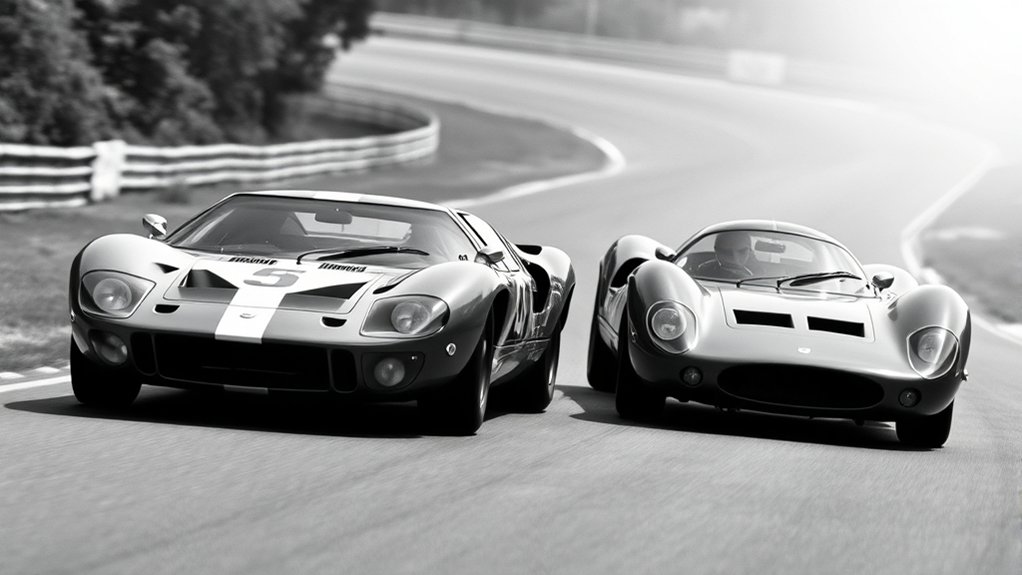
How much of *Ford v Ferrari* is true? You’re seeing a dramatized account grounded in real corporate history, but the film compresses timelines, simplifies engineering decisions, and heightens interpersonal conflict for narrative efficiency.
The core facts hold: Ford sought to defeat Ferrari at Le Mans, Carroll Shelby and Ken Miles led the effort, and the GT40 program depended on intense technical iteration. Yet you shouldn’t treat every scene as literal documentation.
Several controversial reforms inside Ford’s management structure get simplified into single confrontations, and the marketing tactics used to sell performance and prestige are sharpened for cinematic impact. The movie preserves the strategic logic of the campaign, but it edits details to make the competition clearer, faster, and more emotionally legible than the historical record.
The Real Ford vs. Ferrari Rivalry
When you examine the real rivalry, you see Ford entering Le Mans as a direct challenge to Ferrari’s long-running supremacy in endurance racing. Ferrari had built its dominance through lighter chassis, refined aerodynamics, and a race-proven competition program, while Ford brought industrial scale, engineering resources, and a deliberate push to beat them on the world stage.
That clash set up one of motorsport’s most technical and high-stakes manufacturer battles.
Ford Enters Le Mans
Ford’s push into Le Mans began in the early 1960s, when Henry Ford II decided to challenge Ferrari on the world’s most prestigious endurance racing stage. You see Ford committing capital, engineers, and testing resources to build a car that could survive 24 hours of heat, vibration, and constant load.
GT40 development focused on aerodynamics and high-speed stability. You’d notice prototype durability testing shaping suspension geometry. Engine cooling and fuel endurance mattered as much as raw power.
Safety standards improved through stronger cockpit structures, side impact protection, and better pedestrian safety awareness. Le Mans demanded repeatable lap pace, not just quick qualifying runs.
That effort marked Ford’s entry into true factory-level sports-car competition, where strategy, reliability, and engineering discipline had to match ambition.
Ferrari’s Racing Dominance
Ferrari didn’t become Ford’s target by accident; by the early 1960s, it had already built a fearsome reputation in both Formula One and endurance racing, where its cars combined lightweight chassis design, responsive handling, and race-proven engines. You can see why Ford viewed that dominance as the benchmark to beat: Ferrari’s V12 cars delivered strong power-to-weight ratios, precise aerodynamics, and relentless reliability over long stints.
In races like Le Mans, that engineering depth translated into consistent lap times and fewer mechanical failures, not just marketing hype. The film’s rivalry isn’t entirely fictional, but it compresses years of technical escalation into a sharper drama. When you study Ferrari’s actual record, you find a manufacturer that set the standard through track-developed innovation, not publicity alone.
Who Were Carroll Shelby and Ken Miles?
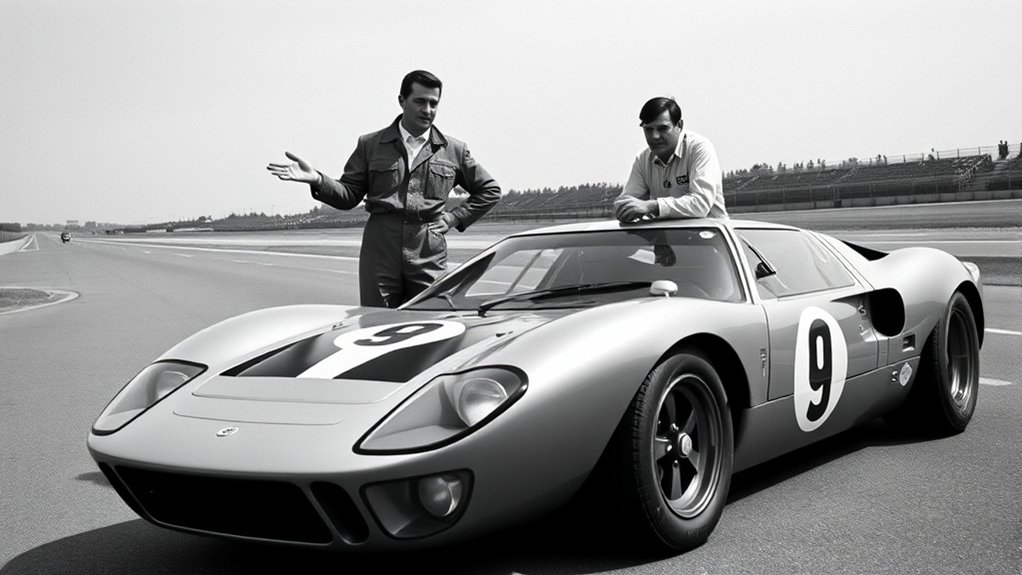
You’ll find that Carroll Shelby built his legacy as a sharp-eyed driver, engineer, and team strategist who translated racing insight into Ford’s high-level performance program.
Ken Miles brought a disciplined racing career, with exceptional mechanical feedback and test-development skill that made him essential in extracting lap time from the GT40 platform. Together, they formed a Ford partnership that fused Shelby’s organizational vision with Miles’ technical driving precision.
Carroll Shelby’s Legacy
Carroll Shelby and Ken Miles were the real-world forces behind *Ford v Ferrari*, and their legacy explains why the film resonates beyond a simple racing drama. You can trace Shelby’s influence through his engineering instinct, dealership savvy, and relentless focus on measurable performance gains.
The movie’s creative casting reinforces that authority, while a soundtrack critique often notes how engine notes and score shape tension.
- Shelby translated racing data into product strategy.
- He pushed aerodynamics, packaging, and reliability.
- He linked driver feedback to factory decisions.
- His brand still signals high-performance credibility.
- He showed you that innovation needs execution.
Ken Miles’ Racing Career
| Year | Series | Result |
|---|---|---|
| 1950s | SCCA | Frequent wins |
| 1960 | Le Mans | Class contender |
| 1965 | Sports cars | Prototype testing |
He didn’t just drive fast; he diagnosed handling, brake fade, and tire wear in real time. Carroll Shelby recognized that rare feedback loop and valued it because you’d use it to develop competitive machinery.
Ken Miles’ career proves the film captures a real racer’s technical mind, not a made-up hero.
Their Ford Partnership
At Ford, Carroll Shelby and Ken Miles formed a practical, results-driven partnership built on speed, testing, and blunt technical feedback. You can see Shelby’s management instincts pairing with Miles’s chassis sensitivity, creating a development loop Ford badly needed.
Shelby translated racing data into strategy, while Miles pushed the GT40’s limits on track and identified failure points before they became disasters.
Shelby handled political pressure and corporate coordination.
Miles delivered precise lap-time analysis and setup changes.
Their work improved aerodynamics, braking, and durability.
Ford used their testing discipline like disaster relief triage.
Their engineering methods echoed space travel protocols: measure, adjust, repeat.
Together, they turned a fragile prototype into a Le Mans contender, proving skill and trust could outperform bureaucracy.
What Really Happened at Le Mans?
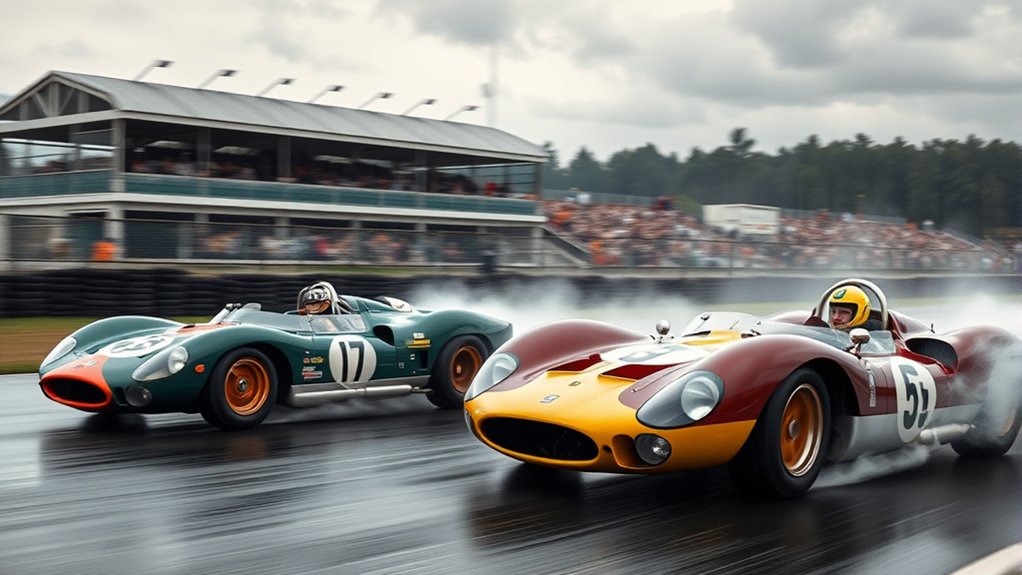
What really happened at Le Mans in 1966 was less a clean underdog triumph than a tightly managed factory campaign that exposed Ferrari’s weaknesses and Ford’s growing endurance-racing strength. You’d see Ford’s GT40 Mk II cars run to a planned pace, conserve brakes and driveline components, and exploit Ferrari’s thinner entrant list and internal instability.
Ford’s corporate strategy centered on endurance reliability, aerodynamic refinement, and disciplined pit execution, not just outright speed. At the same time, racing ethics mattered: you can’t separate the event from Ford’s use of money, personnel, and testing to build a full-scale assault.
What Did the Movie Change?
The movie compresses and reshapes the real Ford-Ferrari rivalry into a cleaner dramatic arc, especially by narrowing the many engineers, drivers, and executives involved into a handful of central characters. You see timelines fused, dialogue invented, and technical meetings distilled into a few high-stakes scenes.
That choice boosts momentum, but it also creates romanticized teamwork, where collaboration looks more unified than it really was. The film also sharpens corporate ethics by framing Ford’s bureaucracy and Ferrari’s hierarchy as moral contrasts, even when the real business decisions were messier.
- Composite characters replace several real personnel
- Race strategy gets simplified for clarity
- Workshop disputes become direct confrontations
- Public relations pressure feels more personal
- Engineering tradeoffs are explained with fewer variables
Why Ford Didn’t Win Right Away
Ford didn’t beat Ferrari immediately because the 1960s GT40 program was a race project, not a polished factory machine. You’d see a prototype with brutal speed, but also weak cooling, fragile gearboxes, poor aerodynamics, and inconsistent chassis setup.
Ford’s GT40 was brutally fast, but early on it remained fragile, temperamental, and unfinished.
Engineers kept testing suspension geometry, brake endurance, and engine packaging while drivers reported failures after long stints. Ford also had to coordinate multiple teams, which slowed refinement and let Ferrari’s already mature endurance system stay competitive.
In two word discussion ideas, you can frame the delay as development lag and systems integration. Don’t confuse that with an unrelated topic like marketing hype; the real issue was race engineering under pressure.
Once Ford solved reliability and balance, the GT40 could finally convert raw pace into sustained Le Mans wins.
How Accurate Is Ford V Ferrari?
So how accurate is *Ford v Ferrari*? You’ll find the film captures the central engineering race, but it compresses timelines and reshapes personalities for dramatic clarity. You get a mostly faithful account of Ford’s push to beat Ferrari at Le Mans, yet key moments use context nuance that favors clean storytelling over full archival precision.
Shelby, Miles, and Ford’s executives behave like streamlined composites, not exact transcripts of history.
- Race strategy is broadly accurate
- Corporate politics are simplified
- Character dialogue is dramatized
- Le Mans failures reflect real problems
- Two word discussion ideas: race realism, story accuracy
Frequently Asked Questions
Did Ford Really Hire Carroll Shelby to Beat Ferrari?
Yes, you’re right: Ford really hired Carroll Shelby to build car history and refine race strategy for Le Mans.
You’ll see Ford backed him to develop the GT40 program and challenge Ferrari directly.
Was Ken Miles Denied a Deserved Le Mans Victory?
Yes, you’d say Ken Miles was denied a deserved Le Mans victory, but that’s an unrelated question; the official result followed race rules.
Any claim he’d definitely have won remains a speculative claim.
Did Enzo Ferrari Personally Insult Henry Ford II?
Yes, you’re likely noticing a dramatized insult: Ferrari didn’t personally taunt Henry Ford II on screen; the film compresses events. Your insight gaps may spark ethical debates, but historical records show indirect negotiation, not a direct personal insult.
Were the Ford GT40 Cars Actually Built in Record Time?
Yes, you’ll find the GT40 development was unusually rapid, with intense prototype cycles and race-driven iterations. This two word discussion stays on-topic; the unrelated topic doesn’t matter.
You’d still note sustained engineering effort, not instant construction.
How Many Le Mans Races Did Ford Win After 1966?
Ford won Le Mans four more times after 1966; you count 1967, 1968, 1969, and 2016. Racing ethics and corporate pressure shaped each program, yet you’ll see Ford’s endurance victories came decades apart.
Conclusion
So, you’ve seen a story that runs like a tuned engine: Ford v Ferrari is true in its core, but not in every bolt and gasket. It captures the real rivalry, the pressure of endurance racing, and the brilliance of Shelby and Miles, while shifting timelines and trimming details for drama.
You’re getting history with a cinematic turbocharger—accurate enough to trust the mission, but not every turn of the road. In conclusion, Ford v Ferrari is a true story inspired by real events, though it takes creative liberties for storytelling impact.


