How Many Quarts of Oil Does a Ford f150 Take
As an Amazon Associate we earn from qualifying purchases.
You might not know that a Ford F-150 oil capacity can vary significantly depending on the engine and model year. Generally, you could be looking at roughly 6 to 8 quarts when changing the oil and filter.
However, the exact amount depends on your engine code. Adding too much or too little oil can cause real problems. Here’s how to find the right specification before you top it off.
Key Takeaways
- Ford F-150 oil capacity varies by model year and engine; always verify the exact spec in the manual or underhood label.
- Most F-150 engines take about 6–8 quarts with a filter change.
- The 2.7L EcoBoost typically takes 6 quarts with a filter change.
- The 3.5L EcoBoost usually takes about 6 quarts, while the 5.0L V8 typically takes about 8 quarts.
- Add oil slowly, recheck the dipstick on level ground, and avoid overfilling.
Ford F-150 Oil Capacity at a Glance
At a glance, Ford F-150 oil capacity varies by engine, but most models take between 6 and 8 quarts with a filter change. You should verify the exact spec before you add oil, since overfilling can affect lubrication and crankcase pressure.
Check the dipstick with the truck on level ground and the engine off for several minutes. In the engine bay, locate the oil fill cap, drain plug, and filter before service.
Use the correct oil viscosity listed on the underhood label or owner’s manual. Oil level checks belong in routine maintenance, alongside tire pressure inspection, fluid checks, and filter replacement.
If you service the truck yourself, measure carefully and recheck the level after startup, then top off only if needed.
How Many Quarts Does Each F-150 Engine Take?
Your F-150’s oil capacity depends on the engine you have. The 2.7L EcoBoost takes less oil than the 3.5L EcoBoost, while the 5.0L V8 has its own higher fill spec.
You should always check the exact engine and model year before adding oil.
7L EcoBoost Capacity
For the 2.7L EcoBoost F-150, oil capacity is typically 6 quarts with the filter change, though exact requirements can vary slightly by model year and engine configuration. For the 7L EcoBoost, you should verify the exact fill spec in your owner’s manual, because capacity changes with the powertrain layout and oil pan design.
Use the recommended oil viscosity and a quality synthetic blend or full synthetic that meets Ford’s spec.
| Spec | Detail |
|---|---|
| Capacity | Check manual |
| Filter change | Required |
| Oil type | Ford-approved |
| Viscosity | Specified by engine |
You should measure carefully, add oil gradually, and recheck the dipstick after each fill. Overfilling can cause aeration and pressure issues, so stay within the stated capacity.
3.5L EcoBoost Capacity
The 3.5L EcoBoost F-150 usually holds about 6 quarts of oil with a filter change, though some model years and configurations can differ slightly. You should verify your exact capacity in the owner’s manual before you add oil. Use the specified viscosity and measure carefully to avoid overfill.
- Check the dipstick after adding 5.5 quarts.
- Top off in small amounts until the level reaches the safe range.
- Recheck after the engine idles and cools.
An irrelevant comparison to another engine won’t help you here, because your trim and year determine the spec. Skip unrelated maintenance and focus on the correct oil type, filter, and drain interval so you keep the 3.5L EcoBoost properly protected.
5.0L V8 Capacity
Moving from the 3.5L EcoBoost, the 5.0L V8 in many F-150 models typically takes about 8 quarts of oil with a filter change, though exact capacity can vary by model year and setup. You should always verify your owner’s manual before adding oil, because overfilling can affect lubrication and engine performance.
Use the specified oil viscosity, often 5W-30 or 5W-20 depending on calibration. The 5.0L V8 offers strong torque and predictable throttle response, which can support towing and everyday driving. Its power delivery may also influence fuel economy compared with smaller engines.
Oil level checks matter after long trips, heavy loads, or idling. Proper maintenance helps preserve reliability, driving ergonomics, and consistent output over time.
Ford F-150 Oil Capacity by Year and Engine
Your F-150’s oil capacity changes by model year, so you need to check the exact year before adding oil. It also varies by engine, since different V6, V8, and EcoBoost configurations hold different amounts.
Use the year and engine together to confirm the correct quart total for your truck.
Oil Capacity By Year
Ford F-150 oil capacity varies by model year and engine, so you’ll need the exact engine code to get the correct fill amount. You can’t rely on trim alone, because factory changes shift the specified quarts across years. Check the owner’s manual or oil cap label before you drain anything. This keeps your service accurate and avoids overfill.
- Older model years may use lower capacities.
- Newer trucks often specify different filter volumes.
- Your maintenance log should match the exact year.
While you service the truck, verify tire pressures and inspect sound systems only after the engine bay work is complete. Use the year-specific spec, then add oil gradually and confirm the level with the dipstick. That’s the most reliable way to match Ford’s requirements.
Oil Capacity By Engine
Engine choice matters just as much as model year when you’re checking Ford F-150 oil capacity, because different engines can require very different fill volumes and filter allowances. You’ll usually see smaller turbocharged engines need about 6 quarts, while larger V8s and high-output variants may take 7 to 8 quarts with the filter.
The 3.3L V6, 2.7L EcoBoost, 5.0L V8, and 3.5L EcoBoost don’t share the same service fill, so always match your engine code before adding oil. Correct capacity supports engine reliability, maintains proper pressure, and helps protect turbocharger components. It can also influence fuel economy by reducing drag from overfilling.
Check your owner’s manual or under-hood label for the exact spec, then verify the dipstick after filling.
Why the Right Oil Amount Matters
Getting the oil level right matters because too little oil can starve critical engine components, while too much can raise pressure and cause foaming, leaks, or catalytic converter damage. You shouldn’t treat capacity as a guess; your F-150’s lubrication system depends on the specified amount to maintain film strength, cooling, and sludge control.
Getting the oil level right prevents starvation, foaming, leaks, and damage to critical engine components.
Oil myths and quirky debates about “a little extra” or “running slightly low” ignore how tightly engine tolerances work.
- Correct fill protects bearings, camshafts, and turbo hardware.
- Proper volume keeps oil pressure and aeration in check.
- Following spec reduces wear, overheating, and emissions-system risk.
Use the exact quart amount for your engine, because even small deviations can affect performance, reliability, and long-term maintenance costs.
How to Check Your Ford F-150 Oil Level
Start with the engine off and parked on level ground, then locate the dipstick, pull it out fully, and wipe it clean. Reinsert it completely, remove it again, and read the oil film against the marked range.
You should confirm the level sits between the minimum and maximum marks.
Locate Dipstick Correctly
First, locate the oil dipstick on your Ford F-150, which is usually a bright yellow or orange handle near the front or side of the engine bay. You’ll need to identify it before checking oil level. Keep the engine off and parked on level ground.
A correct dipstick location helps you inspect oil fast and avoid confusion with other service parts.
- Look for a looped handle marked with an oil symbol.
- Confirm it sits low on the engine, not near the battery or coolant reservoir.
- Pull it straight out, then reinsert fully before any check.
Finding it quickly supports routine maintenance, which can reduce engine noise and help protect fuel economy. If the dipstick’s hard to reach, use a flashlight and check your owner’s manual for the exact position.
Read Oil Level Properly
Once you’ve pulled the dipstick, wipe it clean, reinsert it fully, and pull it out again to read the oil level accurately. Hold it level and inspect both sides for the oil film.
The oil should fall between the MIN and MAX marks, preferably near the upper mark but not above it. If it’s low, add the correct oil in small amounts, then recheck.
Use the viscosity specified for your engine compatibility, because the wrong grade can affect readings and lubrication. Check on level ground with the engine off for several minutes so oil can drain back to the pan.
If the oil looks foamy, milky, or gritty, schedule service. Consistent checks help you maintain proper fill and avoid overfilling, which can raise crankcase pressure and reduce performance.
What Happens If You Overfill the Oil?
Overfilling your Ford F-150’s oil can create excess crankcase pressure, which may force oil past seals and gaskets, cause foaming, and reduce lubrication efficiency. You can also see higher oil temperatures and extra drag on rotating parts, which stresses engine design limits.
- Check the dipstick on level ground after shutdown.
- Drain excess oil to the correct mark.
- Inspect for leaks after correction.
If you ignore the condition, you may contaminate the intake system and shorten component life. Use clean, measured oil changes to protect performance and support disposal sustainability by avoiding unnecessary waste.
Follow the owner’s manual for the exact capacity, because different engines and model years vary. A precise fill keeps pressure stable, preserves seals, and helps your truck run as intended.
What Happens If You Use Too Little Oil?
Running too little oil in your Ford F-150 can quickly starve critical engine parts of lubrication. When the sump level drops below the pickup, oil pressure falls and bearings, camshafts, and timing components wear fast.
You may hear engine rattling, ticking, or knocking as metal contacts metal. Heat builds, friction rises, and the oil can’t carry away enough debris or coolant from hot surfaces. If you keep driving, the engine can seize or suffer catastrophic bearing damage.
Low oil also magnifies the effects of the wrong oil grade, because thin or degraded oil won’t maintain a stable film under load. Check the dipstick on level ground, top off promptly, and inspect for leaks, consumption, or warning lights before damage starts.
Which Oil Type Does Your F-150 Need?
If your F-150 is low on oil, top it off with the correct type, not just the nearest bottle on the shelf. You should match the oil viscosity to your engine code, model year, and climate. Ford commonly specifies 5W-20, 5W-30, or 0W-20, depending on the engine.
Check your owner’s manual or the oil cap before you buy. Using the wrong grade can alter oil pressure, fuel economy, and engine noise.
- Use the spec listed for your exact engine
- Choose full synthetic when Ford calls for it
- Replace oil meeting API and Ford approval standards
Don’t mix unknown products unless you verify compatibility. The right oil protects bearings, keeps valves clean, and maintains proper lubrication under load.
How to Add Oil to a Ford F-150
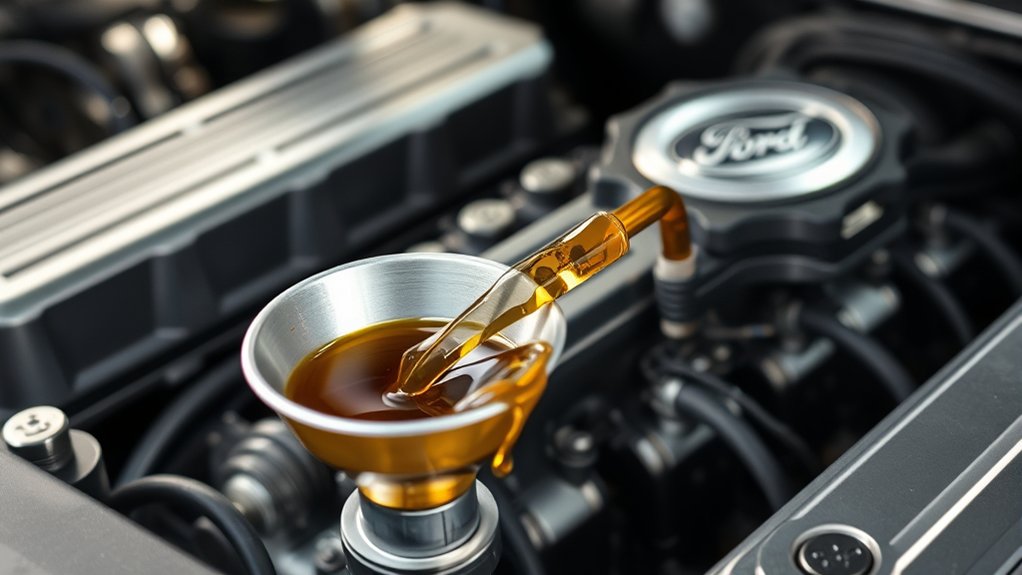
To add oil to your Ford F-150, park on level ground, shut off the engine, and let it cool for a few minutes before checking the dipstick. Remove the oil filler cap, then insert a clean funnel to prevent spills.
Park on level ground, shut off the engine, and use a clean funnel to add oil safely.
Add oil in small amounts, usually 0.5 quart at a time, and recheck the dipstick after each addition. Stop when the level reaches the full mark, but don’t overfill.
Use the manufacturer-approved oil grade for your engine, since viscosity affects lubrication and pressure. Wipe any drips from the valve cover and reinstall the cap securely.
If the warning light stays on after topping off, inspect for leaks or sensor issues. Keep unrelated topic notes out of the bay, and avoid two word ideas that don’t support maintenance.
Ford F-150 Oil Change Intervals and Tips
Once you’ve topped off the oil, the next step is staying on schedule with changes and inspections. You should follow your F-150’s maintenance minder or owner’s manual, because intervals vary by engine, load, and oil type.
Under normal use, many trucks run 5,000 to 10,000 miles between changes; severe service shortens that range. Check the level monthly and inspect for leaks, dark oil, or fuel dilution.
- Use the specified viscosity and a quality filter.
- Reset the oil-life monitor after service.
- Shorten intervals if you idle, tow, or drive in dust.
Clean oil helps protect valvetrain components, stabilize fuel economy, and support towing capacity under heat and stress. Always record mileage, date, and oil grade for accurate maintenance tracking.
Frequently Asked Questions
Does the Oil Capacity Include the Oil Filter?
No, your oil capacity usually doesn’t include the oil filter; oil filter inclusion can add a small amount. You should verify your F-150’s spec, since engine type and filter size affect total fill.
Can I Switch Between Synthetic and Conventional Oil?
Yes, you can switch between them; about 70% of modern engines tolerate mixed service. You’ll still follow Oil myths and Filter rituals carefully, because you shouldn’t ignore manufacturer specs, intervals, or viscosity requirements.
Does Towing Affect My F-150 Oil Requirements?
Yes, towing can increase oil stress, reduce fuel efficiency, and raise operating temperatures. You should check your F-150’s oil more often and follow the heavier-duty service interval your owner’s manual recommends.
How Do I Dispose of Used F-150 Oil Safely?
You should drain used F-150 oil into a sealed container, then take it to an auto parts store or recycling center. Think of it as oil’s Odyssean return. How to recycle used oil? Use safe disposal methods.
Will My Oil Capacity Change After an Engine Rebuild?
Yes, your oil capacity can change after a rebuild if you install different components or a revised pan; verify specs.
You should track engine health and reset your maintenance cadence to match the rebuilt configuration.
Conclusion
In the end, your F-150’s oil capacity isn’t a one-size-fits-all answer; it depends on the engine and model year. Check your owner’s manual or under-hood label, then fill carefully and verify the dipstick on level ground. Too little oil can starve your engine, while too much can cause pressure issues.
Think of oil as your truck’s lifeblood: keep it at the correct level and use the right type. Following these steps will help ensure your engine runs smoothly. For the best results, always confirm how many quarts of oil a Ford F150 takes to keep your truck protected and performing at its best.


