Does Ford Own Jeep
As an Amazon Associate we earn from qualifying purchases.
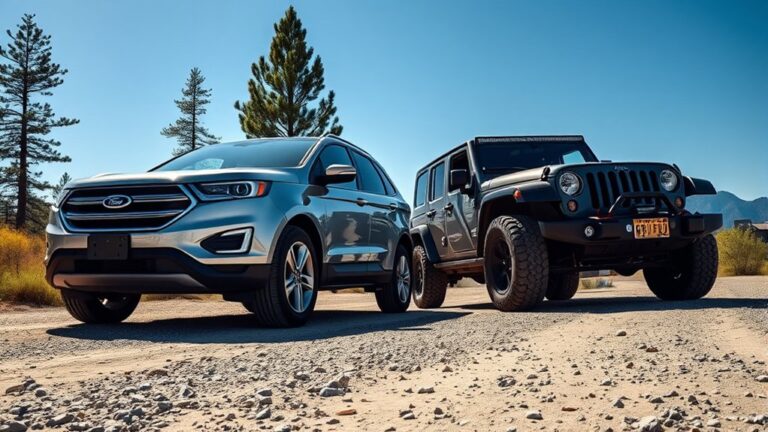
If you compare a Ford Bronco with a Jeep Wrangler, you might wonder, does Ford own Jeep? The answer is no. Ford does not own Jeep.
Jeep is owned by Stellantis, a company formed in 2021 from the merger of Fiat Chrysler and PSA Group. Ford remains an independent rival in the automotive market.
The ownership history of Jeep traces through Willys-Overland, Kaiser, AMC, Chrysler, and FCA. The question gets more interesting when you look at why so many drivers still assume otherwise.
Key Takeaways
- No, Ford does not own Jeep.
- Jeep is currently owned by Stellantis.
- Jeep has been under Kaiser, AMC, Chrysler, FCA, and now Stellantis.
- Ford and Jeep are rivals in SUVs and off-road vehicles, not parent and subsidiary.
- Shared market overlap can cause confusion, but there is no Ford ownership stake in Jeep.
Does Ford Own Jeep?
No. Ford does not own Jeep. You can verify this by tracing Jeep’s brand history, which shows separate corporate transitions, not Ford control.
Jeep began under Willys-Overland, then moved through Kaiser, AMC, Chrysler, DaimlerChrysler, and later Fiat Chrysler Automobiles. That sequence matters because ownership myths often persist when consumers associate Jeep with other American automakers that built trucks and SUVs.
However, historical overlap in vehicle segments doesn’t equal corporate ownership. If you compare filings, brand archives, and merger timelines, you’ll see no period when Ford held Jeep as a subsidiary.
The evidence points to distinct lineage, not shared ownership. So, when you ask whether Ford owns Jeep, the factual answer is no, and the record supports that conclusion clearly.
Who Owns Jeep Today?
Jeep is owned by Stellantis, the multinational automaker formed in 2021 through the merger of Fiat Chrysler Automobiles and PSA Group. If you’re asking whether Ford controls Jeep, the answer is no.
You should treat the two brands as separate corporate assets with distinct ownership, management, and product strategies. Stellantis reports Jeep within its portfolio alongside other global marques, and public filings identify no Ford stake in Jeep.
That means any Ford-Jeep connection is an unrelated topic, not an ownership link. A random pairing of the names may suggest overlap, but the data doesn’t support it. When you evaluate brand ownership, you should rely on corporate structure, not market assumptions or name recognition.
How Jeep Joined Stellantis
You can trace Jeep’s path to Stellantis back through multiple ownership changes, starting with its early corporate history under Kaiser, AMC, and then Chrysler.
In 2009, Chrysler formed Fiat Chrysler Automobiles, or FCA, after Fiat increased its stake and reorganized the company. In 2021, FCA merged with PSA Group to create Stellantis, placing Jeep under a larger global automaker.
Jeep’s Early Ownership
Before Jeep became part of Stellantis, its ownership changed hands several times through a series of corporate mergers and acquisitions. You can trace Jeep’s early corporate history from Willys-Overland, which produced the original civilian Jeep after World War II, to Kaiser Motors, which acquired Willys in 1953.
Later, American Motors Corporation bought Jeep in 1970, expanding the brand’s scale and distribution. When Chrysler purchased AMC in 1987, Jeep moved into a larger global portfolio. Each transfer preserved core product identity while shifting financial control.
You can see the impact in Jeep’s classic design and brand heritage, both of which stayed consistent despite changing owners. Those transitions set the stage for Jeep’s eventual inclusion in the modern Stellantis structure, without altering its market positioning.
FCA Merger Formation
By the mid-2010s, Jeep was part of Fiat Chrysler Automobiles, or FCA, after Chrysler’s earlier corporate restructuring and Fiat’s growing control of the company. You could see the merger logic in the numbers: FCA combined Jeep’s strong SUV sales with Fiat’s smaller global reach, creating a wider manufacturing and distribution base.
Official rumors about consolidation surfaced as investors compared FCA with other unrelated mergers in the auto sector. That backdrop mattered because Jeep wasn’t operating as a standalone Ford asset; it sat inside a larger corporate portfolio.
A showroom lit by chrome and steel
Assembly lines moving under fluorescent lights
Market charts climbing beside Jeep badges
Global shipping lanes linking factories and dealers
Stellantis Brand Merger
In 2021, FCA and PSA Group completed a merger that created Stellantis, instantly placing Jeep under a new parent company rather than Ford. You can trace Jeep’s path through FCA’s earlier ownership and then into Stellantis, a transaction that combined 14 brands and expanded global scale.
From a corporate finance view, the merger aimed to cut overlapping costs, improve platform sharing, and strengthen margins. You should note that Jeep retained strong historical branding, which Stellantis uses to preserve customer loyalty and premium positioning.
Its marketing strategies now target off-road capability, American heritage, and international growth. The data shows Jeep’s brand value remained high after the merger, but governance, supply chains, and product planning now sit inside Stellantis, not Ford.
How Ford Is Connected to Jeep
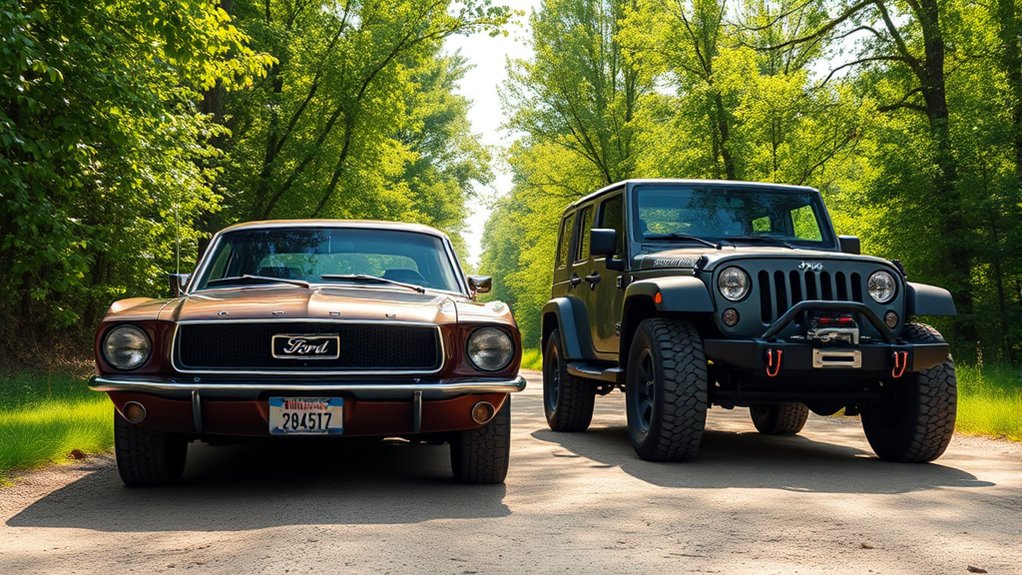
Ford isn’t Jeep’s owner, but the two brands are linked through corporate history and industry rivalry. When you compare their current ownership structure, you’ll see Ford operates separately from Jeep’s parent company, while both compete in SUVs, trucks, and off-road capability.
Ford and Jeep aren’t under the same owner, but they remain close rivals in SUVs, trucks, and off-road performance.
You can trace the connection through decades of market overlap, shared supplier networks, and similar customer targets. Ford’s Bronco revival also sharpened comparisons with jeep branding, pushing both companies into direct performance and image competition.
- A rugged trail beside a paved test track
- Two boxy SUVs lined up at a dealer
- A mountain backdrop behind competing badges
- Engineers reviewing charts and market segments
Why People Think Ford Owns Jeep
Several factors make people assume Ford owns Jeep, even though the brands sit under different corporate umbrellas. You often see both names in SUV comparisons, off-road reviews, and dealership searches, so the overlap can feel structural.
Ford and Jeep also share American-market visibility, which can blur corporate lines in casual research. When you notice similar vehicle classes, four-wheel-drive marketing, and rugged branding, you may infer a common owner.
Search results can reinforce that impression by placing Ford and Jeep side by side, even though that reflects unrelated ownership. In addition, brand licensing agreements and supplier relationships sometimes create public confusion.
If you track manufacturer filings and parent-company data, you’ll see the distinction quickly.
Jeep’s Ownership History
Jeep’s corporate history is more complicated than a simple single-owner story. You can trace Jeep to Willys-Overland, then Kaiser, then American Motors Corporation, which shaped its jeep branding and expanded its suv history.
Jeep’s lineage runs from Willys-Overland to Kaiser to AMC, each shaping its rugged identity.
In 1987, Chrysler bought AMC, mainly to acquire Jeep, and later merged into DaimlerChrysler, then Fiat Chrysler Automobiles. Today, Stellantis controls the brand, not Ford. That sequence matters because ownership changed while Jeep’s identity stayed consistent.
- A rugged wartime grille
- A succession of corporate logos
- Factory lines stretching across decades
- A brand badge moving between parents
Jeep Models That Rival Ford SUVs
You can compare Jeep models against Ford SUVs by looking at size, power output, off-road hardware, and price. The Ford Bronco and Jeep Wrangler often overlap in capability and positioning, while the Explorer and Cherokee compete more directly in the midsize SUV segment.
Those pairings give you a clear way to assess where Jeep matches Ford and where each brand still differentiates itself.
Ford Bronco Comparisons
When comparing the Ford Bronco to Jeep’s lineup, the clearest rivals are the Jeep Wrangler and, to a lesser extent, the Jeep Gladiator. You’ll see similar trail-focused specs: body-on-frame construction, removable doors, and available four-wheel drive.
The Bronco often matches or beats the Wrangler in approach angle and tech features, while the Gladiator adds pickup utility you may value. This is an unrelated topic if you’re focused on branding, and an off topic unrelated detail if you’re only asking ownership.
- Bronco on rocky inclines
- Wrangler crossing a muddy wash
- Gladiator hauling gear to camp
- Bronco’s cabin with terrain screens
Explorer Versus Cherokee
The Ford Explorer and Jeep Cherokee occupy a similar midsize SUV space, but they target different strengths. When you compare explorer vs. cherokee vs., you’ll see the Explorer usually offers more passenger room, stronger towing figures, and a broader lineup of powertrains.
The Cherokee, meanwhile, tends to emphasize off-road hardware, compact maneuverability, and lower curb weight. If you value highway stability and family-friendly packaging, the Explorer can fit better. If you need trail capability and easier urban parking, the Cherokee may be the smarter pick.
You should also weigh fuel economy, cargo capacity, and available safety tech, because those factors can shift ownership costs. In short, these models compete directly, but each serves a distinct buyer profile.
Ford vs. Jeep Off-Road Comparison
Off-road performance separates Ford and Jeep most clearly, because each brand leans on different strengths: Jeep prioritizes trail-specific hardware, while Ford often balances off-road capability with broader on-road refinement. You’ll notice Jeep’s advantage in low-speed articulation, crawl control, and approach angles, which improve off road dynamics on rocky routes.
Ford counters with selectable drive modes, strong traction management, and more stable highway behavior.
- A Jeep climbing a boulder-strewn incline
- A Ford crossing a muddy forest track
- Deep tire ruts under spinning wheels
- Suspension flex over uneven ground
From an analytical view, Jeep’s branding strategy centers on specialization, and Ford’s emphasizes versatility. If you compare measured trail performance, Jeep usually leads in extreme terrain, while Ford can deliver a more balanced package for mixed-use driving.
What Makes Jeep Different From Ford
Jeep differs from Ford mainly in purpose-built capability and brand focus: Jeep designs its vehicles around trail performance, while Ford typically engineers for a wider mix of daily driving, towing, and utility. You see the split in architecture, suspension tuning, and available 4×4 systems. That’s why Jeep’s lineup feels more specialized, even when both brands sell SUVs.
| Factor | Jeep | Ford |
|---|---|---|
| Core mission | Off-road | Broad utility |
| Chassis tuning | Trail-focused | Mixed-use |
| 4×4 emphasis | High | Varies |
| Brand identity | Adventure | Versatility |
| Ownership | Unrelated ownership | Unrelated ownership |
You shouldn’t confuse brand relocation with ownership. Jeep’s corporate history changed, but that doesn’t make Ford its parent. In practical terms, Jeep’s differentiation comes from narrower engineering goals and stronger off-road branding.
Frequently Asked Questions
Is Jeep American-Made or Manufactured Overseas?
Jeep’s American roots run deep, but you’ll find vehicles built in multiple countries, including the U.S. and overseas.
Unrelated mergers and branding disputes don’t change that mixed manufacturing footprint or ownership structure.
Which Company Founded the Jeep Brand Originally?
Jeep’s original brand history traces to Willys-Overland, which you can identify as the founding company behind the brand.
For ownership trivia, you’ll note Bantam and Ford contributed designs, but Willys secured the Jeep name and production.
Does Ford Sell Any Jeep-Like Vehicles?
Yes, you can buy Ford SUVs that feel Jeep-like, especially the Bronco and Bronco Sport. Ford and Jeep ownership differ, but both target off-road buyers.
You’ll also see their electric SUVs future shaping choices.
Are Jeep and Ford Competitors in the SUV Market?
Yes, Jeep and Ford are competitors in the SUV market. You can see clear competition dynamics in overlapping segments, while each brand’s branding strategy targets different buyers.
Data shows frequent head-to-head sales battles.
What Company Makes the Jeep Wrangler Today?
You’ll find the Jeep Wrangler today is made by Stellantis, which manages Jeep branding, not Ford ownership.
Production comes from Jeep’s current corporate parent, and the Wrangler remains an objectively Jeep-branded SUV.
Conclusion
So, if you’re wondering whether Ford owns Jeep, the answer is no. Jeep belongs to Stellantis, not Ford, and that fact lines up with the brands’ long-standing rivalry.
Coincidentally, the confusion often grows right when you compare Ford and Jeep in the same SUV conversations. You’ll see Ford on one side, Jeep on the other, each with different strengths.
In the end, the data points to separate owners, separate strategies, and separate identities. Therefore, Ford does not own Jeep.


