Does Ford Motor Company Own Cummins
As an Amazon Associate we earn from qualifying purchases.
You might picture Ford Motor Company and Cummins like two builders sharing a job site, but each still owns its own tools. Ford Motor Company doesn’t own Cummins; both are separate public companies with independent boards and shareholders.
Their ties are mainly transactional, with occasional diesel collaborations and competing powertrain strategies. If you’re comparing truck brands or engine choices, the ownership question only scratches the surface.
Key Takeaways
- No, Ford Motor Company does not own Cummins; they are separate publicly traded companies.
- Cummins is independently owned by dispersed shareholders, not by Ford or any automaker.
- Their relationship is contractual and project-specific, mainly for select truck and engine applications.
- Ford has used Cummins engines in limited heavy-duty and commercial applications, not as a full ownership arrangement.
- Ford and Cummins remain strategically independent, each developing its own powertrain programs and partnerships.
Does Ford Own Cummins?
No, Ford does not own Cummins. You can verify this by checking corporate filings and investor reports: Ford and Cummins operate as separate public companies with distinct boards, revenues, and strategic priorities.
Ford has used Cummins engines in certain heavy-duty applications, but that commercial relationship doesn’t imply ownership. If you’re evaluating the partnership, focus on measurable factors such as engine performance, fuel efficiency, environmental impact, and total cost of ownership.
You should also consider labor relations, since both firms negotiate independently with unions and suppliers. In practical terms, Ford’s decisions on trucks and powertrains reflect collaboration, not control.
Who Owns Cummins?
Cummins is a publicly traded company, so it’s owned by a broad mix of shareholders rather than by Ford or any single parent company. You’ll find ownership spread across institutional investors, index funds, and individual shareholders, which means no single party controls the company outright.
Public filings show that governance sits with a board elected by shareholders, not with an outside automaker. That structure matters when you assess engine ethics, because accountability flows through corporate reporting and board oversight.
It also shapes supplier dynamics, since Cummins sets strategy independently while negotiating with many customers and partners. In practical terms, you should view Cummins as an autonomous manufacturer with dispersed ownership, market-based control, and financial accountability to investors who buy and sell its stock.
How Ford and Cummins Work Together
Ford and Cummins work together as separate companies that serve overlapping segments of the heavy-duty and commercial vehicle market. You can see their relationship most clearly in how each focuses on its own strengths: Ford on vehicle design, integration, and scale, Cummins on powertrain engineering and diesel expertise.
This alignment helps you evaluate engine performance against real-world demands such as towing, durability, and fuel efficiency. Their cooperation also reflects broader market trends, including tighter emissions standards, changing fleet requirements, and demand for efficient commercial platforms.
Rather than merging operations, they coordinate through industry competition and supplier relationships. That structure lets you compare product choices objectively and understand how brand strategy, engineering priorities, and customer needs shape outcomes in the truck and commercial vehicle space.
Has Ford Used Cummins Engines?
Yes, in limited cases, Ford has used Cummins engines, mainly through specific commercial and specialty applications rather than across its mainstream lineup. You can see this in Ford partnerships that targeted fleet, heavy-duty, or vocational needs where Diesel collaborations made sense.
Ford didn’t broadly badge Cummins powertrains in its consumer trucks, but it did work with Cummins in select projects, suppliers, and development efforts tied to performance, durability, and emissions compliance. That matters because you shouldn’t assume a full engine-sharing relationship.
The data points to occasional integration, not ownership or standard factory use. In practical terms, Ford has leveraged Cummins expertise when a project demanded proven diesel capability, but it’s remained selective, strategic, and contract-based rather than routine.
Ford Diesel Engines vs. Cummins Engines
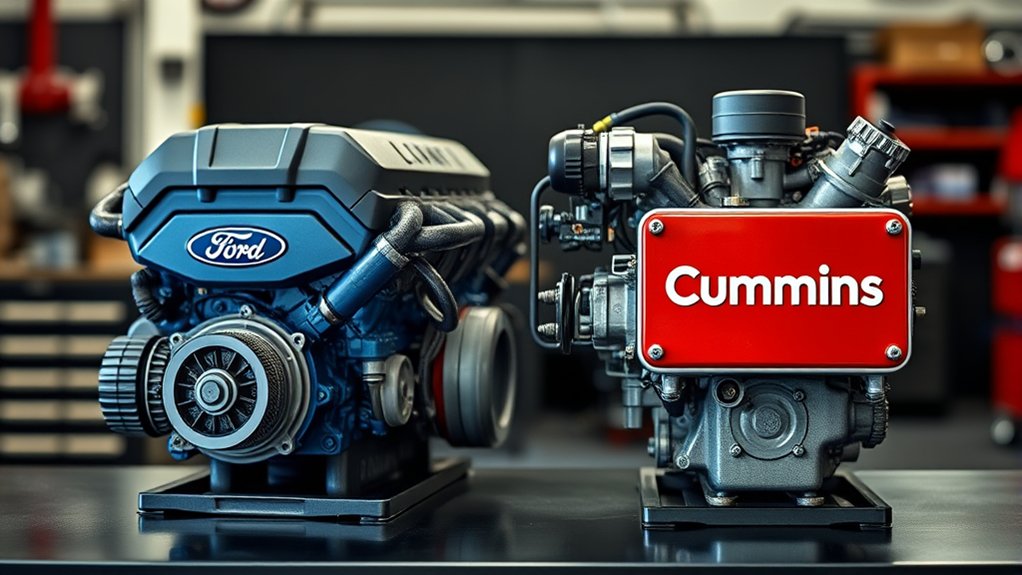
When you compare Ford diesel engines with Cummins engines, the main difference comes down to design priorities and market focus. You’ll see Ford’s Power Stroke line aims for balanced towing, emissions compliance, and integration with Ford partnerships.
Cummins engines emphasize heavier-duty torque delivery and long-haul durability. Both brands pursue diesel innovations, but they optimize differently.
| Metric | Ford Diesel | Cummins |
|---|---|---|
| Towing focus | High | Very high |
| NVH refinement | Strong | Moderate |
| Torque curve | Broad | Flat, strong |
| Integration | Deep | Limited |
| Duty cycle | Mixed-use | Heavy-duty |
You can use Ford for smoother daily work and Cummins for maximum sustained load performance. Choice depends on your payload, runtime, and maintenance goals.
Why Ford Never Bought Cummins
You can see that Ford never bought Cummins because both companies benefited from strategic independence, keeping control over their own engine roadmaps and supply decisions. Ford has long invested in its own Power Stroke diesel programs, while Cummins has stayed focused on serving multiple automakers and commercial customers.
That separation reduced dependency, preserved competition, and let each company target different market needs.
Strategic Independence
Strategically, Ford never bought Cummins because the relationship was more valuable as a supplier partnership than as a full acquisition. You can see the logic in the economics: Ford preserved flexibility, while Cummins kept selling across multiple OEMs, protecting scale and margins.
That setup reduced capital burden and avoided integration risk. When you look at the history, insufficient collaborations limited trust for a merger, and incompatible branding made a single corporate identity less practical.
Ford could source diesel expertise without absorbing Cummins’ operations, culture, or customer ties. Cummins also benefited by staying independent, since ownership could’ve narrowed its market reach.
For you, the takeaway is simple: both companies gained more by staying separate than by forcing ownership.
Competitive Engine Plans
Ford’s engine strategy didn’t leave much room for an ownership deal with Cummins. You can see why: Ford already invested heavily in in-house diesel development, especially for F-Series and commercial platforms. Buying Cummins would’ve meant paying for capacity Ford could build itself, plus accepting a competitor’s roadmap. That’s a poor capital allocation trade-off when margins depend on controlling design, emissions compliance, and production timing.
You also have to factor in market positioning. Cummins served multiple OEMs, so ownership could’ve complicated supply relationships and reduced flexibility. Ford preferred targeted diesel collaboration and selective engine partnerships instead of a full acquisition. That approach let you preserve bargaining power, avoid integration risk, and keep engine choices aligned with truck demand, regulatory shifts, and long-term platform planning.
What Ford-Cummins Partnerships Existed?
You can trace Ford-Cummins ties to early diesel collaborations that focused on practical engineering and market testing, not a merger.
Ford also relied on Cummins for heavy-duty engine supply in select applications where torque and durability mattered most. Those partnerships showed how the two companies worked together commercially while staying separate corporate entities.
Early Diesel Collaborations
Before Ford ever explored a formal diesel alliance with Cummins, the two companies had already intersected through engine sourcing and heavy-duty market pressure in the 1970s and 1980s. You can trace their early ties to practical collaboration, not ownership.
Ford focused on truck competitiveness while Cummins supplied credibility in diesel performance, durability, and fuel economy. In that period, Ford and Cummins didn’t create a broad joint venture, but they did align around market needs, shared dealer interest, and occasional joint marketing.
No evidence shows exclusive royalties or equity control.
| Area | Ford Role | Cummins Role |
|---|---|---|
| Diesel demand | Truck sales pressure | Engine expertise |
| Cooperation | Market positioning | Technical reputation |
| Outcome | Competitive response | Brand lift |
You should view these early links as strategic experimentation, not corporate integration.
Heavy-Duty Engine Supply
So what heavy-duty engine supply ties actually existed between Ford and Cummins? You can trace them to specific truck programs, not ownership. Ford sourced Cummins diesels for select Super Duty and medium-duty applications when buyers demanded higher torque and durability than Ford’s own engines could deliver.
The partnership was transactional: Ford integrated Cummins powerplants, then sold the trucks under its badge while Cummins supplied the engine and calibration support. You should view this as a market response shaped by commodity pricing, customer fleet specs, and tightening emission standards.
When regulations changed, the economics shifted, and Ford leaned more on in-house diesel development. So the link was real, but limited, contractual, and driven by performance needs, not equity control or corporate merger.
What Truck Buyers Should Know
Even if Ford does not own Cummins, truck buyers still need to look at the full powertrain package, not just the badge on the grille. You should compare torque curves, towing ratings, transmission tuning, axle ratios, and fuel economy across trims.
Cummins’ independence strategy lets it supply engines through engine partnerships, but Ford’s own diesel and gas options may better match your payload and budget. Check warranty terms, maintenance intervals, and dealer service capacity, because total ownership cost often beats headline horsepower.
If you tow heavy loads, focus on low-end torque and cooling performance. If you commute daily, prioritize efficiency and noise levels. The best choice depends on your use case, not brand assumptions.
Frequently Asked Questions
Is Cummins an Independent Company?
Yes, Cummins is an independent, publicly traded company, so you can treat its independence as real. Ford ownership doesn’t apply here; does Ford ownership matter? Not for Cummins, which runs its own operations and strategy.
Do Ford Trucks Ever Come With Cummins Engines?
No, you won’t find factory Ford trucks with Cummins engines; Ford uses Power Stroke diesels. Cummins history shows strong Dodge/Ram ties, not Ford partnerships.
Aftermarket swaps exist, but OEM Ford-Cummins combinations aren’t standard.
What Companies Currently Own Cummins Stock?
You should know no companies currently own Cummins stock entirely; it’s a publicly traded, independent company. You can verify ownership through institutional holders like Vanguard and BlackRock, which often own large share blocks.
Has Ford Ever Tried to Acquire Cummins?
You’d likely find no solid evidence Ford ever seriously tried to acquire Cummins; public records don’t show it.
If you’re researching aftermarket diesel tuning, focus on partnerships, licensing, and engine-supply deals instead.
Which Ford Vehicles Partnered With Cummins?
You’ll find Ford Cummins partnership was limited: no Ford production vehicles used Cummins engines.
You should note Cummins ownership status stayed independent, while Ford focused on Power Stroke diesels in Super Duty pickups and vans.
Conclusion
So, if you were wondering whether Ford owns Cummins, the answer is no—despite how often truck talk makes them sound like one big diesel family. Ford and Cummins have collaborated at times, but each company keeps its own board, strategy, and shareholders.
You can think of it this way: the more these brands work together, the clearer it becomes that they’re separate. For buyers, that means choice, not control, and partnership, not ownership.
In conclusion, Ford Motor Company does not own Cummins, as both remain independent entities in the automotive industry.


