Do Ford Still Make Tractors
As an Amazon Associate we earn from qualifying purchases.
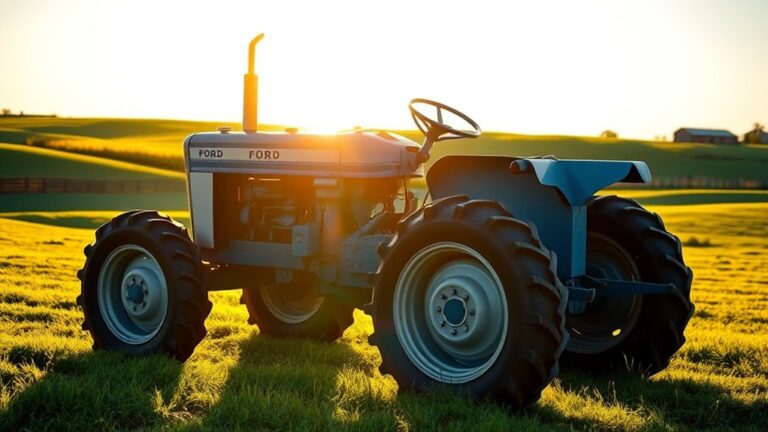
If you’re asking whether Ford still make tractors, the short answer is no, not under the Ford name. Ford tractors have a rich history, but the brand itself no longer produces new models. You can trace the line from Ford’s farm machines through New Holland and into CNH Industrial, where the brand was absorbed and the old blue tractors became history.
Yet the story doesn’t end there, because parts, legacy models, and collector demand still keep Ford tractors in the conversation—and that’s where things get interesting. Enthusiasts and farmers alike continue to value these machines for their durability and heritage. So, while Ford tractors are no longer made, their legacy definitely lives on.
Key Takeaways
- No, Ford does not currently make tractors under the Ford name.
- Ford tractor production ended after the brand transitioned into New Holland and CNH Industrial.
- Ford-branded tractors today are legacy machines, not new factory models.
- Current Ford tractor support comes from parts suppliers, collectors, and successor brands.
- If you want a modern tractor, look at New Holland, Case IH, Kubota, or John Deere.
Do Ford Still Make Tractors Today?
No, Ford does not currently make tractors under the Ford name. If you’re looking for Ford tractors today, you’ll find that production moved through a brand transition that ended Ford-branded agricultural machines.
You can still encounter older Ford tractors in farms, museums, and collector yards, and many remain in service because parts support and aftermarket repair networks still exist. In current dealerships, you’re more likely to see tractors carrying other names linked to Ford’s agricultural legacy, not the Ford badge itself.
This matters if you’re researching models, buying used equipment, or tracing serial numbers, because the historical Ford line and today’s offerings aren’t the same. For archival accuracy, you should treat Ford tractors as a legacy product, not a present manufacturing line.
Why Did Ford Stop Making Tractors?
You can trace Ford’s exit from tractor manufacturing to rising production costs, tighter competition, and the expense of keeping an aging product line current.
Ford also shifted its business strategy toward core automotive and industrial operations, which made tractors less central to its long-term plans.
In the brand transition that followed, Ford’s tractor business moved through licensing and ownership changes that marked the end of direct Ford production.
Rising Production Costs
Rising production costs played a major role in Ford’s exit from tractor manufacturing. You can trace the strain in raw materials, labor, tooling, and plant maintenance, all of which pushed unit expenses higher as older facilities aged.
In the history of branding, Ford’s tractor name had value, but keeping that identity profitable required constant investment in design, parts, and dealer support.
The impact of mergers also mattered, because corporate consolidation raised expectations for efficiency and tighter margins. You see that when a product line can’t absorb these costs without weakening returns, it becomes harder to justify.
Ford’s tractor operations faced that pressure for years, and the economics turned less favorable as manufacturing demands increased.
Strategic Business Shift
As those costs climbed, Ford began to see tractor production as less central to its long-term business. You can trace the decision to a broader strategic shift: Ford focused on higher-margin automotive and industrial lines, while agricultural machinery demanded specialized engineering, dealer support, and capital.
Ford tractors had served farms for decades, but management judged that the division no longer fit its core priorities. In archival terms, this was less a sudden exit than a calculated reallocation of resources. You should understand this as part of Brand evolution, where a large manufacturer narrows its portfolio to protect profitability and competitiveness.
Brand Transition History
Ford stopped making tractors under its own name because the brand changed hands and the business no longer fit Ford’s core strategy. If you trace the brand transition, you’ll see Ford sold its agricultural division to Ford New Holland, then New Holland became part of a broader corporate reshuffle.
In 1991, Fiat acquired Ford New Holland, and by 1993 the Ford name disappeared from new tractors. You can view this as a practical exit: Ford concentrated on automobiles and trucks, where it had stronger scale and higher returns.
Tractor manufacturing also faced rising production costs, tighter competition, and the need for specialized dealer support. So, when you examine the records, Ford didn’t abandon farming technology; it transferred the business to owners better positioned to continue it.
Who Makes Ford Tractors Today?
Today, Ford no longer makes tractors under the Ford name, and the company that once produced them has long since exited the agricultural equipment business. If you’re tracing ownership today, you should look to New Holland Agriculture, which inherited Ford’s tractor legacy through a series of mergers and rebrandings.
Ford tractors became part of a broader brand evolution when Ford sold its agricultural line in the 1980s, and New Holland later absorbed that lineage within CNH Industrial. You won’t find a current Ford-built tractor on the market, but you can still identify the old machines by their blue paint, model numbers, and parts interchangeability.
For collectors, that history affects collector value, since provenance and condition often matter more than age alone.
Are New Ford Tractors Still Sold?
You won’t find new Ford-branded tractors on today’s dealer lots, because Ford’s tractor line ended decades ago. The Ford name still carries weight in farm history, but new tractor sales now come from successor brands rather than Ford itself.
If you’re looking for current models, you’ll need to compare what those modern manufacturers offer instead.
New Ford Tractor Sales
If you’re looking for a brand-new tractor bearing the Ford name, the short answer is no: Ford no longer manufactures or sells new tractors under its own brand. You’ll find the record in the company’s shift away from tractor production and into tractor branding history.
Ford heritage remains visible in older machines, but current sales don’t include fresh Ford-badged models.
| Point | Detail |
|---|---|
| New sales | None under Ford branding |
| Original maker | Ford tractor division ended |
| Market presence | Used and collectible units |
| Name today | Licensing, not production |
You can still research model lines, serial references, and dealer archives, but any “new Ford tractor” listing should be treated carefully. In factual terms, the name survives more in documentation than in showroom inventory.
Brand Legacy Today
Although Ford no longer sells new tractors under its own badge, the brand’s legacy still shapes how buyers search, compare, and collect these machines. You’ll still see Ford names in auction records, parts catalogs, museum labels, and farm histories, where blue paint and old model numbers remain well documented.
Collectors often preserve them as working artifacts, while others display them in miniature farming scenes or with tractor toys that mirror the classic silhouettes. When you research Ford tractors today, you’re usually tracing heritage, not current production.
That legacy matters because it keeps the name visible in rural memory, trade literature, and restoration communities. For you, Ford means historical identity, proven design, and enduring recognition rather than a live factory brand.
New Model Availability
No, Ford does not sell new tractors today under the Ford name. If you’re looking for fresh Ford tractors, you won’t find current factory models in dealer inventories.
The brand transition moved tractor production from Ford to later corporate owners, so the name survives in records, not new sales. You may still encounter:
- Used Ford tractors on the secondary market
- Rebuilt units offered by specialists
- Parts and manuals from archival suppliers
- Modern tractors from successor brands
You should check serial numbers, model histories, and dealer documentation before buying. This helps you verify origin, year, and compatibility.
In archival terms, Ford’s tractor line remains historically important, but new-model availability ended with the brand transition, not with the machinery’s reputation.
How Ford Became New Holland
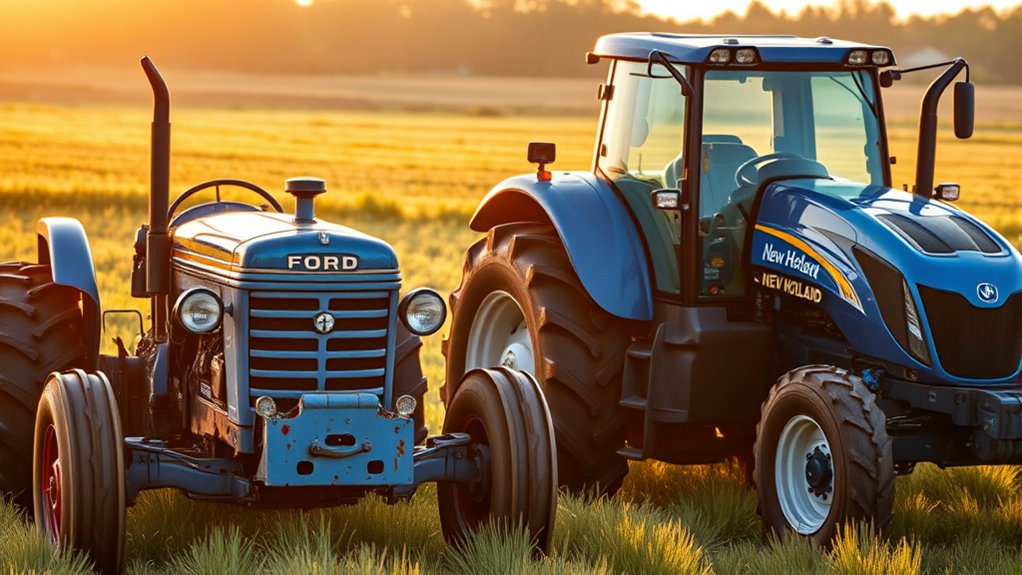
Ford’s tractor business did not disappear overnight; instead, it changed hands through a series of mergers and acquisitions that eventually linked the Ford name to New Holland. You can trace the path back to Ford partnerships with outside manufacturers, then to Ford’s agricultural division, which grew through postwar expansion.
In 1986, Ford bought a controlling stake in New Holland, a company with deep roots in agricultural equipment. By 1991, Ford and Fiat had formed a joint venture, and Ford’s tractor operations merged into the New Holland brand.
If you study antique farming records, you’ll see how this consolidation preserved dealer networks, engineering assets, and market presence. The Ford name faded from new tractors, but its machinery lineage lived on inside New Holland.
Ford Tractor Models Collectors Want Most
Among collectors, a few Ford tractors consistently stand out for their rarity, historical importance, and parts availability. You’ll often see the 9N, 2N, and 8N mentioned first because they mark Ford’s early tractor innovation and helped define wartime and postwar farm power. The N-series remains prized as vintage collectibles for its simple engineering and broad production numbers.
- 9N: introduced the three-point hitch.
- 2N: a wartime update with practical changes.
- 8N: Ford’s best-known classic, widely collected.
- Golden Jubilee NAA: a transitional model with notable styling.
You’ll also find 600 and 800 series tractors desirable for their stronger performance and documented place in Ford’s midcentury lineup.
Ford Tractor Parts and Support Today
Finding parts and support for Ford tractors is still straightforward for many classic models, especially the N-series, 600 series, and 800 series, because these machines have long production histories and strong aftermarket coverage. You can source mechanical, electrical, and sheet-metal components through tractor salvage yards, online suppliers, and specialty dealers that stock ford tractors items.
You’ll also find manuals, service diagrams, and serial-number references that help you match the correct part. For routine repairs, parts support often includes filters, gaskets, ignition pieces, and hydraulic seals. If you keep your model and year handy, you can verify fitment before ordering.
In archival terms, the network remains broad, with original-style replacements and used components available for common restorations and maintenance.
Modern Ford Tractor Alternatives
If you want a new tractor today, you’ll need to look beyond the Ford name, because Ford no longer builds tractors under its own brand. You can trace the company’s tractor line through historical mergers and modern branding, where the lineage shifted into other labels.
- New Holland: You’ll find Ford’s engineering legacy here, especially in utility and row-crop models.
- Case IH: You can compare this brand for broad dealer coverage and established farm equipment support.
- Kubota: You’ll see compact and subcompact options that suit smaller operations.
- John Deere: You’ll encounter a wide catalog with long-running market presence.
When you evaluate alternatives, you should check horsepower, service access, and attachment compatibility, because those details matter more than the badge alone.
What Ford Tractors Are Worth Buying Now?
The Ford tractors worth buying now are usually the well-kept used models from the Ford and Ford/New Holland era, especially the 8N, 9N, 2N, 3000, 4000, 5000, and 6610 series. They still offer solid parts support, simple mechanics, and enough capability for small farms, property work, and light utility tasks.
You’ll get the best value when you inspect engine compression, hydraulics, tires, and transmission condition before you buy. If you want Ford heritage, these machines show the brand’s durable engineering without the cost of newer equipment.
Some tractor collectibles matter to historians, but that’s not relevant if you need dependable work capacity. You should favor original, complete examples with documented maintenance, since clean survivors hold value and stay serviceable.
Frequently Asked Questions
Are Ford Tractors Still Used on Small Farms?
Yes, you’ll still find Ford tractors on small farms, where you value reliability and low upkeep. Tractor nostalgia often preserves them, but economic viability keeps them working, especially when you can source parts and maintain them.
Which Ford Tractor Year Is Most Reliable?
You’ll usually find the Ford 3000 and 4000 among the most reliable; which Ford year you choose matters less than condition.
For tractor reliability, late-1960s to mid-1970s models often deliver durable, simple performance.
Can Ford Tractor Badges Be Restored?
Yes, you can restore badges by cleaning, repainting, and re-plating them. You’ll want careful paint matching to preserve original lettering and finish.
For damaged emblems, you can often source reproduction parts or have originals refinished.
Do Ford Tractors Have Strong Resale Value?
Yes, your Ford tractor can shine like a weathered coin in a collector’s vault; strong tractor branding often supports solid resale markets. You’ll usually see better values on well-kept, original machines with documentation.
Where Can I Find Ford Tractor Manuals?
You’ll find Ford tractor manuals through Ford/New Holland dealers, online archives, auction sites, and enthusiast forums.
Search official Ford manuals by model number; they often include service data, parts lists, and accessory upgrades.
Conclusion
In the end, you won’t find new Ford tractors rolling off the line today; the blue badge has long since passed into the New Holland era. If you’re chasing a Ford, you’re looking at history, not the showroom. Like a well-kept ledger from another age, Ford’s tractor legacy endures through collectors, parts suppliers, and successor brands.
So if you need modern muscle, you’ll choose a current CNH, Kubota, or John Deere machine instead. When it comes to whether Ford still make tractors, the answer is clear: they do not produce new tractors anymore, but their legacy lives on through other brands and enthusiasts.


