Did Ford Own Mazda
As an Amazon Associate we earn from qualifying purchases.

Did Ford own Mazda? The answer is nuanced. Like a hand on a steering wheel rather than a full takeover, Ford didn’t own Mazda outright; you can trace the relationship to a major equity stake that gave Ford board influence and some sway over strategy.
Mazda kept its own name, engineering culture, and design direction, even as the two firms shared platforms and parts. But that balance didn’t stay fixed, and the real turning point came when Ford began stepping back.
Key Takeaways
- Ford did not fully own Mazda; it held a significant minority stake and board influence.
- Ford’s 1979 investment gave it control rights without absorbing Mazda into Ford.
- Mazda remained an independent Japanese automaker with its own identity and design choices.
- Ford and Mazda shared platforms, engineering, and product planning through their alliance.
- Ford later reduced and exited its stake as priorities and financial pressures changed.
Did Ford Own Mazda?

Ford did not outright own Mazda, but it did become Mazda’s largest shareholder and exercised significant influence over the company for decades. You can see the relationship as control without full absorption: Ford held a major stake, shaped strategy, and helped guide operations while Mazda remained a separate Japanese automaker.
This mattered historically because the arrangement let both firms test cross cultural management and align manufacturing, engineering, and branding strategies across markets. You’ll notice Ford’s influence showed up in product planning and corporate decisions, yet Mazda kept its own identity, especially in design and performance tuning.
How Ford and Mazda Became Partners
You can trace Ford and Mazda’s partnership to the late 1970s and early 1980s, when financial strain and industry upheaval pushed both companies toward cooperation. They began sharing platforms and engineering work to cut costs, while Ford bought an equity stake that gave it real influence over Mazda’s direction.
This alliance grew from practical necessity, not a full takeover, and it set the terms for decades of collaboration.
Early Partnership Roots
Long before Ford became Mazda’s major shareholder, the two companies were drawn together by practical need rather than grand strategy. You can trace their bond to the 1970s, when Mazda sought credibility abroad and Ford wanted smaller, efficient expertise.
Their early talks were shaped by:
- market pressure
- capital shortages
- export ambitions
These two word discussion ideas show why cooperation made sense, while any Subtopic irrelevance stays obvious if you focus on business realities. You’ll see Ford’s interest wasn’t charity; it was a calculated response to shifting oil markets and Japanese competition.
Mazda, meanwhile, gained access to a larger global network without surrendering its identity. That early arrangement set a cautious, transactional tone, and it laid the groundwork for later, deeper collaboration.
Shared Platform Development
As their relationship deepened, Ford and Mazda turned cooperation into concrete engineering by sharing platforms, components, and production know-how. You can see the logic in the 1980s and 1990s, when both firms sought lower costs and faster development without sacrificing distinct identities.
Shared architecture let you spot common hard points beneath different bodywork, while each brand kept its own tuning and styling.
| Area | Ford | Mazda |
|---|---|---|
| Platform use | Compact cars | Small cars |
| Parts sharing | Engines, transmissions | Engines, transmissions |
| Plant cooperation | Global assembly | Global assembly |
| Brand effect | Cost control | Distinctive feel |
For fact checking, note that this wasn’t simple badge engineering. Ford used shared foundations to support its branding strategy, and Mazda balanced efficiency with driving character.
Equity Stake and Influence
Ford’s influence over Mazda grew through a series of equity moves rather than a full takeover, and that distinction shaped the partnership from the start. You can trace the relationship to Ford’s 1979 purchase of a minority stake, which gave it boardroom access without erasing Mazda’s identity.
As Mazda struggled financially, you saw Ford’s leverage expand through strategic investment, shared engineering, and cross licensing agreements.
- Ford guided product planning while Mazda kept design autonomy.
- Both brands used global branding to strengthen market reach.
- Equity ties let Ford steer policy without owning Mazda outright.
Ford’s Ownership Stake in Mazda
You can trace Ford’s role in Mazda back to its initial investment, when Ford took a minority stake to strengthen ties with the Japanese automaker. Over time, that partnership expanded as the two companies shared technology, platforms, and manufacturing know-how, which deepened Ford’s influence without giving it full control.
Ford’s Initial Investment
In the late 1970s and early 1980s, Ford began building a strategic stake in Mazda, starting with a minority investment that gave it influence without outright control. You can trace this move in Ford’s ownership history as a calculated response to shifting regional markets and tighter competition.
Ford didn’t buy Mazda outright; instead, it took a measured position that let it observe, learn, and shape decisions.
- You saw Ford gain a foothold in Japan-linked manufacturing.
- You noticed Mazda keep operational independence.
- You watched Ford use the stake to test long-term value.
This initial investment mattered because it balanced risk and access. You can view it as Ford’s first careful step toward a deeper industrial relationship, not a takeover.
Mazda Partnership Expansion
As Ford’s stake in Mazda grew through the 1980s and into the early 1990s, the relationship moved beyond a simple minority investment into a broad industrial partnership. You can see Ford using Mazda’s engineering to sharpen small-car programs, while Mazda gained access to Ford’s capital, distribution, and managerial discipline.
The two companies coordinated platform sharing, especially in compact and subcompact models, and you’d notice how that cooperation improved cost control and accelerated development. Ford also drew on Mazda’s expertise in efficient manufacturing, helping both firms tighten the supply chain across Asia and North America.
In effect, the alliance supported a Mazda brand reboot, giving the Japanese automaker fresh momentum without erasing its identity. By then, Ford wasn’t just a shareholder; it was a strategic partner.
Ford’s Stake Reduction
During the late 1990s and early 2000s, Ford steadily reduced its ownership stake in Mazda as both companies adjusted to shifting market pressures and corporate priorities. You can see the move as part of Ford’s broader brand strategy, not a sudden breakup. Ford trimmed shares to free capital, narrow exposure, and focus on core operations while Mazda pursued greater independence.
Ford’s stake fell as restructuring pressure mounted. Mazda kept technical ties, but control weakened. Investors read the change through impact storytelling about survival and renewal.
How Much Control Ford Had Over Mazda?
Ford did not fully control Mazda, but it did hold enough power to shape major decisions for years. You should view Ford’s role as that of a dominant partner, not an owner with absolute authority.
Ford wasn’t Mazda’s full owner, but it wielded enough influence to shape major decisions.
Through its equity stake, board influence, and management agreements, Ford could steer strategy, financing, and restructuring priorities, especially during Mazda’s difficult periods in the 1990s and early 2000s. Yet Mazda kept its own identity, engineering culture, and executive chain.
Ford’s influence was real, but it stopped short of day-to-day command. A related unrelated topic is labor policy, while a tangential concept is global alliance building; both mattered, but they don’t explain ownership.
In historical terms, Ford’s control was substantial, conditional, and negotiated, reflecting partnership more than possession.
Ford and Mazda Models That Shared Parts

That influence became most visible in the vehicles the two companies built on shared hardware. You can trace Ford and Mazda cooperation through badge-engineered cousins and joint platforms, not through ownership drama.
The Mazda B-Series and Ford Ranger shared core parts, while the Mazda Tribute and Ford Escape rode the same compact SUV architecture. You’ll also notice related engines, suspensions, and transmissions appearing across both lineups, reflecting practical engineering rather than corporate governance control.
- B-Series and Ranger: pickup twins
- Tribute and Escape: shared SUV bones
- 626 and Mondeo-era links: platform overlap
These models mattered because they let you see how global automakers cut costs and sped development. The question of who owned whom is not relevant here; the evidence sits in the sheet metal and underbody pieces.
What Mazda Gained From Ford’s Involvement
Although Mazda kept its own identity, Ford’s involvement gave it capital, engineering support, and access to a wider global distribution network. You can trace the benefits in Mazda’s late-1990s recovery, when shared platforms lowered costs and Ford expertise improved manufacturing discipline.
Britain’s Influence mattered too, because Ford’s European operations helped Mazda study compact-car trends and export tastes.
| Gain | Effect | Scope |
|---|---|---|
| Capital | Funded development | Japan |
| Engineering | Sharper product planning | Plants |
| Distribution | Broader dealer reach | Global Markets |
| Purchasing | Lower component costs | Supply chain |
| Strategy | Faster market entry | Europe, Asia |
You see a company that learned to compete beyond domestic limits while still preserving its brand character.
Why Ford Reduced Its Mazda Stake
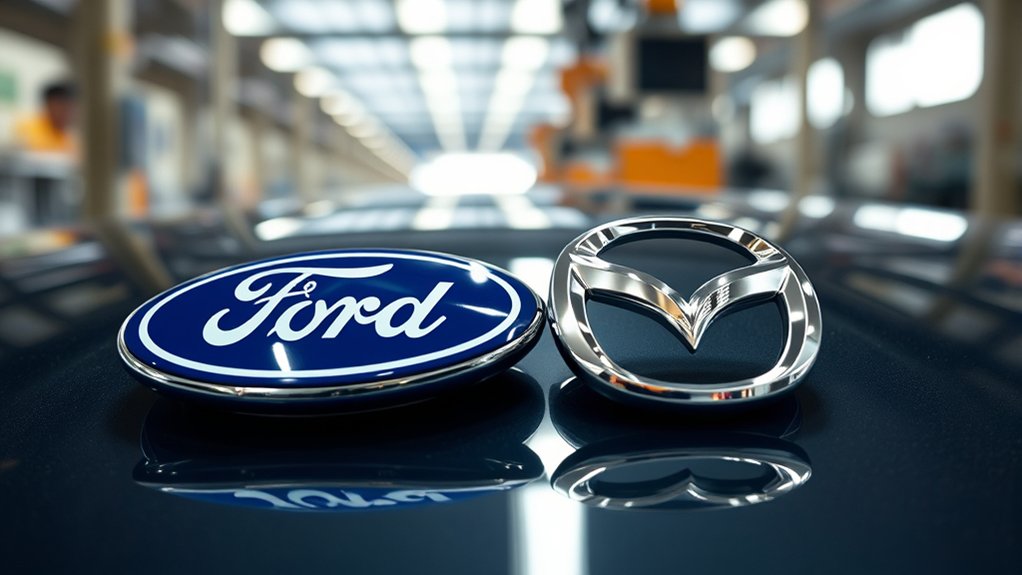
As the 2000s began, Ford trimmed its Mazda stake because the partnership no longer fit its strategic priorities or financial pressures. You can see the move as a pragmatic retreat, not a sudden break. Ford had to protect cash, refocus management, and reduce exposure to overseas brands that didn’t directly support its core branding strategy.
You’d notice Ford’s history bias toward owning control, not just holding shares. You’d also see Mazda becoming more self-directed as Ford reassessed global alliances. You can trace the sale decisions to Ford’s need to streamline assets during a turbulent auto market.
In historical terms, Ford used partial divestment to preserve flexibility, while still keeping useful ties to Mazda’s engineering and market reach.
How Mazda Changed After Ford Left
Once Ford stepped back, Mazda moved faster toward an independent identity, reshaping its product strategy, engineering priorities, and global operations around its own brand rather than a parent’s direction. You could see the shift in cleaner styling, lighter platforms, and a sharper focus on driving feel.
Mazda began to centralize decisions, trim overlap, and invest where it thought its future lay: efficient engines, disciplined manufacturing, and designs that could ignite design interest without excess. It also leaned harder on race tech, translating motorsport lessons into road cars to sharpen handling and responsiveness.
Freed from outside pressure, Mazda pursued a more coherent lineup, with each model serving a clearer role. That change didn’t happen overnight, but it gave Mazda a more distinct voice and a stronger strategic rhythm.
Ford’s Legacy in Mazda’s History
Ford’s years as Mazda’s partner left a lasting imprint on the company’s structure, habits, and product development. You can trace that legacy in shared platforms, disciplined manufacturing, and a sharper global branding strategy. Ford didn’t just supply capital; it exposed Mazda to managerial routines, engineering trade secrets, and international market logic that shaped later decisions.
You see tighter coordination between design and production.
You notice a stronger focus on efficiency and cost control.
You recognize how joint work refined Mazda’s export identity.
Historically, this partnership helped Mazda survive financial pressure while preserving its engineering identity. Even after Ford reduced control, the habits remained. You’re looking at a company that learned from its ally, then adapted those lessons into a more independent, competitive future.
Frequently Asked Questions
When Did Ford First Invest in Mazda?
Ford first invested in Mazda in 1979, when you’d see the start of the Ford Mazda collaboration. That move launched global partnerships, deepened technical ties, and reshaped both companies’ strategies for decades.
Did Ford and Mazda Ever Share Engines?
Yes you’ll find Ford and Mazda shared engines through did ford mazda collaboration and cross brand engineering.
You can trace joint designs in compact cars and trucks from the 1970s onward, blending efficiency, durability, and cost savings.
Which Mazda Vehicles Used Ford Platforms?
You’d see Mazda platforms under models like the Tribute, Navajo, and Mazda2-derived Ford twins. Mazda partnerships and Ford investments shaped the B-series pickup, Mazda MPV, and some shared compact architectures through the 1990s and 2000s.
Was Mazda Ever Fully Owned by Ford?
No, you wouldn’t find Mazda fully owned by Ford. For example, in 1996 Ford held a major stake, yet Mazda kept its own ownership structure.
Disclosure timing later showed Ford never reached complete control.
Did Ford’s Stake Affect Mazda’s Japanese Operations?
Yes, Ford’s stake mostly didn’t alter Mazda’s Japanese operations directly; you’ll see topic relevance in ownership and historical nuance in strategy.
Mazda kept local management, production, and engineering autonomy in Japan.
Conclusion
So, did Ford own Mazda? Not exactly—though for a time, it acted like the older sibling who “just happens” to control the car keys. You can see Ford’s hand in Mazda’s strategy, shared parts, and boardroom influence, but Mazda kept its own name, design sense, and engineering identity.
In the end, Ford’s stake faded, and Mazda drove off more independently, proving that partial control isn’t the same as ownership. Therefore, while Ford had significant influence, it never fully owned Mazda.


