Top 10 Best Value Car Battery Picks That Win
As an Amazon Associate we earn from qualifying purchases.
Best value car battery decisions now involve far more than sticker price. Modern vehicles rely on precise electrical delivery, efficient charging, and dependable starting power across changing conditions. A cost-effective automotive battery must balance cold-cranking amps, reserve capacity, and service life without compromising compatibility with onboard electronics.
Meanwhile, AGM construction, vibration resistance, and start-stop technology are reshaping expectations for replacement batteries in commuter cars, trucks, and performance-focused vehicles. The challenge is distinguishing meaningful engineering advances from attractive claims, especially when climate, driving patterns, and electrical demand affect real-world results.
Understanding these factors can reveal why some affordable options outperform seemingly stronger alternatives—and which specifications deserve closer scrutiny. Continue reading to uncover the buying signals that separate genuine value from a battery that only looks inexpensive.
best value car battery: Top Picks
| Image | Product | Buy |
|---|---|---|
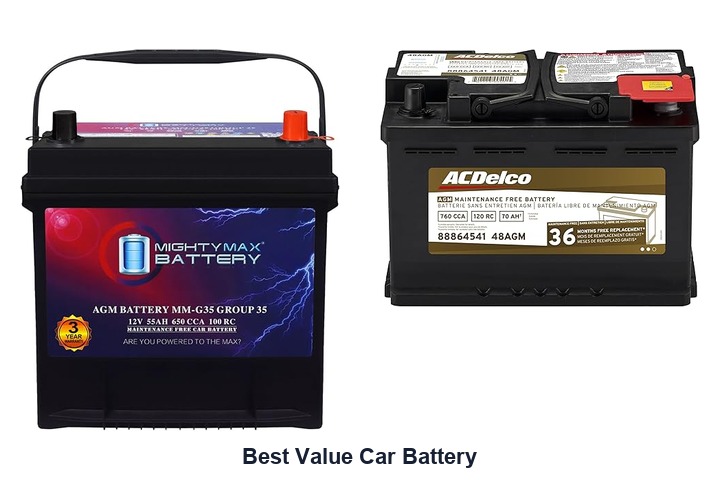
Top Picks- 1  | Mighty Max Battery MM-G35 Start and Stop Car BCI Group Best for: Start-stop vehicles | Check Price On Amazon |
Top Picks- 2  | ACDelco Gold 48AGM (88864541) 36 Month Warranty AGM BCI Group Best for: Warranty-focused drivers | Check Price On Amazon |
Top Picks- 3  | ACDelco Gold 94RAGM (88864542) 36 Month Warranty AGM BCI Group Best for: Large vehicles | Check Price On Amazon |
Top Picks- 4  | Weize Platinum AGM Battery BCI Group 35 Automotive Battery, 100RC, Best for: Everyday drivers | Check Price On Amazon |
Top Picks- 5  | UPLUS BCI Group 35 AGM Car Battery, 12V 55Ah 650CCA Best for: High-demand commuters | Check Price On Amazon |
1. Mighty Max Battery MM-G35 Start and Stop Car BCI Group
Best for: All-weather drivers needing AGM reserve.
A 12-volt, 55Ah AGM battery with 650 CCA gives passenger cars strong starting output across seasonal temperatures. Its sealed, spill-proof construction avoids water filling and helps contain electrolyte, while the 100-minute reserve capacity supports longer accessory operation when the engine is off.
The MM-G35 uses a BCI Group 35 vehicle-specific fit, so buyers must match the application rather than assume universal compatibility. Its 100-minute reserve capacity provides a defined buffer for electrical loads, and the AGM format supports high-discharge output with deep-discharge recovery. Shock- and vibration-resistant construction adds protection for vehicles exposed to rough roads or frequent stop-and-start driving.
Pros
- 650 CCA supplies strong starting output
- 55Ah capacity supports regular passenger-car electrical loads
- 100-minute reserve capacity extends accessory runtime
- Sealed AGM construction prevents spills and water maintenance
Cons
- Vehicle-specific fit requires checking the BCI Group 35 application before purchase
Choose the MM-G35 for a passenger-car owner who wants 650 CCA, AGM spill protection, and a 100-minute reserve. It suits drivers who regularly face seasonal starts or accessory use with the engine off.
2. ACDelco Gold 48AGM (88864541) 36 Month Warranty AGM BCI Group
Best for: High-cycle buyers prioritizing low resistance.
A 0.02-ohm resistance rating gives the 12-volt ACDelco Gold 48AGM a low-resistance electrical path for its six-cell design. High-density negative paste and a calcium-lead positive grid support conductivity and repeated cycling, making this vehicle-specific AGM option relevant to truck owners seeking value through internal construction rather than headline capacity figures.
The battery uses an enhanced-life alloy or Silver Calcium stamped alloy to support cycle life, while its robust envelope separator has a puncture-resistant back. That separator allows increased acid circulation and helps prevent shorts, and the vent-cap design resists acid escape. A listed 36-month warranty gives buyers a defined coverage period for this 12-volt, six-cell configuration.
Pros
- 0.02-ohm resistance supports efficient electrical conduction
- High-density negative paste supports performance and battery life
- Silver Calcium alloy supports increased cycle life
- Puncture-resistant separator improves acid circulation and short prevention
Cons
- Vehicle-specific fit means truck owners must verify application compatibility before ordering
The 48AGM fits buyers who value low resistance, six-cell AGM construction, and a listed 36-month warranty. It is a practical match for a compatible truck application where cycling support matters more than a published amp-hour figure.
3. ACDelco Gold 94RAGM (88864542) 36 Month Warranty AGM BCI Group
Best for: High-cycling AGM buyers with marine terminals.
A high-density plate oxide layer gives the ACDelco Gold 94RAGM more power per pound and dependable high-cycling service. Its 12-volt AGM construction combines a calcium-lead positive grid with a low-resistance current path, offering a vehicle-specific battery for buyers who need repeated electrical cycling and a listed 36-month warranty.
The 94RAGM uses enhanced-life alloy or Silver Calcium stamped alloy to support cycle life and performance. Its robust envelope separator has a puncture-resistant back that improves acid circulation and helps prevent shorts, while the high-density negative paste supports battery life. The product lists a marine terminal and one cell, so terminal and application compatibility deserve careful verification before installation.
Pros
- High-density plate oxide maximizes power per pound
- Silver Calcium alloy supports enhanced cycle life
- Puncture-resistant separator helps prevent internal shorts
- 36-month warranty supplies a defined coverage period
Cons
- The listed marine terminal and one-cell specification require careful fitment verification
Consider the 94RAGM when high-cycling service and power-per-pound construction are more important than a published capacity figure. Buyers should confirm the marine terminal and vehicle application before choosing this 12-volt AGM battery.
4. Weize Platinum AGM Battery BCI Group 35 Automotive Battery, 100RC,
Best for: Group 35 owners needing clear fit dimensions.
Measuring 9.06 by 6.89 by 8.82 inches, the Weize Platinum AGM provides a concrete Group 35 fit reference for passenger-car owners. Its 55Ah capacity and 650 CCA combine everyday electrical supply with strong starting output, while the AGM format suits vehicles that originally use AGM batteries.
The battery has tapered terminals with negative on the left and positive on the right, so terminal position matters as much as case size during replacement. Its 100-minute reserve capacity supports electrical loads during engine-off periods, and the listed cycle life reaches up to twice that of conventional batteries. The 12-volt rating matches standard passenger-car electrical systems.
Pros
- 9.06-by-6.89-by-8.82-inch case simplifies physical fit checking
- 55Ah capacity supports routine passenger-car power demands
- 650 CCA provides strong starting output
- 100-minute reserve capacity supports longer engine-off operation
Cons
- Left-negative, right-positive tapered terminals can prevent installation in vehicles with another layout
This Weize battery suits Group 35 passenger-car owners who can match the 9.06-by-6.89-by-8.82-inch case and terminal orientation. It is especially useful for AGM-equipped vehicles needing 650 CCA and a 100-minute reserve.
5. UPLUS BCI Group 35 AGM Car Battery, 12V 55Ah 650CCA
Best for: Universal-fit Group 35 replacement shoppers.
The UPLUS Group 35 AGM pairs 12 volts, 55Ah, and 650 CCA with a 9.51-by-6.85-by-8.78-inch case. That combination gives passenger-car owners a clearly specified replacement target, while the left-negative, right-positive layout helps buyers compare terminal placement before installation.
Its universal-fit listing makes old-battery measurement particularly important because the stated case dimensions determine whether the unit will sit correctly. The AGM design includes high-density negative paste for repeated cycling, and the product description claims four times extra cycling compared with its reference conventional battery. The 55Ah capacity supports normal electrical loads, while 650 CCA targets dependable engine starting.
Pros
- 55Ah capacity supports everyday passenger-car electrical use
- 650 CCA supplies strong starting performance
- 9.51-by-6.85-by-8.78-inch dimensions enable direct size comparison
- Left-negative, right-positive layout clarifies cable positioning
Cons
- Universal-fit labeling still requires measuring the old battery and checking terminal placement
Pick the UPLUS for a passenger-car owner replacing a Group 35 battery who wants explicit dimensions, 55Ah capacity, and 650 CCA. It fits buyers willing to verify the 9.51-by-6.85-by-8.78-inch case before ordering.
6. ACDelco Gold AUX14-200 (88866185) 36 Month Warranty Auxiliary AGM 200

Best for: Auxiliary AGM systems needing maintenance-free cycling.
The ACDelco Gold AUX14-200 is a 12-volt auxiliary AGM battery with six cells and an AGM terminal. Its maintenance-free, leak-proof format eliminates water service and helps prevent acid damage, giving compatible passenger-car auxiliary systems a contained power source for repeated deep-cycle operation.
A 0.33-milliohm resistance specification identifies the electrical path, while high-density plate oxide supports power per pound and high-cycling service. Heavy top lead and large through-partition connections help maximize power output, and the pressurized valve system helps prevent dry-out. The vehicle-specific fit and 36-month warranty make application checking and coverage length central to the buying decision.
Pros
- AGM construction requires no water maintenance
- Leak-proof pressurized valve system helps prevent acid damage
- Heavy top lead supports higher power output
- High-density plate oxide supports repeated cycling
Cons
- Vehicle-specific fit and AGM terminal limit it to compatible auxiliary applications
The AUX14-200 is aimed at owners replacing a compatible passenger-car auxiliary battery, not a generic primary starter battery. Choose it when maintenance-free AGM cycling, leak control, and a listed 36-month warranty match the vehicle application.
7. OPTIMA Batteries High Performance 34/78 RedTop Sealed AGM Car, Truck,
Best for: High-CCA buyers needing dual terminal posts.
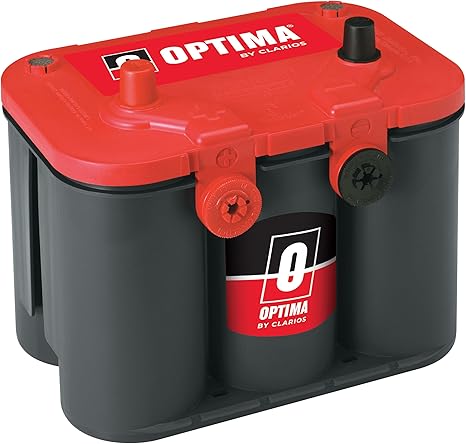
An 800-CCA rating gives the OPTIMA 34/78 RedTop the strongest listed starting output in this group, while its 12-volt SpiralCell AGM construction targets passenger cars and trucks. Dual SAE and GM posts expand terminal connection options, and the 100-minute reserve capacity supports sustained electrical loads after starting.
The battery measures 10.06 inches long, 6.94 inches wide, and 7.88 inches tall, with a listed 38.8-pound weight for buyers checking both fit and handling. Its C20 capacity is 50Ah, and 99.99% pure lead SpiralCell technology is specified for higher power than conventional flat-plate construction. The vehicle-specific fit still requires application verification.
Pros
- 800 CCA provides the highest listed starting output here
- Dual SAE and GM posts support more connection formats
- 100-minute reserve capacity supports longer constant loads
- 50Ah C20 capacity provides a defined energy figure
Cons
- The 10.06-inch length and 38.8-pound weight require careful space and handling checks
Choose the 34/78 RedTop for a compatible car or truck needing 800 CCA and dual SAE/GM posts. It is a strong value match for buyers who want high starting output plus a 100-minute reserve.
8. Group 47 H5 L2 Car Battery 12v 60AH 660CCA AGM

Best for: Start-stop commuters needing faster AGM charging.
A 60Ah AGM capacity and 660 CCA give this Group 47 battery a little more listed energy and starting output than many compact AGM replacements. Its 9.53-by-6.89-by-7.48-inch case supports direct fit comparison, while the start-stop specification targets commuters whose vehicles repeatedly restart during traffic.
The battery uses an A1 terminal and a 12-volt system, so both the terminal style and vehicle wiring must match before installation. Its maintenance-free AGM construction removes routine water service, and the description claims charging 40% faster than SLA batteries. The Group 47, DIN H5, and L2 replacement references help buyers cross-check the original battery size.
Pros
- 60Ah capacity supports repeated start-stop electrical demand
- 660 CCA provides strong engine-starting output
- 9.53-by-6.89-by-7.48-inch dimensions simplify fitment checks
- AGM construction requires no routine water maintenance
Cons
- The A1 terminal specification may not match vehicles using another terminal style
This Group 47 AGM suits start-stop passenger-car owners who need 60Ah, 660 CCA, and a compact H5 or L2 replacement reference. Confirm the A1 terminal and case dimensions against the original battery before buying.
9. Lithium LiFePO4 Car Battery Auto Battery, 12V 40Ah, 660CCA, 100RC

Best for: Small-engine drivers seeking lightweight lithium power.
At 14.8 pounds, this 12-volt LiFePO4 battery weighs substantially less than the listed AGM alternatives while providing 660 CCA. Its 40Ah capacity, 100-minute reserve, and 9.5-by-6.9-by-8-inch dimensions target passenger cars with engines below 2.0 liters and drivers prioritizing low weight.
The universal-fit battery uses an M8 terminal and an IP66 waterproof rating, giving buyers two compatibility points beyond case size. Its lithium chemistry requires a full charge before first use according to the product guidance, and the stated 660 CCA supports starting output despite the 40Ah capacity. Engine displacement below 2.0 liters is the stated application limit.
Pros
- 14.8-pound weight reduces lifting and vehicle load
- 660 CCA supplies strong starting output
- IP66 rating supports waterproof protection
- 100-minute reserve capacity provides a defined runtime buffer
Cons
- The stated below-2.0-liter engine limit excludes larger-engine applications
Choose this LiFePO4 battery for a passenger-car owner with an engine below 2.0 liters who values 14.8-pound weight and 660 CCA. Plan to fully charge it before first use and verify the M8 terminal connection.
10. OPTIMA® Batteries High Performance 35 REDTOP® Sealed AGM Battery |

Best for: Compact trucks and cars needing SpiralCell AGM.
The OPTIMA 35 RedTop combines 720 CCA with a 9.38-by-6.75-by-7.69-inch case, giving compatible cars and trucks a compact starting battery with substantial cranking output. Its sealed AGM format and SAE post terminals simplify the choice for buyers replacing a vehicle-specific battery in a matching tray.
A 44Ah C20 capacity supplies a defined energy figure, while the 90-minute reserve capacity supports constant electrical loads after the engine stops. SpiralCell technology uses 99.99% pure lead and is specified to outperform conventional flat-plate batteries, and the listed 31.7-pound weight provides a concrete handling reference. The 12-volt system fits compatible passenger-car and truck applications.
Pros
- 720 CCA provides strong starting power
- 9.38-by-6.75-by-7.69-inch size supports compact fit checks
- 90-minute reserve capacity supports extended constant loads
- 31.7-pound weight gives a defined handling benchmark
Cons
- Vehicle-specific fit and SAE posts may not match applications using another case or terminal arrangement
The OPTIMA 35 RedTop fits car and truck owners who need 720 CCA in a 9.38-inch-long case. It is a sensible choice for buyers seeking sealed AGM construction, SAE posts, and a 90-minute reserve.
How to Choose the Best Value Car Battery
Vehicle fit and battery size
Start with the group size printed in the owner’s manual, then match the replacement battery exactly rather than choosing by appearance. Confirm the length, width, height, positive-terminal position, and terminal style, since a reversed layout can leave cables too short. Check that the case fits the factory holddown bar or clamp and that the hood closes without touching the terminals.
Measure cable reach and tray clearance before ordering, especially on compact cars and vehicles with tight engine bays. Choose the exact manual-listed group size with matching terminals and holddown hardware for the safest value.
Starting power and reserve capacity
Use the manual’s minimum cold-cranking-amp rating as the floor, then select a battery with a modest reserve above it for dependable starts in your climate. Higher CCA matters most in freezing regions, while excessive output adds little benefit to a mild-weather commuter. Reserve capacity shows how long the battery supports lights, alarms, infotainment, and accessories during an alternator fault or extended idle, so prioritize it for work vehicles and electronics-heavy cars.
Choose a battery meeting the required CCA with strong reserve capacity for cold climates, frequent accessories, or long roadside waits.
Battery construction and durability
Choose flooded lead-acid construction for a conventional vehicle with moderate vibration, accessible mounting, and straightforward maintenance. Select AGM construction for vehicles with start-stop systems, heavy accessory loads, frequent short trips, or severe vibration; its absorbed electrolyte, sealed case, and stronger cycling performance suit demanding use. Look for reinforced separators, vibration-resistant labeling, leak-resistant casing, and secure venting rather than relying on marketing claims alone.
A sealed AGM battery is the decisive pick for demanding electrical loads and rough conditions; a quality maintenance-free flooded battery suits ordinary daily driving and simpler replacement needs.
Warranty and ownership value
Read the warranty in full, separating the free-replacement period from the later prorated period, which provides reduced credit rather than a direct replacement. Confirm the claim process, approved retailers, return window, receipt requirements, battery testing rules, and coverage for defects after installation. A longer free-replacement term carries more practical value than an impressive total term dominated by prorated credit.
Compare the warranty with the battery’s expected service life and your driving pattern, then choose the model offering the longest clear free-replacement coverage and straightforward proof-of-purchase rules for dependable ownership value.
Installation and maintenance needs
Check the vehicle service information before installation because newer cars often require battery registration, charging-system resets, or computer calibration after replacement. Favor a battery with accessible terminals, a visible charge indicator where applicable, and a case that fits the original tray and holddown without improvised spacers. Plan periodic terminal inspection and cleaning, voltage or charging checks, and prompt correction of loose connections.
Wear eye protection, avoid sparks, and use an approved recycling outlet for the old unit. Choose a direct-fit battery with simple terminal access for owners handling routine care, or professional installation for electronically managed vehicles requiring registration.
Which Should You Choose?
- If your vehicle requires a BCI Group 35 battery and you want dependable all-season starting power, choose a 12V 55Ah battery rated around 650 CCA with at least 100 minutes of reserve capacity.
- If your car has start-stop technology or heavy electrical demands, choose an AGM battery in the exact required group size, such as Group 48, 94R, or 47, with roughly 660 CCA or more.
- If you are replacing a dedicated auxiliary battery, choose a maintenance-free auxiliary AGM battery designed for the vehicle’s specified auxiliary-battery size.
- If you need strong starting performance and flexible terminal compatibility for a truck or performance vehicle, choose a sealed AGM battery with around 720–800 CCA and dual SAE/GM posts.
Quick Best Value Car Battery Buying Checklist
- Verify group size: Match the battery dimensions and classification to your vehicle manual.
- Check terminal layout: Confirm positive and negative post positions match the cable arrangement.
- Compare CCA: Choose sufficient cold-cranking amps for the engine and local climate.
- Review reserve capacity: Look for enough backup power to support accessories when the engine is off.
- Inspect warranty terms: Compare replacement coverage, prorated periods, and return requirements.
- Confirm installation needs: Check mounting hardware, charging requirements, and any vehicle battery-registration procedure.
Frequently Asked Questions
What Makes A Car Battery The Best Value?
The best value car battery is one that matches your vehicle’s fitment, required cold-cranking amps, reserve capacity, and warranty without paying for unnecessary upgrades. Compare the battery group size, terminal layout, driving climate, and replacement coverage, because a cheaper purchase can cost more if it starts poorly or fails early.
Is An Agm Battery Worth The Extra Cost?
An AGM battery is worth choosing for the best value car battery when the vehicle uses start-stop technology, powers many accessories, or requires spill-resistant construction. Conventional flooded batteries usually cost less and suit standard vehicles, while AGM batteries offer stronger vibration resistance and deeper cycling but may not deliver value in a basic commuter car.
How Many Cold-Cranking Amps Should A Car Battery Have?
The best value car battery should provide enough cold-cranking amps for reliable starting in your climate, not simply the highest published number. Use the vehicle manufacturer’s specification as the baseline, then consider reserve capacity for accessories; excessive CCA can add cost without improving performance when fitment and electrical demands are already satisfied.
How Can Battery Maintenance Improve Value?
Car battery maintenance improves value by slowing corrosion and preventing avoidable discharge. Keep terminals clean and tight, secure the battery against vibration, avoid leaving lights on, and test resting voltage or charging performance when starting becomes sluggish; sealed batteries need less servicing, but they still require correct charging and inspection.
Does A Longer Warranty Make A Car Battery A Better Buy?
A longer replacement warranty can make a car battery better value by reducing financial risk if the unit fails prematurely. Check the free-replacement period, prorated terms, return process, and proof-of-purchase requirements, and confirm that the warranty applies to the exact group size and battery type your vehicle requires.
Final Suggestions
Choosing the best value car battery means matching group size, terminal position, CCA, reserve capacity, construction, and warranty to your vehicle and driving conditions. The right battery delivers dependable starts, durable service, and sensible ownership costs without paying for capacity or technology you do not need. Check fitment carefully, compare meaningful specifications, and make your purchase confidently for reliable everyday performance through every season.