Top 10 Best Electric Car Battery Picks That Impress
As an Amazon Associate we earn from qualifying purchases.
The best electric car battery sits at the center of every EV’s performance, efficiency, and ownership experience. More than a storage unit, an EV battery pack must balance energy density, charging speed, thermal management, weight, and long-term durability. Cell chemistry, battery management systems, and enclosure materials all influence how reliably an electric vehicle battery delivers power in traffic, on highways, and across changing temperatures.
These technical differences can affect driving range, charging cycles, safety, replacement costs, and the confidence to travel farther without range anxiety. Yet specifications often reveal only part of the story, while compatibility and real-world operating demands add another layer of complexity.
Understanding how these factors interact makes it easier to separate meaningful innovation from attention-grabbing claims. Continue reading to uncover the details that distinguish the best electric car battery choices from ordinary alternatives.
best electric car battery: Top Picks
| Image | Product | Buy |
|---|---|---|
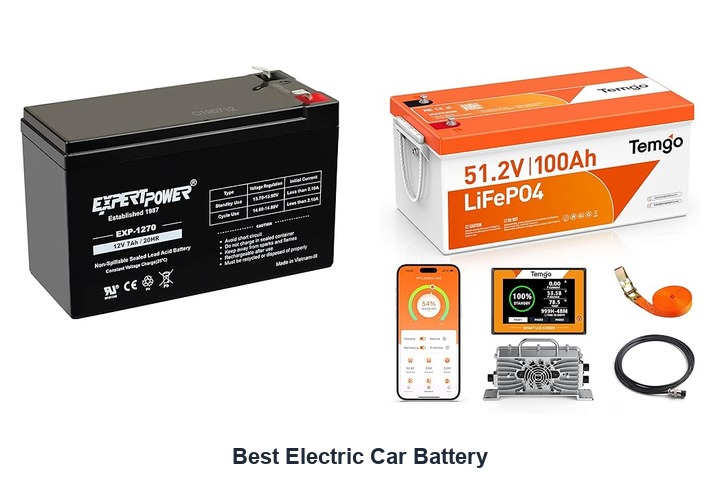
Top Picks- 1  | ExpertPower EXP1270, 12V 7Ah Battery SLA Rechargeable with F1 Terminals Best for: Small backup systems | Check Price On Amazon |
Top Picks- 2  | TEMGO 48V (51.2V) 100Ah LiFePO4 Lithium Golf Cart Battery | Best for: Long-range golf carts | Check Price On Amazon |
Top Picks- 3  | Lithium LiFePO4 Car Battery Auto Battery, 12V 40Ah, 660CCA, 100RC Best for: Cold-weather car starts | Check Price On Amazon |
Top Picks- 4  | TEMGO 48V (51.2V) 100Ah LiFePO4 Golf Cart Battery with Voltage Best for: Golf cart upgrades | Check Price On Amazon |
Top Picks- 5  | SafeAMP 12V 9.5Ah Battery for Ride-On Toys, Red 2-Pin | Best for: Ride-on toy replacements | Check Price On Amazon |
1. ExpertPower EXP1270, 12V 7Ah Battery SLA Rechargeable with F1 Terminals
Best for: Compact backup-power and ride-on replacements.
A 12V, 7Ah sealed lead-acid format makes the ExpertPower EXP1270 a direct replacement option for alarm systems, security devices, UPS units, deer feeders, and kids’ ride-on cars. Its rechargeable, spill-proof construction supplies maintenance-free power where a familiar 1270-size battery is required, while F1 terminals simplify matching an existing connection.
The 12V7Ah/20HR rating provides consistent output for compatible low-voltage equipment rather than engine-starting use. Compatibility includes UB1270, RT1270, CA1270, and 12FM7 battery references, giving buyers several cross-check points before ordering. One battery is included, and the manufacturer lists a one-year warranty, adding a defined replacement-support period for properly installed household or recreational equipment.
Pros
- 12V, 7Ah capacity supports alarm, UPS, and ride-on applications
- Sealed lead-acid construction prevents routine electrolyte maintenance
- Spill-proof design suits indoor security and backup equipment
- F1 terminals support direct replacement of matching battery connections
Cons
- The F1-terminal format requires a compatible connector, so it is not a universal replacement for every 12V battery
Choose it for a 12V alarm panel, UPS, deer feeder, or kids’ ride-on car using a 1270-family battery. It is a practical fit when sealed lead-acid chemistry and F1 terminals match the original unit.
2. TEMGO 48V (51.2V) 100Ah LiFePO4 Lithium Golf Cart Battery |
Best for: Golf-cart upgrade buyers wanting monitoring.
A 51.2V, 100Ah LiFePO4 pack turns the TEMGO golf-cart upgrade into a high-capacity battery system with a 2.8-inch LCD touch display. The included 58.4V 18A charger, retention strap, and Bluetooth-enabled 200A smart BMS let owners charge, secure, and monitor the pack without sourcing those core accessories separately.
Bluetooth connectivity sends battery information to a mobile app, while the 200A BMS provides protection against overcharging and over-discharging. The 2.8-inch touch display adds on-cart visibility instead of requiring a phone for every check. M8 terminals support the listed universal-fit vehicle connection, and the kit’s 58.4V charger is matched to the 51.2V battery platform.
Pros
- 51.2V, 100Ah LiFePO4 capacity supports a substantial golf-cart energy reserve
- 200A smart BMS adds overcharge and over-discharge protection
- Bluetooth app monitoring provides remote battery-status access
- Included 58.4V 18A charger eliminates a separate charger purchase
Cons
- The listed compatibility is for golf carts, so buyers of passenger cars should not treat it as a general automotive replacement
Select this pack for a golf-cart owner who wants high capacity plus app-based battery information. The included charger, display, BMS, and strap make it suited to a bundled cart conversion rather than a bare battery swap.
3. Lithium LiFePO4 Car Battery Auto Battery, 12V 40Ah, 660CCA, 100RC
Best for: Small-engine car owners needing lithium starting power.
With 660 CCA and a 100-minute reserve-capacity rating, this 12V 40Ah LiFePO4 car battery targets passenger vehicles with engine displacement below 2.0L. Its 14.8-pound format and IP66 waterproof protection combine starting output with a compact footprint, while the M8 terminals provide a clearly identified connection style for compatible installations.
The 9.5-by-6.9-by-8-inch dimensions give buyers measurable clearance points for checking a battery tray before purchase. A 40Ah capacity supplies the stated energy storage, while 660 CCA identifies its starting capability and 100RC specifies reserve performance. The IP66 rating adds protection against dust and water exposure, but the manufacturer recommends fully charging the battery before first use.
Pros
- 660 CCA supplies a defined starting-output figure for compatible vehicles
- 40Ah capacity provides more storage than a small auxiliary battery
- 14.8-pound weight supports a lighter installation than many lead-acid formats
- IP66 protection supports use around dust and water exposure
Cons
- Compatibility is limited to vehicles below 2.0L engine displacement, so larger-engine cars fall outside the stated application
This battery fits drivers of compatible passenger cars under 2.0L who want LiFePO4 chemistry and a specified 660 CCA. Confirm the 9.5-by-6.9-by-8-inch space and M8 connection before installing it.
4. TEMGO 48V (51.2V) 100Ah LiFePO4 Golf Cart Battery with Voltage
Best for: High-output golf-cart and auxiliary-power users.
A 51.2V, 100Ah LiFePO4 battery delivers 200A continuous discharge for golf carts, RVs, trolling motors, and home backup systems. Its included voltage converter, 56.8V 18A charger, 2.8-inch LCD touch display, and retention strap create a complete upgrade package for buyers who need both high-current output and visible operating information.
The pack can reach a 315A peak for 35 seconds and 600A for 3 seconds, giving the listed applications short-duration high-output support. A 20-ohm resistance specification identifies an electrical characteristic for system matching, while the M8 terminal provides a defined connection format. The converter helps provide stable output, and the display allows direct checks without relying only on external equipment.
Pros
- 200A continuous discharge supports sustained high-current vehicle operation
- 315A for 35 seconds provides a specified short-term power reserve
- 600A for 3 seconds supports brief peak-demand events
- Included converter and 56.8V 18A charger simplify system installation
Cons
- Its 51.2V platform is unsuitable for vehicles or equipment requiring a different system voltage
Choose this TEMGO battery for a golf cart or auxiliary system that needs documented continuous and peak discharge figures. The converter, charger, display, and strap suit buyers planning a complete 48V-class upgrade.
5. SafeAMP 12V 9.5Ah Battery for Ride-On Toys, Red 2-Pin |
Best for: Ride-on owners matching a red connector.
A 12V 9.5Ah capacity gives the SafeAMP ride-on battery more stated storage than a typical 12V 5Ah replacement, provided the toy uses the required red 2-pin connector. Its 5.9-by-2.5-by-3.9-inch housing offers exact fit-check measurements, helping parents verify both wiring and compartment clearance before ordering.
The metric dimensions of 151-by-65-by-99 millimeters provide a second measurement reference for checking the existing battery bay. One 12V battery is included, and the red 2-pin connector is the only stated electrical match; similar-looking plugs may not connect correctly. A six-month manufacturer warranty supplies a defined support period for a properly matched ride-on installation.
Pros
- 9.5Ah capacity provides a larger stated reserve for compatible 12V ride-ons
- Red 2-pin connector enables direct use with matching toy wiring
- 5.9-by-2.5-by-3.9-inch dimensions support precise compartment checks
- 151-by-65-by-99-millimeter measurements help verify metric clearances
Cons
- The battery only works with the red 2-pin connector, so visually similar toy plugs may be incompatible
Buy it for a 12V ride-on owner whose original battery uses the red 2-pin plug. Measure the compartment against 5.9 by 2.5 by 3.9 inches before relying on its 9.5Ah capacity.
6. S ZEVZO ET03 Car Jump Starter 4000A Jump Starter Battery

Best for: Emergency starting for multiple 12V vehicles.
Peak current reaching 4,000A lets the S ZEVZO ET03 jump-start common 12V vehicles with engines up to 8.0L gas or 7.0L diesel. Its 20,000mAh lithium-ion battery supports up to 50 jump starts per charge, extending its usefulness from passenger cars to trucks, motorcycles, lawnmowers, tractors, vans, and boats.
The 12V output matches the listed vehicle category, while the 4,000A peak-output figure identifies its starting capability rather than a replacement battery’s storage rating. The product includes a force-start function in the jumper clamps for starting 0V dead batteries, according to the supplied description. Its universal-fit listing covers several vehicle types, making it a portable emergency tool instead of a permanently installed battery.
Pros
- 4,000A peak current supports engines up to 8.0L gas and 7.0L diesel
- 20,000mAh lithium-ion capacity supports up to 50 jump starts per charge
- 12V output matches the listed common vehicle applications
- Force-start clamps address the stated 0V dead-battery scenario
Cons
- It is a jump starter rather than a replacement battery, so it does not permanently power the vehicle after the starting event
Choose the ET03 for drivers who need roadside starting assistance across several 12V vehicle types. It suits a glovebox or garage emergency kit, especially where the 4,000A rating and 50-start claim match the intended vehicles.
7. 12V 5Ah Li-ion Replacement Battery for Kids 12V 5Ah Ride-On

Best for: Kids’ ride-on owners needing a 12V swap.
A 12V 5Ah Li-ion format supplies a direct replacement path for compatible 12V kids’ ride-on vehicles. The battery’s stated strong, steady power and quick installation focus on restoring play equipment without changing the vehicle’s voltage, while the universal-fit listing keeps the application broad but still requires a connector and compartment check.
The 12V rating matches the listed ride-on platform, and the 5Ah capacity identifies the available storage for the replacement. Lithium-ion chemistry differentiates it from sealed lead-acid alternatives in this roundup, while the product description emphasizes durable, long-lasting performance. No dimensions, terminal type, charger, or connector are provided, so buyers must compare those details with the original battery before ordering.
Pros
- 12V output matches compatible 12V kids’ ride-on systems
- 5Ah capacity provides a clearly specified replacement energy rating
- Li-ion chemistry offers a lighter-technology alternative to SLA batteries
- Quick-installation description supports a straightforward replacement process
Cons
- The listing provides no battery dimensions or connector specification, making physical and wiring compatibility harder to verify
Select it for a child’s 12V ride-on when the original battery’s voltage and capacity match. Confirm the connector, charger, and battery-bay dimensions first because those details are not supplied.
8. Mighty Max Battery Ride On Replacement 6V 7AH Battery For

Best for: Compact 6V ride-on battery replacements.
The ML7-6 combines 6V output with 7Ah capacity in a sealed lead-acid package measuring 5.94 by 1.42 by 3.94 inches. That narrow, rechargeable format suits compatible ride-on equipment and scooters where F1 terminals, maintenance-free operation, and flexible mounting matter more than a higher-voltage automotive starting system.
Its SLA/AGM construction is spill-proof and can be mounted in any position, giving buyers more installation flexibility than a battery that must remain upright. The F1 terminal identifies the required connection style, while UL certification provides a stated safety credential. The listing includes one battery only; no wire harness or mounting accessories are included for the installation.
Pros
- 6V, 7Ah rating matches compatible low-voltage ride-on equipment
- 5.94-by-1.42-by-3.94-inch dimensions support narrow battery compartments
- SLA/AGM spill-proof construction reduces leakage concerns
- Any-position mounting supports flexible installation orientations
Cons
- No wire harness or mounting accessories are included, so an existing F1 connection and mounting setup are required
Choose the ML7-6 for a 6V ride-on or scooter using an F1 terminal and a similarly narrow battery bay. Its 7Ah capacity and any-position SLA mounting help when the original installation space is restricted.
9. Mighty Max Battery ML7-12, 12 Volt 7.2 AH SLA F1

Best for: General-purpose 12V F1 battery replacements.
A 12V 7.2Ah sealed lead-acid battery gives the Mighty Max ML7-12 a familiar F1-terminal replacement profile for compatible equipment. Its rechargeable, maintenance-free construction supports everyday backup or recreational use, while the ability to mount it in any position helps buyers work around installations where upright placement is inconvenient.
The 5.94-by-2.56-by-3.94-inch dimensions provide concrete clearance checks before purchase, and the single-battery package keeps the replacement quantity clear. SLA construction resists shocks and vibration, while the stated wide-temperature performance supports use in both high- and low-temperature conditions. The listing includes the battery only, with no wire harness or mounting accessories supplied.
Pros
- 12V, 7.2Ah capacity provides a specified replacement rating
- 5.94-by-2.56-by-3.94-inch housing supports precise fit checks
- SLA construction resists shocks and vibration during equipment use
- Any-position mounting accommodates non-upright installation layouts
Cons
- The package excludes a wire harness and mounting accessories, requiring compatible existing hardware
Pick the ML7-12 for a compatible 12V device using F1 terminals and a battery bay near 5.94 by 2.56 by 3.94 inches. It is suited to buyers who want maintenance-free SLA storage without adding installation accessories.
10. OTTARO 24V 7AH Battery for Ride on Car UTV

Best for: 24V ride-on car and UTV replacements.
A 24V, 7Ah rating makes the OTTARO battery a direct replacement candidate for 24V ride-on cars and UTVs. Its 7.4-by-4.0-by-3.7-inch housing gives buyers specific space requirements, while the fully charged presentation allows a compatible vehicle to return to use after the battery is correctly positioned and connected.
The 24V system voltage is the primary compatibility requirement, separating this battery from the 12V ride-on replacements in this roundup. The 7Ah capacity identifies its energy rating, and the listed dimensions provide length, width, and height for checking the battery compartment. Installation requires placing the battery in a suitable position and connecting the power wires; no connector or accessory details are stated.
Pros
- 24V output matches the listed 24V ride-on car and UTV applications
- 7Ah capacity provides a defined replacement storage rating
- 7.4-by-4.0-by-3.7-inch size supports compartment measurement before purchase
- Fully charged presentation can shorten the time before compatible use
Cons
- No connector type or wiring accessory is specified, so buyers must verify the existing power-wire connection
Choose OTTARO for a 24V ride-on car or UTV with a compartment matching 7.4 by 4.0 by 3.7 inches. Verify the power-wire connection before installation because the listing does not identify a plug style.
How to Choose the Best Electric Car Battery
Capacity and vehicle compatibility
Match the pack to the vehicle before comparing range figures. Start with the manufacturer’s specified nominal voltage, usable capacity, physical length, width, height, and weight; a 60-kWh usable pack is not equivalent to a 60-kWh total pack because buffer capacity remains unavailable to protect the cells. Check that the connector position, mounting points, cooling ports, and high-voltage interface match the chassis, then verify communication with the vehicle’s battery-management and charging software.
Choose a 50–70-kWh usable pack for compact cars and daily commuting, or a 75–100-kWh usable pack for heavy vehicles, long trips, and frequent highway driving.
Battery chemistry and longevity
Choose lithium iron phosphate cells for durability, frequent charging, and hot-climate commuting, and choose nickel-rich lithium-ion cells when long range and low pack weight matter most. LFP packs typically tolerate roughly 3,000–5,000 full cycles and regular charging to a high state of charge, while nickel-rich packs commonly deliver higher energy density with roughly 1,000–2,000 full cycles and stricter charge limits. Compare the maker’s retained-capacity target, such as 70% after a stated cycle count, rather than relying on chemistry alone.
Pick LFP for maximum service life and predictable daily use; pick nickel-rich cells for maximum range in a lighter vehicle.
Thermal management and charging performance
Prioritize a complete liquid thermal-management loop covering every module, with both cooling and battery heating, rather than passive air cooling alone. Confirm the pack’s AC input and DC fast-charging limits against your routine: an 11-kW AC charger suits overnight home charging, while a 150–250-kW DC rating serves frequent long-distance travel. Strong packs maintain charging speed across repeated sessions and protect cells during freezing starts and hot-weather fast charging.
Look for preconditioning controlled through the vehicle software and temperature sensors throughout the pack. Choose liquid-cooled and heated packs for all-season use; choose air-cooled packs only for mild climates and slower charging.
Safety systems and construction
Treat safety hardware as essential, not optional equipment. The battery-management system should track voltage, current, and temperature at cell and module level, balance cells, record faults, and limit charging when readings exceed safe thresholds. Seek a rigid enclosure with crash reinforcement, isolation monitoring, pyrofuse or contactor-based automatic disconnect, and an ingress rating of at least IP67.
A sealed pack that withstands immersion and road debris offers stronger protection than an enclosure with vague water-resistance claims. Choose the pack with documented crash testing, continuous isolation monitoring, automatic high-voltage disconnect, and IP67-or-better sealing for passenger vehicles.
Warranty, installation, and longterm value
Compare the complete ownership package, not the battery alone. Favor warranties covering defects and capacity retention, with a clear threshold such as 70% usable capacity for eight years or 160,000 kilometers, plus replacement labor and transferable coverage. Confirm whether a certified installer must fit the pack, register its serial number, pair it with the vehicle, and complete software calibration.
Estimate value from usable energy, vehicle efficiency, service access, replacement-module support, and projected cycle life. Choose the longest capacity warranty with certified installation included for daily drivers; choose a serviceable modular pack for high-mileage owners who prioritize repairability and extended life.
Which Should You Choose?
- If you need a dependable replacement for a 12V alarm system, UPS, security device, or children’s ride-on car, choose a 12V 7Ah sealed lead-acid battery with F1 terminals.
- If you are upgrading a 48V golf cart for longer range and want built-in monitoring, choose a 48V 100Ah LiFePO4 battery kit with a dedicated charger and LCD display.
- If your vehicle has an engine smaller than 2.0 liters and you want a lightweight starting battery, choose a 12V 40Ah LiFePO4 battery rated around 660 cold-cranking amps.
- If your priority is restarting a dead 12V vehicle battery during an emergency rather than replacing it, choose a portable jump starter delivering about 4,000 peak amps.
Quick Best Electric Car Battery Buying Checklist
- Verify compatibility: Match voltage, dimensions, connectors, mounting points, and battery-management communication with your vehicle.
- Compare usable capacity: Choose enough kilowatt-hours for your range needs without adding unnecessary weight or cost.
- Check cell chemistry: Balance energy density, cycle life, charging speed, and operating temperature for your driving pattern.
- Inspect thermal control: Prioritize effective cooling and heating to support consistent performance in changing conditions.
- Review safety equipment: Look for isolation monitoring, crash protection, automatic disconnects, and a sealed enclosure.
- Read warranty terms: Confirm capacity retention limits, coverage duration, installation requirements, and authorized service availability.
Frequently Asked Questions
What Battery Capacity Is Best For An Electric Car?
The best electric car battery for a vehicle matches the original pack’s usable capacity, voltage, dimensions, and communication system. A larger pack can extend driving range, but it may add weight, require compatible charging hardware, and demand software calibration, so confirm the vehicle manufacturer’s specifications before purchase.
Which Battery Chemistry Is Best For An Electric Car?
The best electric car battery chemistry depends on whether you prioritize longevity, weight, range, or charging performance. Lithium iron phosphate cells typically emphasize durability and thermal stability, while nickel-rich lithium-ion cells can provide higher energy density; vehicle compatibility, cooling design, and charging limits remain equally important.
How Long Should The Best Electric Car Battery Last?
The best electric car battery should deliver many years of service when its temperature and charging limits are managed properly. Longevity depends on cell chemistry, cycle count, fast-charging frequency, climate, and depth of discharge, so compare capacity-retention warranties and avoid routinely storing the pack at full charge.
What Thermal-Management Features Should An Electric Car Battery Have?
The best electric car battery uses active thermal management to keep cells within a controlled operating range during charging and driving. Liquid cooling and battery heating can protect performance in hot or cold conditions, reduce charging slowdowns, and help maintain more even cell aging across the pack.
Is Professional Installation Necessary For An Electric Car Battery?
Professional installation is necessary for most electric car battery replacements because high-voltage packs require isolation testing, lifting equipment, software configuration, and careful connector handling. A qualified technician can verify pack fitment, calibrate the battery-management system, and test charging and safety functions before returning the vehicle.
Final Suggestions
Choosing the best electric car battery means balancing usable capacity, cell chemistry, thermal management, safety systems, compatibility, and warranty protection. A well-matched pack can improve driving range, charging consistency, reliability, and long-term ownership value while supporting safer electric mobility. Compare specifications carefully, use qualified installation, and select the battery that fits your vehicle and daily route with confidence.