Top 10 Best Diesel Coolant Additive Picks
As an Amazon Associate we earn from qualifying purchases.
The best diesel coolant additive plays a critical role in managing the extreme thermal and chemical demands of heavy-duty engines. As combustion temperatures rise, coolant systems must move heat efficiently while resisting corrosion, cavitation, scale, and liner damage. Modern formulas are engineered around inhibitor chemistry, fluid compatibility, and long-service performance, making product selection more nuanced than simply choosing a familiar brand.
Fleet vehicles, construction equipment, agricultural machinery, and commercial trucks can each face different operating stresses, coolant compositions, and maintenance intervals. Understanding how top diesel coolant additives address these variables helps clarify the tradeoffs between protection, concentration, monitoring, and total operating cost.
This guide examines the technology and key specifications behind the category, revealing which details deserve closer attention before purchase. Continue reading to uncover the features that separate dependable coolant protection from costly guesswork.
best diesel coolant additive: Top Picks
| Image | Product | Buy |
|---|---|---|
Top Picks- 1  | Cummins Filtration Fleetguard DCA60L Coolant Additive 16oz. DCA4 Best for: Diesel fleet maintenance | Check Price On Amazon |
Top Picks- 2  | Ford Genuine Ford Fluid VC-8 Diesel Cooling System Additive – Best for: Factory-spec diesel systems | Check Price On Amazon |
Top Picks- 3  | Motorcraft Ford Diesel Coolant Additive VC8 – 3 Bottles Best for: Stock-up diesel maintenance | Check Price On Amazon |
Top Picks- 4  | Genuine Ford Fluid VC-8 Diesel Cooling System Additive – 16 Best for: Diesel cooling maintenance | Check Price On Amazon |
Top Picks- 5  | PEAK Fleet Charge SCA Precharged Coolant/Antifreeze, Concentrate, 1 Gallon Best for: Fleet coolant systems | Check Price On Amazon |
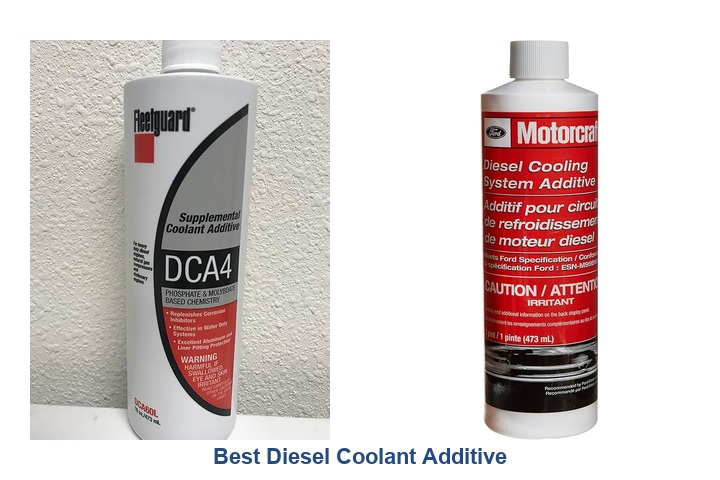
1. Cummins Filtration Fleetguard DCA60L Coolant Additive 16oz. DCA4
Best for: Fleetguard buyers needing DCA4 treatment.
A 16-ounce Fleetguard DCA60L bottle gives diesel-maintenance buyers a compact DCA4 coolant-additive format for keeping a Cummins Filtration part on hand. Its 7 x 2 x 2-inch dimensions fit more easily into a service cabinet than a bulk container, while the listed 1.23-pound weight keeps the package manageable for routine shop handling.
The Cummins manufacturer listing identifies DCA60L as the manufacturer part number, helping buyers match the bottle to an existing Fleetguard or Cummins service reference. The package carries a 12-volt specification in its technical data, and the 16-ounce size supplies a clearly identified single-container format rather than a multi-bottle kit. No dosage or coolant-capacity coverage is provided in the listing.
Pros
- 16-ounce size provides a clearly defined single-bottle format
- DCA4 designation helps match the additive to the listed treatment type
- 7 x 2 x 2-inch dimensions simplify storage in a service area
- Cummins Filtration manufacturer identification supports part-number matching
Cons
- The listing gives no dosage or cooling-system coverage guidance
Choose it when your diesel maintenance records call for Fleetguard DCA4 and you want one compact 16-ounce bottle. It suits owners who can confirm the required treatment amount from their engine or coolant-service documentation.
2. Ford Genuine Ford Fluid VC-8 Diesel Cooling System Additive –
Best for: Ford owners replenishing depleted coolant additives.
Yellow dye now replaces the earlier fluorescent-green appearance in Ford VC-8, helping buyers avoid an unwanted coolant color change when mixing. The additive is intended for replenishing depleted protection between coolant change-outs, giving Ford diesel owners a targeted OEM-style maintenance option in an 8-ounce bottle.
Ford lists VC-8 as replacing V119 coolant meeting specification ESE-M97B44-A and Motorcraft gold coolant meeting WSS-M97B51-A1. Its 7.9 x 2.3 x 2-inch package is compact for a workshop shelf, while the 8-ounce weight specification identifies a smaller service bottle. The universal fit-type label broadens the listed fit category, but buyers should still verify coolant compatibility.
Pros
- Yellow dye preserves a consistent coolant color when mixing
- VC-8 replaces additives depleted between coolant change-outs
- Ford OEM and VC-8 part-number identification supports parts matching
- 7.9 x 2.3 x 2-inch dimensions make storage straightforward
Cons
- The 8-ounce bottle provides no stated treatment-volume coverage
It fits Ford diesel owners topping up additive protection between scheduled coolant changes. Select it when the vehicle’s coolant documentation references Ford VC-8, V119, ESE-M97B44-A, or WSS-M97B51-A1.
3. Motorcraft Ford Diesel Coolant Additive VC8 – 3 Bottles
Best for: Ford diesel owners wanting a three-bottle supply.
Three Motorcraft Ford VC8 bottles create a multi-bottle supply for diesel owners who service more than one vehicle or want replacement additive available for later maintenance. The package lists 47.97 fluid ounces in total, making it a larger purchase format than a single VC8 bottle while retaining the Ford VC8 part reference.
Motorcraft identifies VC8 as both the brand-linked part and the OEM-equivalent part number, giving buyers two matching references for catalog checks. The UPC is 031508421479, and the listing records three items rather than one. A 4.8-out-of-5 rating from 455 reviews supplies strong marketplace feedback, although the data does not state dosage per cooling system.
Pros
- Three-item count supports repeated coolant-service work
- 47.97-fluid-ounce unit count identifies the total listed supply
- VC8 OEM-equivalent numbering simplifies Ford parts verification
- 4.8 rating from 455 reviews provides substantial buyer feedback
Cons
- The listing does not provide treatment coverage or per-vehicle dosage
This package suits Ford diesel owners maintaining several vehicles or keeping VC8 on the shelf for recurring service. It is most practical when your maintenance records already specify the VC8 product and required amount.
4. Genuine Ford Fluid VC-8 Diesel Cooling System Additive – 16
Best for: Ford OEM buyers wanting one larger bottle.
Genuine Ford VC-8 is listed as a 16-ounce diesel cooling-system additive, giving Ford owners a single OEM-branded bottle for additive maintenance. Its 1-pound listed weight and machined exterior specification identify a compact service package, while the VC-8 model and part number make it easier to compare against Ford maintenance records.
The package measures 8.74 x 5.71 x 2.44 inches, providing concrete storage dimensions for a garage cabinet or service bin. Ford identifies the model as VC-8 and the manufacturer part number as VC-8, so both references point to the same additive. The listing does not provide coolant-capacity coverage, dosage instructions, or compatibility details beyond its Ford OEM positioning.
Pros
- 16-ounce format provides a clearly identified single-bottle supply
- Ford OEM labeling supports manufacturer-specific parts matching
- VC-8 model and part number simplify maintenance-record comparison
- 8.74 x 5.71 x 2.44-inch package dimensions aid storage planning
Cons
- No dosage or cooling-system coverage is supplied in the listing
Pick this bottle when a Ford diesel service schedule calls for genuine VC-8 and you prefer one 16-ounce package. It works best for buyers who will confirm the additive amount through Ford service information.
5. PEAK Fleet Charge SCA Precharged Coolant/Antifreeze, Concentrate, 1 Gallon
Best for: Heavy-duty owners wanting precharged coolant.
PEAK Fleet Charge combines coolant and supplemental coolant additive in a one-gallon heavy-duty formulation, reducing the need to add a separate SCA product. The listing describes 50/50 prediluted antifreeze with no water addition, while also labeling the product concentrate, so buyers receive a convenient format but should verify the intended preparation before use.
PEAK states compatibility with heavy-duty diesel, gasoline, and natural-gas engine cooling systems, giving this coolant broader engine-type coverage than a diesel-only listing. The 9.66-pound package measures 11.73 x 7.56 x 3.78 inches, useful details for storage and handling. Its stated benefits include freeze and boil-over protection plus an SCA formulation intended to last the engine’s life.
Pros
- One-gallon format supplies a substantial coolant quantity
- 50/50 prediluted labeling avoids a separate water-mixing step
- Heavy-duty diesel, gasoline, and natural-gas compatibility broadens use
- Precharged SCA formulation combines coolant and additive in one product
Cons
- The listing calls it both concentrate and 50/50 prediluted, creating preparation ambiguity
Choose it for a heavy-duty diesel coolant service where a precharged SCA coolant is preferable to separate additive measurement. Confirm the concentrate-versus-prediluted instructions on the container before filling the system.
6. Lubegard 96430 Heavy Duty 2-in-1 Coolant Treatment, 32 fl. oz.

Best for: Diesel owners prioritizing corrosion and cavitation control.
Lubegard 96430 packages a 2-in-1 heavy-duty coolant treatment in a 32-fluid-ounce bottle, combining corrosion protection with temperature reduction in one additive. Its stated protection for wet sleeve cylinder liners addresses cavitation erosion, giving diesel owners a product focused on several heavy-duty cooling-system concerns rather than corrosion alone.
The treatment also targets chemical electrolysis, scale, deposits, and slime that can contribute to overheating, covering distinct coolant-system maintenance issues in the product description. Its 9.3 x 5.8 x 2.6-inch dimensions establish the storage footprint, and the 2.23-pound listed weight identifies a substantial bottle for shop handling. Lubegard also states extended water-pump impeller and seal life.
Pros
- 32-fluid-ounce capacity provides a substantial treatment supply
- 2-in-1 formulation combines corrosion protection and temperature reduction
- Wet-sleeve liner protection addresses cavitation erosion
- Scale, deposit, and slime control targets overheating contributors
Cons
- No dosage or system-capacity guidance is included in the supplied data
It suits diesel owners whose priority is broad heavy-duty cooling-system protection, especially with wet sleeve liners. Use the 32-fluid-ounce format when your service documentation confirms how much treatment the system requires.
7. Royal Purple 01600 Purple Ice Super-Coolant Radiator Additive – 12

Best for: Mixed-coolant users seeking water-pump protection.
Royal Purple Purple Ice is listed as compatible with all coolant types and contains lubricants for water-pump protection, giving diesel owners a flexible additive option when coolant chemistry varies. The 12-ounce package measures 3.75 x 1.14 x 7.5 inches, keeping the bottle narrow enough for compact storage.
The product description specifically names erosion and electrolysis prevention, two concerns relevant to maintaining a diesel cooling system. Royal Purple identifies the product as model 01600 and part number 01600, while the technical listing records a 12.8-ounce package weight and a 12-volt specification. Its fit type is vehicle-specific, so buyers should verify application despite the all-coolant compatibility claim.
Pros
- All-coolant compatibility supports varied coolant types
- Lubricants provide stated water-pump protection
- Erosion and electrolysis prevention address two coolant-system threats
- 3.75 x 1.14 x 7.5-inch dimensions simplify narrow-space storage
Cons
- Vehicle-specific fit labeling requires application verification before purchase
Select it for a diesel vehicle where coolant-type flexibility and water-pump lubrication matter. Verify the vehicle-specific fit and additive amount before using the 12-ounce Purple Ice bottle.
8. Red Line 80213 Diesel WaterWetter Super Coolant – 15 Ounces

Best for: Diesel owners wanting a single WaterWetter bottle.
Red Line 80213 is specifically identified as Diesel Water Wetter in a 15-ounce bottle, giving diesel owners a purpose-labeled coolant additive rather than a general automotive treatment. The one-pack format supplies a single unit for a maintenance job, while the 2.75-inch height and width with 9.25-inch length define its storage footprint.
Red Line lists part number 80213 and UPC 083522802130, giving buyers two identifiers for catalog or reorder checks. The unit count is 15 fluid ounces and the listed package weight is 1.1 pounds, concrete details for handling and shelf planning. The product carries a 4.4-out-of-5 rating from 88 reviews, but the supplied data does not state dosage.
Pros
- Diesel Water Wetter labeling directly identifies the intended application
- 15-fluid-ounce unit count defines the available additive volume
- One-pack format provides a single bottle for service planning
- Part number 80213 and UPC support accurate reordering
Cons
- No application dosage or cooling-system coverage is stated
This bottle fits diesel owners who specifically want Red Line’s Diesel Water Wetter format. Confirm the required amount from the vehicle’s cooling-system instructions before adding the 15-ounce unit.
9. Red Line 80204 WaterWetter Super Coolant – 12 Ounce (2

Best for: Small-system users needing measured treatment guidance.
Red Line 80204 uses a wetting agent that doubles water’s wetting ability, giving cooling-system owners a treatment aimed at improving water contact and rust protection. Its directions state that one bottle treats 3 to 5 gallons, while small systems use 1 ounce per quart, making the product easier to match to different cooling-system sizes.
The listing permits use with new or used antifreeze and states that straight water can be used in racing or with reduced antifreeze levels in warm climates. Larger cooling systems require two bottles, while the 12-ounce package provides the listed container size. The technical data identifies part number 80204-2 and dimensions of 8.66 x 6.38 x 3.5 inches.
Pros
- One bottle treats the stated 3-to-5-gallon range
- 1-ounce-per-quart direction supports small-system measurement
- Two-bottle guidance covers larger cooling systems
- Compatibility with new or used antifreeze broadens application options
Cons
- The 1-ounce-per-quart small-system direction requires separate measuring because no measuring tool is listed
Choose it when you need explicit treatment guidance for a small, standard, or larger cooling system. Diesel owners should confirm antifreeze and water-use requirements before applying the 12-ounce format.
10. Cummins Filtration Fleetguard DCA30L Coolant Treatment 16 oz. DCA2 Borate/Nitrite

Best for: Fleetguard users needing DCA2 borate-nitrite treatment.
Fleetguard DCA30L is identified as a 16-ounce DCA2 borate/nitrite coolant treatment, giving diesel-maintenance buyers a clearly named chemistry and treatment format. The 1.26-pound package is compact enough for routine service storage, while the DCA30L part number helps match the bottle to Fleetguard maintenance documentation.
Fleetguard lists DCA30L as the model and manufacturer part number, creating consistent identification across the package data. The product also cross-references Luber Finer 920021 and Baldwin CS5008USA, giving buyers two additional catalog numbers for replacement searches. No dosage, coolant capacity, dimensions, or specific engine compatibility is supplied, so application must be confirmed separately.
Pros
- 16-ounce size defines a compact single-treatment format
- DCA2 designation identifies the listed treatment category
- Borate/nitrite chemistry is clearly named for specification matching
- Luber Finer and Baldwin cross-references aid replacement searches
Cons
- No dosage or cooling-system coverage is provided in the listing
It suits diesel operators whose service documentation calls for Fleetguard DCA2 borate/nitrite treatment. Confirm the required amount and engine compatibility before using the 16-ounce DCA30L bottle.
How to Choose the Right best diesel coolant additive
Coolant compatibility and chemistry
Start with the coolant already in the engine, then match the additive chemistry exactly. Conventional coolant generally needs a compatible conventional inhibitor package, while hybrid and extended-life coolants require products labeled for their specific organic-acid, phosphate, silicate, or nitrite requirements. Read the coolant and additive technical sheets together, because combining incompatible formulas weakens corrosion control and can create deposits.
Do not treat a chemistry mismatch as a universal upgrade. Choose a fully compatible extended-life additive for an extended-life system, a hybrid-compatible formula for hybrid coolant, and a conventional SCA-compatible product for conventional coolant.
Cavitation and corrosion protection
Wetsleeve diesel engines need protection against liner pitting from cavitation, along with rust, scale, and erosion in the cooling passages. Select an additive whose technical documentation explicitly names wet-sleeve diesel service and lists cavitation or liner-pitting control, rather than relying on a general automotive label. Engines that require supplemental coolant additives or diesel coolant additives need the specified SCA or DCA formulation and a maintenance schedule tied to inhibitor levels.
Choose a diesel-rated SCA or DCA product for wet-sleeve engines with manufacturer requirements; select a compatible extended-life inhibitor for systems approved to run without routine SCA replenishment.
Concentration, dosing, and capacity
Calculate the cooling-system capacity before comparing bottles, then choose coverage that matches the required dose without leftover concentrate or improvised measuring. A clear label should state treatment in gallons of coolant, show the amount per service, and explain whether the dose applies to a refill or an initial fill. Graduated markings, a narrow dispensing neck, and a secure cap support accurate, waste-free use; an unmarked container offers poor control.
Never add extra additive for stronger protection, since excess inhibitor can upset coolant balance. Pick a single bottle with labeled coverage for one complete service, or a marked multi-service container for fleet maintenance.
Testing and maintenance support
Choose an additive that fits the coolant test method specified for the engine, especially the recommended inhibitor test strips and refractometer or freeze-point procedure. The label or technical sheet should identify compatible test strips and provide target ranges for freeze protection and inhibitor concentration, not just claim general monitoring support. Favor formulas that support repeat testing after initial treatment and at scheduled service intervals, with coolant analysis taking priority over a fixed guess.
Keep records of test results, top-ups, and drain intervals. Pick a test-strip-compatible SCA or DCA formula for monitored conventional coolant, or a test-supported extended-life additive for extended-life systems.
Application safety and value
Verify that the container specifically names diesel cooling systems and wet-sleeve or heavy-duty service; a general automotive coolant treatment does not meet that requirement. Read directions for gloves, eye protection, ventilation, storage temperature, container sealing, and spill cleanup before purchase, and favor packaging with clear hazard information and a secure cap. Compare the required volume per service with the stated replenishment interval, then confirm technical documentation that preserves the engine maker’s coolant and warranty requirements.
Pick a documented diesel-specific additive with safe handling instructions and the longest approved service interval that matches your maintenance program.
Which Should You Choose?
- If your diesel uses a manufacturer-specific coolant system, choose an OEM-spec additive matched to the required coolant specification.
- If you maintain several heavy-duty diesel, gasoline, or natural-gas engines, choose a precharged SCA coolant concentrate in a one-gallon container.
- If your wet-sleeve diesel needs routine nitrite and borate protection against cavitation, choose a 16-ounce DCA treatment with the correct DCA2 or DCA4 chemistry.
- If corrosion, electrolysis, scale, and water-pump protection are your main concerns, choose a 2-in-1 heavy-duty coolant treatment with broad coolant compatibility.
Quick Best Diesel Coolant Additive Buying Checklist
- Confirm coolant chemistry: Match the additive with the coolant already installed in the diesel cooling system.
- Check engine requirements: Verify whether the manufacturer specifies SCA, DCA, nitrite-free, or another inhibitor technology.
- Measure system capacity: Use the cooling-system volume to calculate the correct treatment amount.
- Prioritize cavitation protection: Choose a formula rated for wet-sleeve liner pitting and diesel-engine corrosion.
- Plan testing: Ensure the additive can be monitored with compatible test strips or coolant analysis.
- Follow safe application: Add only when the system is cool and follow the label’s mixing and handling instructions.
Frequently Asked Questions
What Does The Best Diesel Coolant Additive Do?
The best diesel coolant additive replenishes corrosion inhibitors and helps protect cooling-system metals from rust, scale, and wet-sleeve liner cavitation. Its value depends on matching the formula to the coolant chemistry and engine design, because an incompatible additive can upset inhibitor balance or reduce the protection supplied by the original coolant.
Do All Diesel Engines Need A Coolant Additive?
Not all diesel engines need a separate coolant additive, because some use fully formulated or extended-life coolant that already contains the required inhibitors. Check the owner’s manual, coolant label, or fluid-analysis recommendation before treating the system, especially on wet-sleeve engines where cavitation protection is critical.
Can Diesel Coolant Additive Be Mixed With Any Antifreeze?
Diesel coolant additive cannot be mixed safely with every antifreeze, since conventional, hybrid, and extended-life coolants use different inhibitor packages. Confirm compatibility on both labels and avoid combining incompatible chemistries; for example, a nitrite-free organic-acid coolant may require a specifically approved supplemental treatment rather than a generic SCA.
How Much Diesel Coolant Additive Should Be Used?
The correct amount of diesel coolant additive depends on cooling-system capacity, current inhibitor strength, and the product’s treatment rate. Measure the system in gallons or liters, then follow the label or test-strip result; adding extra concentrate does not guarantee better protection and may create an overtreated coolant.
How Often Should Diesel Coolant Additive Be Checked Or Replenished?
Diesel coolant additive should be checked and replenished according to the engine maker’s service schedule, coolant test results, and operating conditions. Test strips or laboratory analysis can reveal depleted inhibitors, while frequent towing, high heat, or a wet-sleeve design may justify closer monitoring than a lightly used engine.
Final Suggestions
Choosing the best diesel coolant additive helps maintain inhibitor strength, reduce corrosion, and defend wet-sleeve engines against damaging cavitation. The right formula also supports longer coolant life when its chemistry, dosage, and testing requirements match the engine manufacturer’s guidance. Compare compatibility, treatment coverage, and maintenance needs carefully, then apply the selected additive with confidence to keep the cooling system protected through demanding service.