Top 10 Best Battery Powered Dash Cam: Don’t Miss These!
As an Amazon Associate we earn from qualifying purchases.
Best battery powered dash cam technology is changing how drivers think about vehicle security. Unlike traditional wired units, battery-powered dash cameras introduce greater flexibility for discreet installation, temporary use, and monitoring when the engine is off. Advances in lithium-ion cells, low-light imaging, motion detection, and loop recording are helping compact cordless car cameras capture important details without adding visual clutter to the cabin.
Yet battery capacity, heat resistance, charging behavior, and standby efficiency can vary sharply between models. Materials, mounting systems, and app connectivity also influence how dependable a camera feels in daily driving or parking surveillance scenarios.
This guide examines the best battery powered dash cam options through the features that matter most, revealing technology trade-offs that can be easy to overlook—so keep reading to see what separates promising devices from truly useful ones.
best battery powered dash cam: Top Picks
| Image | Product | Buy |
|---|---|---|
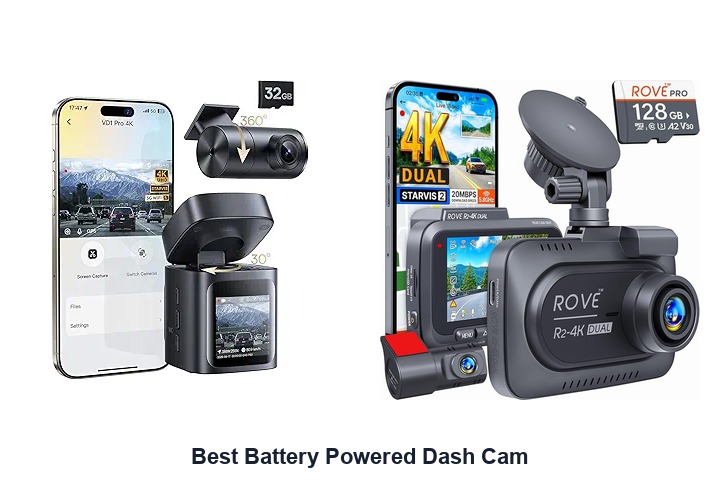
Top Picks- 1  | Baseus VD1 Pro Solar Dash Cam Front and Rear, 4K+1080P Best for: Solar drivers | Check Price On Amazon |
Top Picks- 2  | ROVE R2-4K Dual Dash Cam Front and Rear, SRTARVIS 2 Best for: Dual-camera coverage | Check Price On Amazon |
Top Picks- 3  | 4CH Dash Cam, mmWave Radar Parking Guard,360° Full Coverage | Best for: Parking protection | Check Price On Amazon |
Top Picks- 4  | 4K Dash Cam Front, 5GHz WiFi, 32GB Card Included, Mini Best for: Compact commuters | Check Price On Amazon |
Top Picks- 5  | REDTIGER F7NP 4K Dash Cam Front Rear, STARVIS 2 Sensor, Best for: High-resolution drivers | Check Price On Amazon |
1. Baseus VD1 Pro Solar Dash Cam Front and Rear, 4K+1080P
Best for: Hardwire-free parking protection shoppers.
Solar Sync power and a built-in lithium battery give this Baseus camera up to 14 days of parking-mode protection without a hardwire kit. It drops into low-power standby after shutdown and saves a 30-second clip when its collision sensor detects an impact, making it suited to parked-vehicle event recording rather than continuous surveillance.
The front camera records true 4K at 2160p while the rear records 1080P, covering both directions for incident evidence. A 140-degree field of view widens the forward scene, and 5GHz Wi-Fi 6 sends footage to the Baseus app. GPS, voice control, HDR night vision, loop recording, and the included 32GB card add practical daily-use features.
Pros
- Built-in lithium battery enables up to 14 days of parking protection
- Solar Sync system reduces dependence on a hardwire kit while parked
- 2160p front and 1080P rear recording capture both traffic directions
- 5GHz Wi-Fi 6 and Baseus app simplify footage access
Cons
- Parking mode records only collision-triggered 30-second clips, not continuous parked footage
Choose it if your priority is parking-event coverage without routing a hardwire kit. It suits drivers who leave a car outdoors and want solar-assisted, battery-supported impact recording.
2. ROVE R2-4K Dual Dash Cam Front and Rear, SRTARVIS 2
Best for: High-resolution dual-camera commuters.
A 3840x2160P front camera and 1920x1080P rear camera record simultaneously, giving this ROVE dual dash cam evidence from both ends of the vehicle. The combination suits commuters and road-trippers who need license-plate and traffic detail ahead while retaining a separate view of following vehicles.
The front lens covers 150 degrees and the rear lens covers 140 degrees, expanding the recorded roadway beyond a narrow center view. A Sony STARVIS 2 sensor, HDR, and 2026 Super Night Vision support low-light capture, while the included 128GB card stores more clips. Built-in GPS adds geotagging and live-speed information, and 5G Wi-Fi transfers at up to 20MB/s.
Pros
- 3840x2160P front recording preserves fine road detail
- 1920x1080P rear recording documents traffic behind the vehicle
- Included 128GB memory card provides substantial onboard storage
- Sony STARVIS 2, HDR, and Super Night Vision support darker scenes
Cons
- The supplied supercapacitor is not a built-in battery, so normal recording requires vehicle power
It is a strong match for drivers wanting detailed front-and-rear evidence rather than battery-only operation. Commuters, family drivers, and road-trippers get GPS, wide coverage, and fast phone transfers in one system.
3. 4CH Dash Cam, mmWave Radar Parking Guard,360° Full Coverage |
Best for: Maximum-coverage parking monitors.
Four camera channels and a 360-degree coverage specification give this R4RD system a broader surveillance layout than a conventional front-facing dash cam. Its mmWave radar parking guard monitors a parked vehicle, while front, rear, and cabin views help document impacts or activity around cars, trucks, RVs, and other compatible vehicles.
The system records at 1080p and includes a 128GB memory card, giving the multi-camera setup storage without an immediate card purchase. Eight infrared LEDs, WDR, and an f/1.6 aperture support tunnels, garages, and nighttime scenes. A 3.18-inch LCD, built-in GPS, app control, USB, OBD, and Wi-Fi provide several ways to operate and review footage.
Pros
- Four-channel recording expands coverage beyond front and rear views
- mmWave radar supports 24-hour parking monitoring
- Eight infrared LEDs and WDR improve low-light scene handling
- Included 128GB card supplies substantial recording storage
Cons
- 1080p capture provides less front-detail resolution than the 4K systems in this roundup
Pick it when parking surveillance and surrounding-vehicle coverage matter more than maximum front resolution. It fits owners of larger vehicles, frequently parked cars, and drivers who want cabin visibility alongside road views.
4. 4K Dash Cam Front, 5GHz WiFi, 32GB Card Included, Mini
Best for: Discreet plug-and-play front-camera users.
A mini adhesive-mounted body and included 32GB microSD card let this 4K camera occupy little windshield space while recording out of the box. Its front-only layout favors drivers who want a hidden-looking recorder for everyday incident evidence without adding a rear camera or managing a larger display.
The 2160p video resolution and 160-degree field of view capture detailed forward footage across multiple lanes. Built-in 5G Wi-Fi connects to the app for file access, while the f/1.6 aperture and Super Night Vision address darker driving conditions. Loop recording, accident lock, voice recording, and a G-sensor support routine use, with storage expandable to 256GB.
Pros
- 2160p recording preserves detailed forward road footage
- 160-degree viewing angle covers a broad front scene
- Included 32GB card allows immediate recording after installation
- 5G Wi-Fi and app control simplify clip retrieval
Cons
- Front-only recording leaves rear traffic and cabin events undocumented
This is appropriate for buyers who want a compact front camera rather than full vehicle coverage. It suits a daily commuter seeking discreet installation, phone access, and 4K evidence with minimal hardware.
5. REDTIGER F7NP 4K Dash Cam Front Rear, STARVIS 2 Sensor,
Best for: Night-driving and road-trip evidence seekers.
STARVIS 2 sensing pairs with 4K front and 1080P rear recording in the REDTIGER F7NP, giving drivers high-detail forward footage plus a dedicated rear view. The dual-camera arrangement supports commuting, road trips, rideshare work, and new drivers who need a documented view of changing traffic conditions.
A 170-degree front lens and 140-degree rear lens cover broad areas around the vehicle, while the F1.5 aperture and WDR help balance difficult lighting. The included 128GB memory card supports longer clip storage, and built-in GPS records location information. Wi-Fi app control, a built-in display, automatic incident detection, loop recording, and a supercapacitor add operating flexibility.
Pros
- STARVIS 2 sensing improves detail in low-light recordings
- 4K front and 1080P rear channels document both directions
- Included 128GB card supports extended clip storage
- F1.5 aperture and WDR help manage night and high-contrast scenes
Cons
- The rear channel is limited to 1080P, so it captures less detail than the 4K front camera
Choose it for balanced front-and-rear evidence with particular attention to nighttime visibility. It fits commuters, rideshare drivers, and road-trippers who also want GPS and automatic incident capture.
6. REDTIGER 4K STARVIS 2 Dashcam Front Rear, 5GHz WiFi 20MB/s,

Best for: Touch-control dash cam shoppers.
A touchscreen interface distinguishes the REDTIGER F7N TOUCH from app-only cameras, while its 4K front and 1080P rear channels record both traffic directions. Touch access helps drivers review or adjust settings from the camera itself, and STARVIS 2 sensing supports clearer evidence across daytime and low-light drives.
The front view spans 170 degrees and the rear view spans 140 degrees, giving broad coverage around the car. WDR and HDR work with enhanced night vision for uneven lighting, while the included 128GB card supplies substantial storage. Built-in GPS, voice commands, Wi-Fi, app control, loop recording, parking monitoring, and a supercapacitor cover everyday operation and incident recording.
Pros
- Touch screen provides direct camera-side control
- 4K front and 1080P rear recording cover both travel directions
- 170-degree front and 140-degree rear angles widen scene coverage
- Included 128GB card supports extended recording before file management
Cons
- The rear camera records at 1080P rather than matching the front channel’s 4K resolution
It suits buyers who prefer physical touchscreen control alongside phone connectivity. Daily commuters and family drivers get broad dual-camera coverage, GPS, voice commands, and parking monitoring without relying exclusively on an app.
7. 4K Dash Cam Front and Rear, Full HD 3 Channel

Best for: Rideshare and cabin-coverage drivers.
Three simultaneous channels record 4K ahead, 1080P behind, and 1080P inside the cabin, giving this dash cam coverage for road incidents and passenger activity. Its 3.16-inch IPS screen keeps the multi-camera layout viewable in the vehicle, making it useful for rideshare work, family trips, and commercial driving.
The front camera uses a 170-degree angle, while the rear and cabin cameras each use 165-degree angles to capture broad surrounding scenes. An f/1.6 aperture supports darker conditions, and the system accepts microSD cards up to 512GB for substantial storage. App and push-button controls, USB and Wi-Fi connectivity, and MP4 recording add practical review options.
Pros
- 4K front recording captures detailed roadway evidence
- 1080P rear and cabin channels document traffic and interior activity
- 165-degree rear and cabin angles broaden secondary-camera coverage
- 512GB maximum card support accommodates extensive multi-channel footage
Cons
- Three-channel recording creates more footage to store than a front-only camera
Select it when cabin documentation is as important as roadway recording. Rideshare drivers, family travelers, and commercial users benefit from the simultaneous front, rear, and interior views.
8. 1296P Dash Cam Front, WiFi Dash Camera for Cars with

Best for: Compact single-camera daily commuters.
The V300 records at 2304x1296P through a 170-degree front lens, providing more image detail than standard 1080P while keeping the camera focused on the road ahead. Its mini, discreet form suits drivers who want a low-profile daily recorder with phone-based access rather than a dual-camera installation.
A six-layer glass lens and F1.7 aperture support visibility during nighttime and other low-light drives, while the CMOS sensor records at 30 FPS. Built-in Wi-Fi connects to the VeeCar app for live preview, playback, and downloads. The camera accepts microSD cards up to 256GB and adds loop recording, G-sensor protection, and parking monitoring.
Pros
- 2304x1296P resolution records more detail than standard 1080P
- 170-degree lens covers multiple lanes ahead
- Six-layer glass lens and F1.7 aperture support low-light visibility
- 256GB card capacity allows substantial local storage
Cons
- The front-only configuration does not record rear traffic or cabin activity
It is a practical choice for a solo commuter who wants compact front coverage and wireless clip access. Choose it when discreet installation matters more than 4K resolution or rear-camera evidence.
9. 70mai A810 Lite 4K Dash Cam Front and Rear, 5GHz

Best for: Voice-controlled dual-camera commuters.
A 4K front channel, 1080P rear channel, and 24-hour parking mode give the 70mai A810 Lite coverage for driving and parked-vehicle incidents. Voice control and 5GHz Wi-Fi 6 let drivers manage or transfer footage with less handling, while the dual-camera format documents both the road ahead and following traffic.
The front camera records 3840x2160P, and the rear camera records 1080P, preserving different levels of detail across both views. Its F1.55 aperture, HDR night vision, and 140-degree field of view address darker scenes and broad roadway capture. Three-mode GPS, G-sensor protection, loop recording, 4G LTE support, and supercapacitor power expand its monitoring and connectivity functions.
Pros
- 3840x2160P front recording captures detailed road evidence
- 1080P rear recording documents vehicles approaching from behind
- F1.55 aperture and HDR support low-light and high-contrast scenes
- 5GHz Wi-Fi 6 enables fast app-based footage transfers
Cons
- The 24-hour parking mode requires the vehicle’s parking-power setup because the listed power system is a supercapacitor, not a built-in battery
Choose it for high-resolution dual coverage with voice and fast wireless controls. It fits commuters, rideshare drivers, and family vehicles that need parking monitoring but can provide vehicle power.
10. 70mai 4K Dash Cam Front and Rear Inside, 3 Channel

Best for: Rideshare drivers needing interior coverage.
Three channels combine 4K front, 1080P interior, and 1080P rear recording, giving the 70mai T800E a complete evidence layout for road, cabin, and following traffic. Switchable interior infrared support and the F1.55 aperture help preserve cabin visibility, making it especially suitable for Uber, Lyft, and family vehicles.
The system provides a 402-degree combined field-of-view specification across its cameras, while HDR and 3D noise reduction improve difficult scenes. A 64GB card is included, with support for cards up to 512GB for expanded storage. Five-mode GPS, Wi-Fi 6 transfer, voice control, super night vision, and 24/7 parking monitoring with G-sensor protection add coverage beyond basic driving footage.
Pros
- 4K front recording captures detailed roadway evidence
- 1080P interior recording documents passenger-area activity
- Switchable infrared support improves interior visibility in darkness
- 512GB maximum card support accommodates extensive three-channel footage
Cons
- The included 64GB card provides less starting storage than the 128GB cards bundled with several dual-camera alternatives
This is the clearest fit for rideshare operators and families who need interior evidence as well as road coverage. It also suits buyers who want voice control, GPS modes, and parking monitoring in a three-camera system.
How to Choose the Right best battery powered dash cam
Battery capacity and recording runtime
Start with usable recording time rather than the battery label alone. For driving coverage, choose a camera delivering at least 60–90 minutes of continuous recording at its advertised resolution, then check how that figure changes at 60 frames per second. Parking mode should provide several days of motion-triggered standby, with buffered capture using less power than constant recording.
A 1,000mAh-or-larger battery gives stronger endurance, but only when paired with efficient low-power hardware. Confirm a USB power input or hardwire option for extended coverage.
Choose a larger-battery camera for frequent unplugged driving, or an externally powered model for round-the-clock protection.
Video quality and night performance
Choose 1440p at 30fps as the practical quality target for clear plates, while 4K at 30fps suits drivers who need more detail across several lanes. Select 1080p at 60fps for fast-moving traffic when smooth motion matters more than distant crop detail. Look for HDR or strong WDR, a wide-aperture lens, and effective glare control; these features separate readable plates from blown-out headlights and dark shadows.
Test sample footage at 10, 20, and 30 metres and during night driving. Pick 4K HDR for maximum evidence detail, or 1440p HDR for a balanced everyday choice with infrared parking footage.
Parking surveillance and motion detection
Prioritize a camera that combines a sensitive impact sensor with a low-power motion detector, rather than relying on one trigger alone. Three-axis G-sensor adjustment prevents false incident files from minor bumps, while buffered parking recording saves several seconds before and after movement. A 140–160-degree lens covers useful roadside area without excessive edge distortion, and an adjustable mount keeps the horizon level.
Detection-zone controls help ignore passing traffic, trees, or neighbouring driveways. Choose high-sensitivity impact recording for vandalism-prone parking, or a PIR-assisted buffered system for longer, quieter surveillance in a private driveway.
Heat resistance and battery safety
Check the stated operating range before leaving a battery-powered dash cam in a parked car. A suitable model covers at least -20°C to 70°C and includes charge control, overheat shutdown, short-circuit protection, and a battery from an established manufacturer. The casing should resist heat deformation, and the mount should keep the camera away from direct windshield hotspots where possible.
Continuous charging in direct sunlight places unnecessary stress on a rechargeable cell, so external power needs temperature-aware charging and reliable cutoff protection. Pick a thermally protected lithium-battery camera for moderate climates, or a model with conservative charging limits for hot regions.
Storage, connectivity, and everyday usability
Use a high-endurance microSD card rated U3 or V30, with 128GB as a strong baseline and 256GB for frequent driving or higher-resolution footage. Confirm the camera supports the card’s full capacity and offers automatic loop recording, one-button formatting, and protected incident folders that do not fill the drive permanently. WiFi and a stable app simplify clip review, while physical controls remain valuable when phone access is inconvenient.
Installation should require a short cable path, clear status indicators, and a secure mount; a written warranty adds practical reassurance. Choose 256GB with WiFi for heavy users, or 128GB with simple controls for occasional drivers.
Which Should You Choose?
- If your car spends several days parked outdoors and you want protection without installing a hardwire kit, choose a solar-assisted dash cam with a built-in battery and extended parking mode.
- If you want clear evidence from both ends of the vehicle during everyday driving, choose a dual-camera system with 4K front and 1080P rear recording.
- If you need coverage around a parked car, including dark garages, tunnels, and side-impact zones, choose a four-channel dash cam with mmWave radar, infrared night vision, and full-surround recording.
- If you drive passengers or want to document activity inside the cabin as well as outside, choose a three-channel camera with 4K front, 1080P rear, and 1080P interior recording.
Quick Best Battery Powered Dash Cam Buying Checklist
- Battery runtime: Confirm active and parking-mode recording times match your driving and parking habits.
- Video clarity: Choose a resolution and low-light system that can capture readable plates in varied conditions.
- Parking protection: Look for impact sensing, motion detection, buffered recording, and low-power standby.
- Heat safety: Verify operating limits, thermal protection, and battery safety for hot vehicle interiors.
- Storage support: Check microSD compatibility, maximum capacity, loop recording, and protected-event handling.
- Installation and access: Confirm secure mounting, adjustable positioning, app connectivity, and warranty coverage.
Frequently Asked Questions
What Makes The Best Battery Powered Dash Cam?
The best battery powered dash cam combines dependable battery life with clear video, efficient standby recording, and reliable motion detection. Battery capacity alone is not enough; check whether it records while parked, supports an external power source, and handles heat without shutting down.
How Long Can A Battery Powered Dash Cam Record?
Battery powered dash cams usually record for a limited time without vehicle power because compact batteries prioritize safety and size. A model may provide only several hours of active recording, while motion-triggered parking mode lasts longer; verify stated runtime under your chosen resolution and temperature conditions.
Is A Battery Powered Dash Cam Suitable For Parking Protection?
The best battery powered dash cam for parking protection should offer motion or impact detection, low-power standby, and loop recording. A wide lens can cover more of the scene, but placement still matters, so choose a camera with adjustable mounting and test detection at the edges of the frame.
What Storage Does A Battery Powered Dash Cam Need?
Battery powered dash cams need dependable storage, typically a high-endurance microSD card matched to the camera’s supported capacity. Higher resolutions consume space faster, so loop recording, automatic file protection, and simple card formatting help preserve incident clips without requiring frequent manual file management.
Can Heat Damage A Battery Powered Dash Cam?
Heat resistance matters in a battery powered dash cam because a parked cabin can become extremely hot. Choose a model with documented operating limits, thermal protection, and a reputable battery design; avoid leaving the camera charging in direct sun unless the manufacturer specifically permits that use.
Final Suggestions
Choosing the best battery powered dash cam means balancing recording clarity, battery runtime, parking surveillance, storage support, and heat protection. This category delivers flexible installation and useful evidence capture even when a permanent power connection is inconvenient, making it valuable for commuters, parked vehicles, and temporary setups. Compare real-world runtime, detection features, and warranty coverage carefully, then select the camera that fits your driving routine with confidence.