BEST Battery Powered Air Conditioner for Car: Top 10
As an Amazon Associate we earn from qualifying purchases.
The best battery powered air conditioner for car use is no longer judged only by cold airflow. Modern portable car air conditioners combine compact housings, rechargeable power systems, and smarter thermal management to address heat buildup when engines are off. That matters during camping stops, roadside breaks, overnight travel, and electric-vehicle downtime, where conventional cabin climate control may be unavailable or inefficient.
Yet battery capacity, compressor or thermoelectric cooling performance, noise levels, airflow, and ventilation needs can vary widely between models. Materials, controls, and charging flexibility also influence whether a unit feels practical beyond the first few minutes.
Understanding these technologies makes it easier to separate meaningful innovation from promising specifications. Our roundup examines the best battery powered air conditioner for car use and the details that deserve closer attention before the next journey.
best battery powered air conditioner for car: Top Picks
| Image | Product | Buy |
|---|---|---|
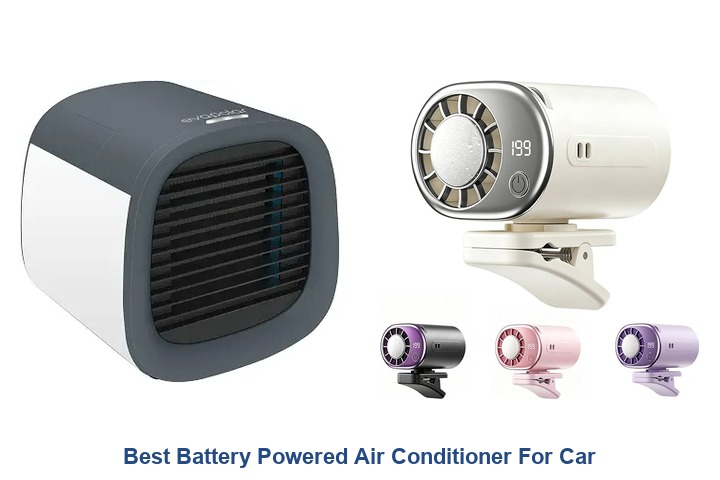
Top Picks- 1  | Evapolar evaCHILL Portable Air Conditioners – Portable AC Unit – Best for: Compact personal cooling | Check Price On Amazon |
Top Picks- 2  | Clip On Fan with Led Display, Portable Ac for Car, Best for: Car commuters | Check Price On Amazon |
Top Picks- 3  | Car Clip on Air Conditioner, Portable Car Ac with Digital Best for: Digital-display drivers | Check Price On Amazon |
Top Picks- 4  | 12V DC air conditioner, battery powered A/C system is applicable Best for: 12V vehicle users | Check Price On Amazon |
Top Picks- 5  | Portable Air Conditioners,Air Conditioner,Ac Unit with 1600ML Water Tank,2 Spray Best for: Longer cooling sessions | Check Price On Amazon |
1. Evapolar evaCHILL Portable Air Conditioners – Portable AC Unit –
Best for: Quiet personal cooling for parked cars.
An 800 ml reservoir gives the Evapolar evaCHILL enough water for personal evaporative cooling while its 7.5-watt, 5-volt operation suits USB power in a car. The built-in handle makes repositioning easy, while four fan speeds let the driver or passenger adjust airflow without carrying a room-sized appliance.
At 25 dB, evaCHILL is the quietest clearly rated option in this lineup, making it more suitable for conversation, rest, or focused work inside a parked vehicle. Its one-button control keeps operation simple, and the cartridge catches large dust particles as it humidifies and cools the air. Evapolar specifies personal cooling rather than whole-room cooling, so its benefit is concentrated airflow at one seat.
Pros
- 800 ml reservoir supports extended personal evaporative cooling between refills
- 7.5-watt draw suits low-power USB operation
- Four fan speeds provide adjustable airflow
- 25 dB noise rating limits cabin disruption
Cons
- Evaporative cooling is intended for personal airflow rather than lowering the temperature of the entire car
Choose evaCHILL for a passenger who needs quiet, close-range cooling from a USB-powered setup in a parked car. Its handle, dust-catching cartridge, and 800 ml reservoir are especially useful when portability matters more than whole-cabin cooling.
2. Clip On Fan with Led Display, Portable Ac for Car,
Best for: Customizable clip-on cooling for car seats.
Sixteen cooling chips and 199 adjustable speed settings give this clip-on car fan unusually fine control over airflow. Its 360-degree rotary design lets you aim the cooling toward a driver, passenger, or child seat, while the battery-powered format avoids depending on a fixed dashboard installation.
The semiconductor cooling system is rated to produce a temperature drop of up to 16°C, adding more than ordinary fan circulation when the unit is positioned close to the occupant. A smart LED display shows operating information, and the clip-on mounting keeps the device attached to a suitable surface. The package includes a USB charging cable, retractable lanyard, box, and instruction manual.
Pros
- Sixteen cooling chips provide semiconductor-based cooling
- 199 speed settings allow exceptionally precise airflow adjustment
- 360-degree rotation directs air toward different seating positions
- Battery-powered operation avoids a permanent car installation
Cons
- Its clip-on mounting requires a suitable attachment point inside the car
This model fits drivers and passengers who want highly adjustable, directional cooling from a clip-mounted unit. The 16°C stated temperature drop and 199 settings make it more compelling for close-range use than a basic fan.
3. Car Clip on Air Conditioner, Portable Car Ac with Digital
Best for: Long-runtime high-airflow car cooling.
An 8-hour rechargeable runtime makes this clip-on car air conditioner suitable for a full commute, travel day, or extended parked-car use without an immediate recharge. Its motor reaches 18,000 RPM, producing strong airflow quickly while the portable black housing remains easy to move between vehicle and office.
The high-efficiency battery supplies up to 8 hours of continuous operation on a full charge, giving buyers a clear runtime target for daylong use. The 18,000 RPM motor is the key airflow specification, and the product also lists quiet operation as an additional feature. A clip-on format keeps the cooling source near the user instead of relying on broad cabin circulation.
Pros
- Up to 8 hours of stated runtime supports extended trips
- 18,000 RPM motor produces rapid high-speed airflow
- Rechargeable battery supports cordless use in the car
- Clip-on format keeps cooling close to the occupant
Cons
- The available data does not specify charging time or battery capacity, making recharge planning less precise
Pick this unit when runtime and strong close-range airflow are the main priorities for commuting or travel. Its 8-hour battery claim and 18,000 RPM motor suit buyers who want cordless cooling without sacrificing airflow speed.
4. 12V DC air conditioner, battery powered A/C system is applicable
Best for: Permanent 12V cooling for parked vehicles.
A 12V DC scroll-compressor system with 8,875 BTU of cooling power offers a fundamentally different approach from USB personal coolers. Connected to a battery or generator, it can operate while the vehicle engine is off, making it relevant for parked vehicles that need cabin-level air conditioning rather than airflow at one seat.
The aluminum-alloy compressor uses R-134A refrigerant and has a listed displacement of 21 cm³ per revolution, giving this system automotive-style hardware rather than evaporative cooling. Its 30 dB noise rating supports comparatively quiet operation, but startup current reaches 75A, so the battery or generator must accommodate that demand. The product requires a new outdoor unit and professional installation.
Pros
- 8,875 BTU cooling capacity targets broader cabin cooling
- 12V DC input suits compatible vehicle battery systems
- Aluminum-alloy core supports the compressor assembly
- 30 dB noise rating keeps operation relatively quiet
Cons
- Professional installation, a new outdoor unit, and 75A startup current make setup substantially more involved than a portable cooler
This is for van, camper, and work-vehicle owners seeking engine-off cabin cooling from a dedicated 12V system. Choose it only if professional installation and a battery or generator capable of the 75A startup demand fit your setup.
5. Portable Air Conditioners,Air Conditioner,Ac Unit with 1600ML Water Tank,2 Spray
Best for: Water-assisted cooling for larger personal spaces.
A 1,600 ml water tank gives this portable cooler more refill capacity than the 800 ml personal unit in the lineup. Adding water or ice activates its cooling mode, while two mist sprayers provide additional moisture for users who want a stronger water-assisted breeze in a parked car, campsite, or nearby outdoor area.
Three fan speeds let users adjust airflow, and the natural-breeze mode can run without water when mist is unnecessary. The two spray outlets operate continuously for a double-mist effect, while the listed 1 kW cooling power indicates a more substantial appliance than low-wattage USB personal coolers. Its 55 dB noise rating is worth considering when using it inside a quiet vehicle.
Pros
- 1,600 ml tank reduces refill frequency during water-assisted use
- Two mist sprayers add moisture from separate outlets
- Three fan speeds provide adjustable airflow
- Natural-breeze mode works without adding water
Cons
- The 55 dB noise rating may be noticeable in a quiet car cabin
Choose this model for buyers who want a larger water reservoir and dual misting near a parked car or campsite. It is a better fit for users who value water-assisted airflow and flexible fan operation over the quietest cabin experience.
6. Portable Air Conditioner -5200mAh Rechargeable Personal Air Cooler, Green Mini

Best for: Cordless cooling for overnight car camping.
A 5,200mAh rechargeable battery gives this green mini air cooler a cordless power source for personal cooling away from an outlet. Its airflow system is rated to reduce ambient temperatures by 41–45°F, while the lightweight format and three wind speeds support close-range use during sleep, rest stops, or overnight car camping.
The high-performance motor works with an innovative duct design to direct cool air toward the user rather than attempting to condition an entire vehicle. Three wind speeds allow lower airflow for rest or stronger airflow for immediate comfort, and the low-noise system is specifically described for sleep use. The product is listed as a residential personal cooler with no inverter.
Pros
- 5,200mAh battery enables rechargeable cordless operation
- 41–45°F stated reduction targets fast personal cooling
- Three wind speeds allow sleep-friendly adjustment
- Lightweight construction is easier to move between car and room
Cons
- The product is a personal residential cooler, so its stated cooling is not a whole-car air-conditioning specification
This model suits car campers and sleepers who need battery-powered cooling beside one person rather than across the cabin. Its 5,200mAh battery, lightweight body, and sleep-oriented low-noise operation make it practical for overnight personal use.
7. Portable Air Conditioner -5200mAh Rechargeable Mini Air Conditioner with 3

Best for: Quiet rechargeable cooling with humidity control.
The 5,200mAh rechargeable battery gives this white mini air conditioner cordless operation for car travel, camping, or bedside use. Three wind speeds let users select gentler or stronger airflow, while the built-in dehumidifier function separates it from models that only add moisture through evaporative cooling.
Its low-noise upgraded system is intended for comfortable sleep, allowing buyers to prioritize quieter operation when the cooler runs near a parked vehicle seat or sleeping area. The portable installation and residential application point to personal rather than full-cabin cooling, and the no-inverter specification identifies a simpler electrical design. The white housing also makes the unit easy to identify in a dark vehicle or tent.
Pros
- 5,200mAh battery supports rechargeable cordless cooling
- Three wind speeds provide personal airflow control
- Dehumidifier function can reduce reliance on added moisture
- Low-noise system suits overnight use
Cons
- No runtime figure is provided for the 5,200mAh battery, so operating time cannot be compared precisely with rated-hour models
Pick this unit for a car camper who wants rechargeable personal airflow with dehumidifying capability. It is particularly suitable when quiet nighttime operation matters more than a specified whole-cabin cooling capacity.
8. Portable Air Conditioners: Mini AC Fan Swamp Evaporative Cooler with

Best for: Directional mist cooling for parked-car comfort.
Dual mist outlets and triple evaporative cooling work with a high-speed 2000r/h motor to produce a concentrated stream of cooler air. The adjustable 60-degree vent lets users aim that airflow toward a driver or passenger, making this freestanding unit better suited to one-seat comfort than trying to chill an entire vehicle.
A premium bead-bearing motor supports the unit’s quiet-use construction, and the 34 dB noise rating gives buyers a concrete indication of cabin disruption. The dual outlets distribute mist from two points, while the 60-degree vent angle allows directional adjustment without moving the whole cooler. Its white, freestanding residential format is appropriate for a parked car, tent, desk, or bedside position.
Pros
- 2000r/h motor provides high-speed airflow
- Dual mist outlets increase water-assisted airflow coverage
- Triple evaporative cooling adds multiple cooling stages
- 60-degree adjustable vent aims air toward one occupant
Cons
- Evaporative operation depends on mist and is not a compressor-based whole-car cooling system
This cooler fits buyers who want quiet, directional mist near one seat in a parked car or during camping. Select it for the 34 dB rating and adjustable 60-degree vent when aimable personal airflow is more useful than broad cabin conditioning.
9. Portable Air Conditioners, 4-Speed Mini Air Conditioner, 3-in-1 Personal Cooling

Best for: Multi-mode USB cooling for one-seat use.
A 50-watt, 5-volt evaporative system combines a high-velocity fan, humidifier, and air cooler in one compact personal appliance. That three-in-one layout lets a parked-car user switch between regular airflow, mist, or ice-assisted cooling instead of relying on a single operating mode.
Four fan speeds provide a wider adjustment range than three-speed models, while two mist modes let users tailor humidity and cooling intensity. The evaporative method works with ice or cold water for boosted cooling, and built-in RGB lighting adds a visible cabin feature after dark. At 52 dB, its noise level is a relevant tradeoff for users who want stronger settings near a seat.
Pros
- 50-watt output supports a stronger USB personal-cooling setup
- Four fan speeds offer detailed airflow adjustment
- Two mist modes allow different humidity levels
- Three-in-one operation includes fan, humidifier, and evaporative cooler functions
Cons
- The 52 dB noise level may be intrusive during quiet nighttime vehicle use
Choose this model for USB users who want several cooling modes in one personal unit beside a parked-car seat. Its four speeds, two mist modes, and ice-compatible evaporative operation suit buyers who value adjustability over minimum noise.
10. Portable Air Conditioner, 2026 Upgraded 4-IN-1 Portable Ice Fan with

Best for: Remote-controlled cooling for parked-car camping.
A 1,500 ml tank provides up to 8 hours of continuous misting, giving this 5-watt personal cooler a clear endurance advantage for parked-car camping or overnight use. Its four-in-one design adds a fan, humidifier, and seven-color night light, while the remote lets users change settings without reaching across the cabin.
Three fan speeds cover basic airflow adjustment, and two cooling mist modes let users choose between different water-assisted settings. The 5-volt input suits compatible USB power, while the 45 dB noise rating gives a practical indication of how noticeable operation may be in a small cabin. The freestanding form keeps placement flexible on a stable vehicle surface, tent table, or bedside area.
Pros
- 1,500 ml reservoir supports up to 8 hours of misting
- 5-watt consumption suits low-power USB operation
- Remote control allows adjustment from the seat or sleeping area
- Four-in-one design adds fan, humidifier, and seven-color light functions
Cons
- The 45 dB noise rating is higher than the 34 dB and 30 dB options in this roundup
This unit suits car campers who want long misting, remote control, and nighttime lighting from one compact appliance. Its 1,500 ml tank and 8-hour misting claim are especially useful when refilling during an overnight stop is inconvenient.
How to Choose a Battery Powered Car Air Conditioner
Cooling method and realworld performance
Start by separating actual cooling from stronger airflow. Fan-assisted units move air across skin but do not lower cabin temperature. Evaporative units provide relief in dry climates and lose effectiveness in humid cars because saturated air absorbs less moisture.
Compressor-based units deliver genuine temperature reduction and suit parked vehicles or front cabins, but check stated coverage rather than assuming one outlet cools rear seats. Choose outlet direction, duct length, and cooling area for the space you need.
Pick a compact evaporative cooler for dry-climate front-seat relief, a fan-assisted unit for airflow only, or a compressor-based model for true cooling across a parked cabin.
Battery capacity and runtime
Match battery capacity to the run time you expect, using watt-hours alongside the unit’s wattage rather than trusting a single headline claim. A 100-watt appliance with a 500-Wh battery has a shorter practical run than a 50-watt appliance using the same battery, especially at maximum cooling. Confirm whether the unit includes an integrated battery or requires a separate power station, then compare low, medium, and maximum settings.
A clear percentage display, remaining-time readout, and low-voltage protection signal better control. Pick an integrated 400–1,000-Wh system for several parked hours, or an external-battery model when you already own a larger power station.
Vehicle fit and portable design
Measure the dashboard, center console, window opening, or rear-seat area before choosing a portable air conditioner, leaving room around intake and exhaust vents. A unit with a compact footprint, directional outlet, and at least 1.5–2 meters of cable fits more vehicles than a bulky box with a short lead. For driving, favor a wide rubberized base or a secure strap and mounting bracket that prevent movement during turns; loose units become hazards.
Check carrying weight and packed dimensions for storage in the trunk. Pick the smallest model that clears vents and controls, with a locking mount for moving vehicles and a stable base for parked use.
Moisture management and maintenance
Treat water handling as a daily-use decision. Evaporative systems need a removable tank, a sealed fill opening, and a drain plug that lets you empty residual water without tipping the appliance; spill-resistant construction matters on seats and consoles. Check that the filter slides out without tools and that replacement or washable filter access is clear.
Empty and dry the tank after every use to prevent odors, then brush dust from intake grilles because blockage reduces airflow and raises strain. Pick a removable-tank evaporative unit for regular cleaning, or a compressor-based model with condensate drainage when you want less water handling.
Safety, noise, and controls
Prioritize automatic shutoff, overheating protection, fused or locking electrical connections, and a battery system with secure terminals. For sleeping or quiet parked use, choose a unit rated below roughly 55 dB; driving permits more fan noise, but loud operation still masks conversations. Controls should provide separate temperature and fan-speed settings, a timer, and visible battery status without forcing phone use.
Position the appliance so it never blocks the windshield, mirrors, airbags, pedals, gear selector, or factory vents. Pick the quietest protected model under 55 dB for rest, or a simpler high-airflow unit with physical controls for driving, provided its mounting remains secure.
Which Should You Choose?
- If you need compact cooling for a parked car, desk, or tent, choose a small evaporative cooler with a carry handle, water reservoir, and washable dust-catching filter.
- If you want quick personal airflow while driving or commuting, choose a rechargeable clip-on fan with semiconductor cooling, USB charging, and a digital display.
- If you regularly spend long periods in the car away from a charger, choose a mini personal cooler with an 8-hour battery, multiple fan speeds, and a quiet operating mode.
- If you need to cool the cabin with the engine switched off, choose a 12V battery-powered air-conditioning system designed for direct vehicle or generator power.
Quick Best Battery Powered Air Conditioner For Car Buying Checklist
- Cooling type: Confirm whether the unit provides true refrigerant cooling or mainly circulates and evaporates air.
- Runtime: Compare stated wattage, battery capacity, and usable runtime at the selected cooling setting.
- Vehicle fit: Measure the installation area and leave enough room around every intake and exhaust vent.
- Moisture control: Choose a drainable or spill-resistant design and plan where condensation or tank water will go.
- Safety protection: Look for automatic shutoff, overheating protection, stable mounting, and low-voltage safeguards.
- Maintenance: Check that filters, grilles, tanks, and drains are easy to access and clean.
Frequently Asked Questions
What Is The Best Battery Powered Air Conditioner For Car Use?
The best battery powered air conditioner for car use depends on whether you need true refrigerant cooling or spot relief. Compact evaporative units and battery fans consume less power, while compressor-based units cool more effectively but require substantial battery capacity, ventilation, and safe condensation management.
How Long Can A Battery Powered Air Conditioner Run In A Car?
Battery runtime for a battery powered air conditioner for car depends on cooling load, battery capacity, and operating mode. A small 100-watt unit on a 500-watt-hour power station has roughly five hours of ideal runtime before losses, while maximum cooling shortens that estimate.
Are Battery Powered Air Conditioners Safe To Use In Cars?
A battery powered air conditioner for car should be used safely by keeping vents clear and preventing moisture from reaching wiring. Choose models with low-voltage protection, automatic shutoff, secure mounting, and a drain or spill-resistant design, and never operate fuel-burning equipment inside an enclosed vehicle.
What Size Battery Powered Air Conditioner Fits In A Car?
Portable size matters for a battery powered air conditioner for car because a compact body fits dashboards, center consoles, or rear seating without blocking visibility. Measure the intended space, check outlet and vent clearance, and favor a stable base or strap so sudden braking does not turn the unit into a hazard.
How Do You Maintain A Battery Powered Air Conditioner For Car?
Cleaning a battery powered air conditioner for car requires regular filter, intake, and water-tank care when the design uses evaporation. Empty and dry reservoirs after use, remove dust from grilles, and follow the manufacturer’s cleaning instructions to reduce odors, mineral buildup, and restricted airflow.
Final Suggestions
Choosing the best battery powered air conditioner for car travel means balancing cooling method, runtime, airflow, noise, portability, and safe moisture handling. The right unit can make parked breaks, camping stops, and hot commutes more comfortable without relying solely on the vehicle’s engine-driven climate system. Compare real power demands with your available battery, verify fit and ventilation, then choose confidently for cooler, more flexible journeys ahead.